試す 金 - 無料
Space conspiracies EXPOSED
BBC Sky at Night Magazine
|November 2025
Armed with hard science, Alastair Gunn takes apart 10 of the most popular and persistent space conspiracy theories
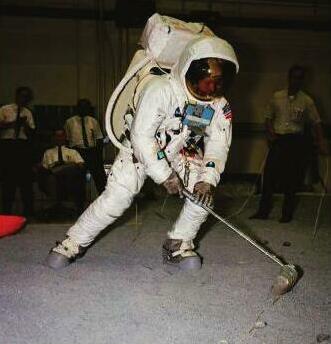
Humans love conspiracy theories. From the JFK assassination, the Illuminati and the 'deep state', to vaccine distrust and 'chemtrails', the modern world is awash with beliefs in collusion and hoaxes. How and why these baseless claims arise, and what maintains them, are complex questions. But one thing's for sure: contrarian narratives are not going away. Here are 10 widely held falsehoods concerning space and our place within it, which we examine rationally. It's safe to say they don't stand up to scrutiny...
 1. Planet Earth is flat
Let's start with perhaps the strangest conspiracy theory of all: that Earth is flat. The basic premise is that ancient cultures were right – Earth is a circular disc that is perfectly stationary while the sky rotates above it. Furthermore, the idea that Earth is a sphere is a villainous lie spread across millennia by an evil, secret establishment.
There are many reasons (or excuses) flat Earthers give for this belief: Earth looks flat; we don't feel Earth moving; NASA has faked images of the spherical Earth; gravity doesn't exist; ships don't sink below the horizon; the tides are caused by Earth moving up and down; explorers who have discovered the edge of the world have been silenced; the Moon generates its own light; artificial satellites don't exist... and so on. All of these can be easily disproved or logically discounted.
 Exposed!
 Disproving the flat-Earth hypothesis is surprisingly easy - so easy that the Greek philosopher Eratosthenes did it in 240 BC. You can actually perform a similar proof yourself. All you need are two synchronised clocks, two sextants (or other devices for measuring angles in the sky), a car and a friend.

このストーリーは、BBC Sky at Night Magazine の November 2025 版からのものです。
Magzter GOLD を購読すると、厳選された何千ものプレミアム記事や、10,000 以上の雑誌や新聞にアクセスできます。
すでに購読者ですか? サインイン
BBC Sky at Night Magazine からのその他のストーリー
BBC Sky at Night Magazine
The Giant Leap: Why Space is the Next Frontier in the Evolution of Life
“Earth is the cradle of humanity, but one cannot live in the cradle forever,” wrote Konstantin Tsiolkovsky in 1911.

1 mins
February 2026
BBC Sky at Night Magazine
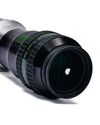
Tele Vue Nagler Type-7 series eyepieces
These premium optics were inspired by Apollo - and deliver a giant leap to your views
4 mins
February 2026
BBC Sky at Night Magazine
Once Upon a Time in Space
While the Space Race of the Cold War years was ultimately a geopolitical contest between the USA and the Soviet Union, the rivalry sparked rapid innovation and inspired multiple generations to look skyward.
1 mins
February 2026
BBC Sky at Night Magazine
The Multiverse: When One Universe Isn't Enough
The concept of a 'multiverse' – the idea that our Universe may be just one of many – is widespread in science fiction and a common thread of online discussions.
1 mins
February 2026
BBC Sky at Night Magazine
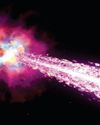
Q&A WITH A GAMMA RAY SPECIALIST
In 2025, astronomers detected a blast from space that lasted seven hours. Now they're uncovering the strange processes behind the exceptional outburst
3 mins
February 2026
BBC Sky at Night Magazine
Astronomy Photographer of the Year
The world-leading astrophotography competition returns. Could your image take the top prize of £10,000?
2 mins
February 2026
BBC Sky at Night Magazine
MOONWATCH
February's top lunar feature to observe
2 mins
February 2026
BBC Sky at Night Magazine
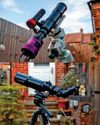
NOVAStar Scarlet A62Q 62mm f/8.4 quadruplet achromatic refractor
Well-built and capable, this beginner scope punches well above its bargain price
4 mins
February 2026
BBC Sky at Night Magazine
STAR OF THE MONTH
Rasalas, Leo the Lion's metal-rich crown
1 min
February 2026
BBC Sky at Night Magazine
Comet 24P/Schaumasse
Having reached perihelion on 8 January, comet 24P/ Schaumasse is now fading. Starting the month at a small-telescope-friendly mag. +10.5, it dims throughout February to below 12th magnitude.
1 min
February 2026
Listen
Translate
Change font size