試す 金 - 無料
Build your own EQ camera mount
BBC Sky at Night Magazine
|June 2023
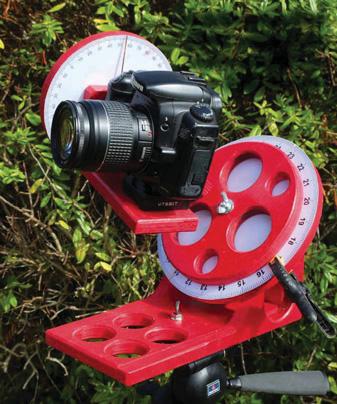
This month's project is a manual equatorial mount that is enjoyable to use and helps to develop your knowledge of the night sky.

Using RA and dec. (Right Ascension and declination) coordinates, it is possible to locate a faint target that might otherwise be difficult to see in your viewfinder. With an undriven mount, you are limited to relatively short exposures, but with a fast lens and high ISO setting, impressive night-sky images are certainly achievable.
The mount's RA axis must be aligned with Earth's axis of rotation, so you must adapt the downloadable plans to suit your latitude. At the North or South Poles, the RA axis would point vertically upwards, and at the equator it would be horizontal. For most of us, the angle between the RA disc and the ground is somewhere in between (90° minus your latitude).
Wrangle the angles
The dec. assembly pivots on the RA disc, but it is clampable with a wing nut when you're ready to take a photo. Similarly, the camera platform pivots on the dec. assembly, also with a clamp. The dec scale is glued so that it reads 90° when the camera is pointing directly at the Pole. As the night sky appears to rotate, the RA scale must be free to turn, so you can adjust it. A strong bulldog clip holds it still while you move the dec. assembly between targets.
To use the mount, it must firstly be polar aligned. Make sure the base is level, with the RA disc facing due north (in the Northern Hemisphere). To fine-tune the alignment, you can place a smartphone (with a planetarium app) on the RA disc and centre the displayed south celestial pole.


このストーリーは、BBC Sky at Night Magazine の June 2023 版からのものです。
Magzter GOLD を購読すると、厳選された何千ものプレミアム記事や、10,000 以上の雑誌や新聞にアクセスできます。
すでに購読者ですか? サインイン
BBC Sky at Night Magazine からのその他のストーリー

BBC Sky at Night Magazine
Crush: Close Encounters with Gravity
Gravity is something that we're all innately familiar with. It keeps our feet on the ground, fights against a rocket trying to leave Earth and governs the movement of the planets and stars.

1 mins
April 2026

BBC Sky at Night Magazine
Exploring the Universe
There's no shortage of children's books about astronomy.
2 mins
April 2026
BBC Sky at Night Magazine
Make your Milky Way images pop
Simple, free processing techniques using FastStone Image Viewer
3 mins
April 2026

BBC Sky at Night Magazine
Nightfaring: In Search of the Disappearing Darkness
This book is a manifesto for dark skies, written as a travel memoir.
1 mins
April 2026
BBC Sky at Night Magazine
Flying saucers- The making of a modern myth
Our obsession with UFOs goes back further than you might think. Robert Pateman traces how early science fiction, dubious sightings and an alien-mad media led to the 1950s saucer fever
9 mins
April 2026
BBC Sky at Night Magazine
STAR OF THE MONTH
Alphecca, the brightest jewel in the Crown
1 min
April 2026
BBC Sky at Night Magazine
How to use a planisphere
Navigate the sky with the original stargazer's tool. No batteries, apps or Wi-Fi required!
3 mins
April 2026
BBC Sky at Night Magazine
Why rockets don't launch straight up
For a rocket to get its payload into space, it has to follow a curved path. But what would happen if it didn't?
2 mins
April 2026
BBC Sky at Night Magazine
Q&A WITH A DARK MATTER SPECIALIST
Dark matter makes up 27 per cent of all matter in the Universe. So why is it so hard to find? Meet one of the people making a map that leads us to it
3 mins
April 2026

BBC Sky at Night Magazine
Why I want to put a hotel on the Moon
Bored of the beach? Sick of city breaks? Step this way. Space entrepreneur Skyler Chan explains how he'll build a holiday destination on the Moon by 2030
2 mins
April 2026
Translate
Change font size