試す 金 - 無料
HOW TO MAKE THE MOON ON EARTH
BBC Science Focus
|November 2023
The expense and prestige involved in sending landers and rovers to the Moon means you can’t afford for them not to work when they get there. But the lunar landscape is like nothing here on Earth. So how, and where, do you test equipment that’s bound for the Moon?

Nighttime in the Mojave Desert. The stars of the Milky Way turn slowly above a landscape so dark you can barely make it out. Suddenly, spotlights switch on. They're angled low to the horizon and off to one side, but spill light across a pale grey, undulating terrain that's pockmarked by craters. You know you're standing among the sands of California, but lit like this, it looks like you're on the Moon.
This 'Moon in the Mojave' is the work of spaceflight company Astrobotic, which has been building the Lunar Surface Proving Ground (LSPG). The 100m² (approx 1,000ft²) site has been made to look exactly like the lunar south pole. The region was ignored by early Moon explorers, but has witnessed a surge in interest over the last decade after signs of water ice were found in the permanently shadowed recesses of deep craters. Such water could be an invaluable resource both for science and future explorers.
Astrobotic aims to head to the region with its Peregrine and Griffin landers, due to launch this December and then November 2024 respectively. They're just two of a great many missions supporting NASA's Artemis programme to return humans, including the first woman and person of colour, to the lunar surface by the end of the decade. But before either Peregrine or Griffin can even think of leaving the ground, they have to be fully tested.
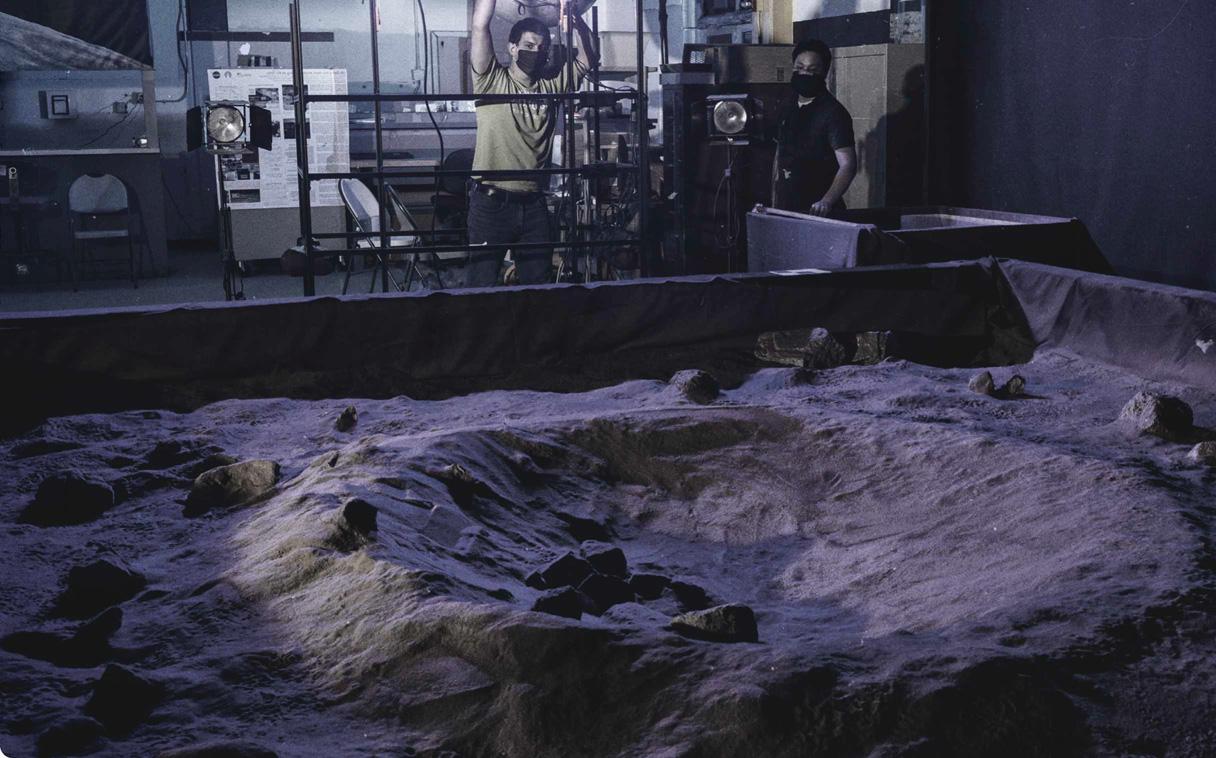
MIMICKING THE MOON


このストーリーは、BBC Science Focus の November 2023 版からのものです。
Magzter GOLD を購読すると、厳選された何千ものプレミアム記事や、10,000 以上の雑誌や新聞にアクセスできます。
すでに購読者ですか? サインイン
BBC Science Focus からのその他のストーリー

BBC Science Focus
HEALTH: Eating oats could lower your cholesterol in just two days
The health benefits of a two-day porridge diet lasted for weeks afterwards

1 mins
April 2026

BBC Science Focus
Most people are too sure they can identify fake human faces
Even 'super recognisers' struggle with the challenge. Can you do better?
1 min
April 2026

BBC Science Focus
WHAT'S THE WORST THING YOU CAN DO FOR THE PLANET ONLINE?
Human beings can barely move a muscle without some kind of deleterious effect on the environment around us.
2 mins
April 2026
BBC Science Focus
A bug in the system
The complex arrangement of equipment you see here is part of a particle accelerator.
1 min
April 2026
BBC Science Focus
Snug as a bug in a rug
At first glance, you might feel envious of this little leafhopper, swaddled beneath the folds of what appears to be a luxurious fur blanket.
1 min
April 2026

BBC Science Focus
WHY DO WE ROOT FOR THE VILLAIN IN MOVIES?
Whether it's Darth Vader or Cruella de Vil, we all have a favourite movie villain.
1 mins
April 2026

BBC Science Focus
A TURN TO DISPERSE
Why a fart walk after dinner does more than release your gas
3 mins
April 2026
BBC Science Focus
Hatching a nebula
Welcome to the Egg Nebula, an enigmatic structure formed by ejected stardust in the Cygnus constellation around 1,000 light-years from Earth.
1 min
April 2026

BBC Science Focus
7 TIMES AI GOT IT SPECTACULARLY WRONG
For the past four years, AI has been reshaping how we work and live. But its failures are proving just as transformative as its triumphs
8 mins
April 2026
BBC Science Focus
CHARLES ADCOCK, VIA EMAIL: COULD DARK MATTER BE ALL AROUND PLANET EARTH BUT UNDETECTABLE?
Astronomers have gathered overwhelming evidence that 80 per cent of all matter in the Universe is invisible.
1 min
April 2026
Translate
Change font size