試す 金 - 無料
States versus citizens
THE WEEK India
|October 12, 2025
From Dhaka to Colombo to Kathmandu, youth-led uprisings are not just outbursts of anger, but deliberate responses to unemployment, inequality and systemic exclusion
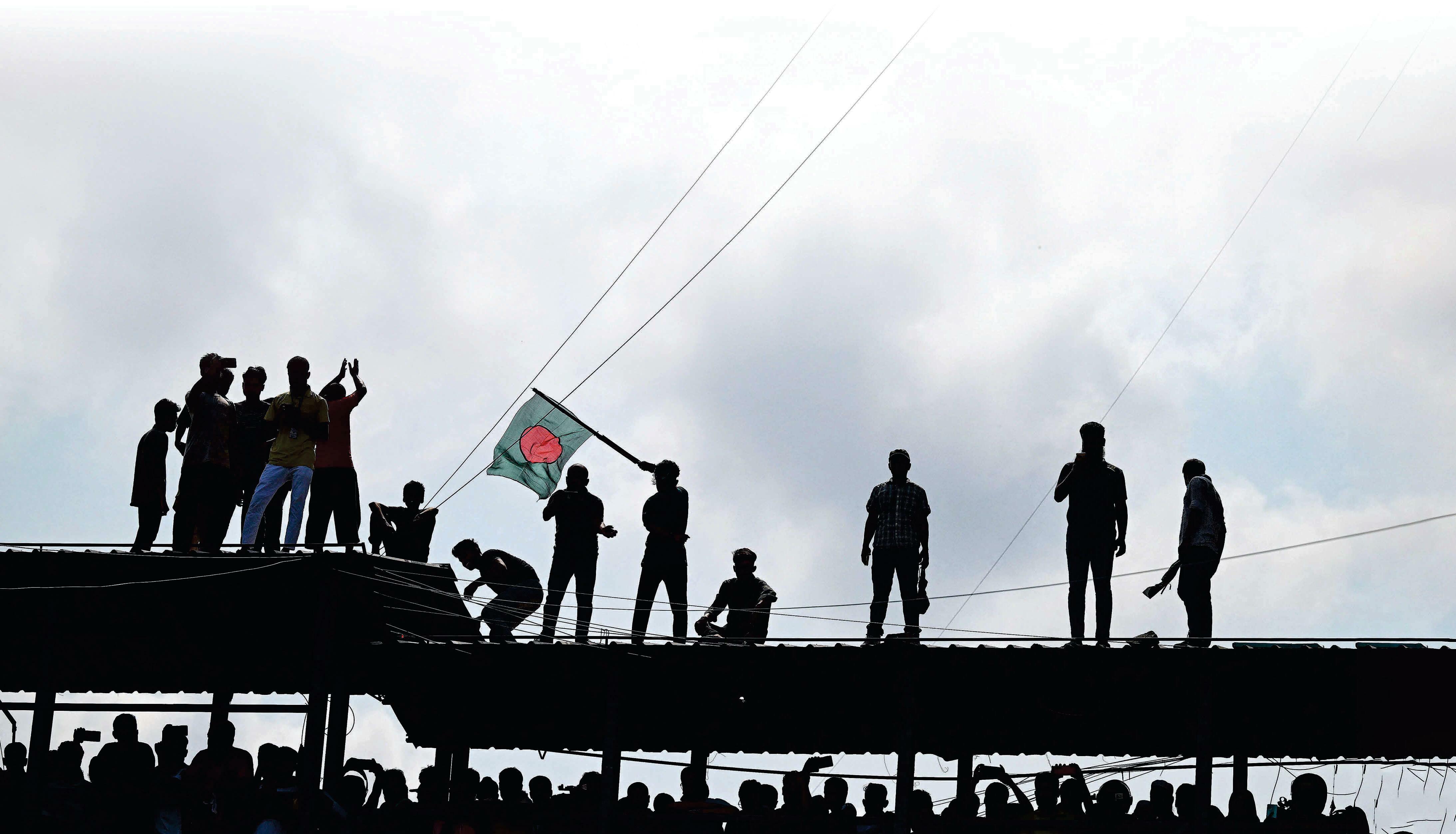
The wave of people's uprisings across South Asia, overthrowing the regimes in Sri Lanka, Bangladesh and Nepal, transcends simple explanations of economic crises or governance failures. These are not isolated events, but symptoms of deep-seated structural fault lines: chronic youth unemployment, systemic discrimination and a near-total lack of social protection have converged with oligarchic state capture, exposing a fundamental crisis of state-building in South Asia.
What defines these movements is their sense of purpose. Contrary to the persistent labelling of Gen Z as a “post-ideological” or “post-political” generation, they stand at the forefront, like their predecessors, articulating voices for change. Their mobilisation is reinforced by the massive participation of the working class, mired in a deepening cost-of-living crisis.
The cycle of popular uprisings demonstrates the resilience of people against unmet promises. In Nepal, there is a long history of Jana Andolan. The party-less panchayat system was opposed through major mass movement in the 1990s, and the country witnessed an armed rebellion led by the Maoists from 1996 until 2006. Despite becoming a republic, more than 13 governments have changed between 2008 and 2024, inflicting instability on the lives of ordinary people.
The Aragalaya represents a collective struggle for democratic renewal, accountability and a rejection of callous governance in Sri Lanka. The island nation is also haunted by memories of decades-long civil war. In Bangladesh, history is also marked by popular uprisings, notably, the uprising of 1969, leading to the eventual liberation war in 1971. In 1991, a dictatorship was toppled through mass uprising, and in 2024, an oligarchic regime, which bore no resemblance to an elected government, was overthrown.


このストーリーは、THE WEEK India の October 12, 2025 版からのものです。
Magzter GOLD を購読すると、厳選された何千ものプレミアム記事や、10,000 以上の雑誌や新聞にアクセスできます。
すでに購読者ですか? サインイン
THE WEEK India からのその他のストーリー
THE WEEK India
The buzz is real
The investment announcements by Google and other companies in Andhra Pradesh are already yielding tangible results, triggering a real estate surge across Visakhapatnam's IT zones and adjoining districts.

1 mins
January 18, 2026

THE WEEK India
Legacy reloaded
From sugar mills in Uttar Pradesh to Mumbai's high-street retail, a new generation of scions is reshaping India's old businesses
7 mins
January 18, 2026

THE WEEK India
TRIAL IN THE US IS THE ONLY WAY TO GET RID OF MADURO
Mercedes Baptista Guevara is an attorney and diplomat based in Spain.
3 mins
January 18, 2026
THE WEEK India
Wrong decisions, right places
Sometimes a film, a book, and a bottle of vodka blend in ways so unexpectedly perfect that you feel grateful simply for having been present.
4 mins
January 18, 2026

THE WEEK India
TRUST FACTOR
Lokesh's willingness to listen, his comfort with detail, and his bias for execution create confidence
3 mins
January 18, 2026

THE WEEK India
March to Caracas—Yankee oil doo
Lefties and liberals want Narendra Modi to condemn Don Trump's invasion of Venezuela. All invasions are bad; innocents get shot. But if we condemn one, shouldn't we condemn all?
2 mins
January 18, 2026
THE WEEK India
Revision before the exam
BJP and Trinamool use SIR to kick-off state election campaign, but those affected by the exercise remain anxious about their future
5 mins
January 18, 2026
THE WEEK India
Nuclear governance: caution to confidence
Nuclear power has long occupied a singular and somewhat uneasy place in Bharat's public imagination. It has been viewed, often with pride, as proof of scientific achievement and strategic resolve, yet governed with a restraint that reflected a deeper discomfort with the diffusion of risk.
2 mins
January 18, 2026

THE WEEK India
I WANT TO BE KNOWN AS CHIEF JOB CREATOR
Historically, the Telugu Desam Party has been a regional party but it has always had the nation’s interest at heart.
12 mins
January 18, 2026

THE WEEK India
The battle of words
As young adults we certainly used abbreviations and cryptic phrases. But MC and BC did not stand for the master of ceremonies and the era before Christ. They stood for something else which, if said in full, would certainly have made our mothers make us rinse our mouths with soap. Once you have tasted soap, you would not want to taste it ever again.
4 mins
January 18, 2026
Listen
Translate
Change font size