
Magzter GOLDで無制限に
10,000以上の雑誌、新聞、プレミアム記事に無制限にアクセスできます。
試す 金 - 無料
Rain and Ruin
Outlook
|October 01, 2025
In the last 50 years, Punjab has witnessed several devastating floods that have left deep scars on its landscape and people
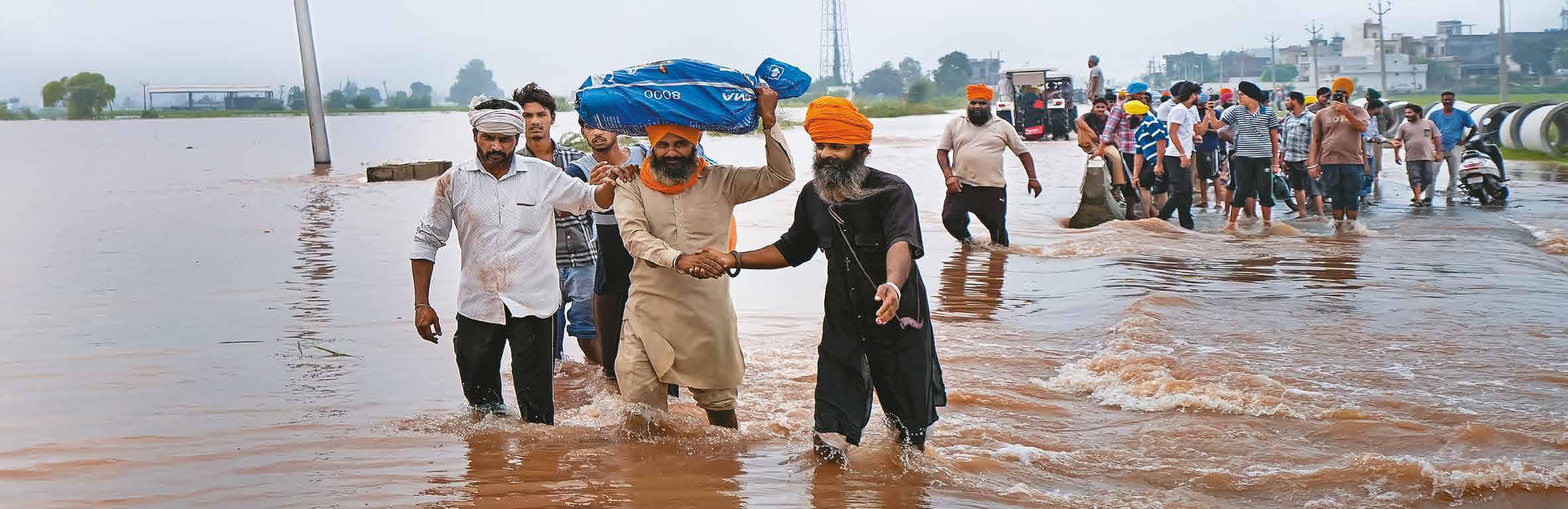
PUNJAB, the land of five rivers, has always carried both the blessings and the burdens of water. Its very name comes from the Sutlej, Beas, Ravi, Chenab and Jhelum rivers that crisscross its plains. These rivers made Punjab one of the most fertile regions of the subcontinent, the birthplace of civilisations and the breadbasket of India and Pakistan. But alongside prosperity, they have also brought recurring floods, leaving behind a trail of devastation that stretches from ancient times to the present day.
Floods in Punjab are not new. Historical records and traveller accounts—from Al-Biruni in the 11th century to Chinese pilgrims—describe how the monsoon often transformed the plains into vast sheets of water. The Indus and its tributaries, like the Nile in Egypt, brought silt and fertility but also destruction. Entire villages could be swallowed up overnight if a river changed its course.
Medieval chronicles mention swollen rivers halting invading armies or disrupting trade routes. Seasonal flooding was both feared and accepted, seen as part of the natural rhythm of life. Communities adapted by building embankments or shifting settlements, but no large-scale flood management systems existed.
During Mughal rule, agriculture flourished, thanks to Punjab’s rivers. The emperors encouraged irrigation and sometimes ordered the construction of bunds and canals to regulate water. Yet, floods remained a recurring menace, particularly along the Sutlej and Beas, which frequently changed course.
By the 18th century, as wars and deforestation reshaped the land, rivers became more volatile. Villages frequently suffered inundations. Under the Sikh misls and later Maharaja Ranjit Singh, rulers attempted small-scale embankment projects. But without centralised planning or resources, these efforts only offered partial relief.

このストーリーは、Outlook の October 01, 2025 版からのものです。
Magzter GOLD を購読すると、厳選された何千ものプレミアム記事や、10,000 以上の雑誌や新聞にアクセスできます。
すでに購読者ですか? サインイン
Outlook からのその他のストーリー
Outlook
Joy Words Club
Lit fests are defined by their audience. Organisers, speakers, curators are all replaceable but not the readers, not the audience

4 mins
February 01, 2026

Outlook
The Sting of the Bar
India today has more than 4.3 lakh undertrial prisoners. A significant number of them are linked to political cases
8 mins
February 01, 2026
Outlook
The Dispossessed
The systematic creation of criminal and security legislations view Adivasis as an inherently suspect class of criminals and terrorists
8 mins
February 01, 2026

Outlook
The Hypocrisy of Liberals
Favour of the self-proclaimed 'liberals' is lost the minute religion intervenes
5 mins
February 01, 2026
Outlook
Inside the Phansi Yard
Death row intensifies the structured brutalities of the penal system and reminds us why the struggle against the death penalty must also include the fact of prison violence
9 mins
February 01, 2026
Outlook
The Detention Legacy
Since Independence, a number of laws have been enacted that allow preventive detention which have been widely used by all regimes against their political opponents
7 mins
February 01, 2026
Outlook
“This Could Happen to You
The Bhima Koregaon case is not only about those who were imprisoned. It is also about the fate of democracy itself
8 mins
February 01, 2026

Outlook
"I Remember Swinging Between Hope and Despair"
HOPE and despair are basic human emotions and I believe that all human beings, now and then, swing between these two ends of the spectrum in life.
2 mins
February 01, 2026

Outlook
Think Ink
In 2026-the 'year of analog'-how will our relationship with literary festivals evolve?
6 mins
February 01, 2026

Outlook
Who Stole My Youth?
A Delhi district court granted Mohammad Iqbal bail in the riots case within three months. On March 18, 2025, he was discharged in the Babbu murder case, even as the riots trial continues
6 mins
February 01, 2026
Listen
Translate
Change font size