
Magzter GOLDで無制限に
10,000以上の雑誌、新聞、プレミアム記事に無制限にアクセスできます。
試す 金 - 無料
Luce Irigaray
Philosophy Now
|June/July 2024
Luce Irigaray, now ninety-two years old, was, among many other things, one of the most impactful feminists of the 1970s liberation movements - before she was marginalised, then ostracised, from the francophone intellectual sphere.

The reason for this was the publication of her thesis, Speculum of the Other Woman (1974), a radical critique of the use of the feminine in psychoanalysis, and a deconstruction of the very foundations of our culture. According to Irigaray, our culture is built around the idea of a 'neutral subject'; but this idea is fictitious: the reality is what she calls 'sexuate belonging' and 'sexuate difference'. This says there are two subjectivities, masculine and feminine, and also a culture of 'between two'; as opposed to the idea of a universal human subject who in practice is male.
The immediate scandal of the publication was commensurate with the book's success: Irigaray was cast away from Vincennes University and the École Freudienne de Paris. Later she was prevented from publishing anything. Already exiled from her birth country, Belgium, and from her coal-miner family, the young woman faced intellectual rejection in her new homeland. She and her ideas took refuge abroad; in Italy where she worked alongside the Communist party for years; and in the United States, where she became a fundamental reference for gender studies and feminist theory. Her deep ecological conviction was born out of 'a respect for nature', which is also at the heart of her differentialist approach to gender. Reluctant to look back on the controversies she's had to face, she tirelessly endeavours to 'create something positive for the present and the future' instead of dwelling on negatives.
Her latest work, The Mediation of Touch, explores the role of touch as living mediation in relating to oneself, to the other(s) and to the world. It develops the idea that touch entails communing with other living beings rather than seizing hold of them as quasi-objects; and suggests that touch can ensure a sensitive mediation between individuals in a culture of transcendental difference(s).
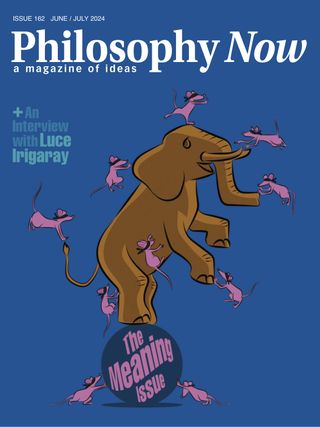

このストーリーは、Philosophy Now の June/July 2024 版からのものです。
Magzter GOLD を購読すると、厳選された何千ものプレミアム記事や、10,000 以上の雑誌や新聞にアクセスできます。
すでに購読者ですか? サインイン
Philosophy Now からのその他のストーリー
Philosophy Now
Bilbo Theorizes About Wellbeing
Eric Comerford overhears Bilbo and Gandalf discussing happiness.

9 mins
December 2025 / January 2026

Philosophy Now
What Women?
Marcia Yudkin remembers almost choking at Cornell
11 mins
December 2025 / January 2026
Philosophy Now
Islamic Philosophers On Tyranny
Amir Ali Maleki looks at tyranny from an Islamic perspective.
4 mins
December 2025 / January 2026

Philosophy Now
Peter Singer
The controversial Australian philosopher defends the right to choose to die on utilitarian grounds
5 mins
December 2025 / January 2026

Philosophy Now
Another Conversation with Martin Heidegger?
Raymond Tallis talks about communication problems.
7 mins
December 2025 / January 2026

Philosophy Now
Letters
When inspiration strikes, don't bottle it up. Email me at rick.lewis@philosophynow.org Keep them short and keep them coming!
17 mins
December 2025 / January 2026
Philosophy Now
The Philosophy of William Blake
Mark Vernon looks at the imaginative thinking of an imaginative artist.
9 mins
December 2025 / January 2026

Philosophy Now
Philosophical Haiku
Peering through life’s lens God in nature is deduced: The joy of being.
1 mins
December 2025 / January 2026

Philosophy Now
Philosophy Shorts
More songs about Buildings and Food' was the title of a 1978 album by the rock band Talking Heads. It was about all the things rock stars normally don't sing about. Pop songs are usually about variations on the theme of love; tracks like Rose Royce's 1976 hit 'Car Wash' are the exception. Philosophers, likewise, tend to have a narrow focus on epistemology, metaphysics and trifles like the meaning of life. But occasionally great minds stray from their turf and write about other matters, for example buildings (Martin Heidegger), food (Hobbes), tomato juice (Robert Nozick), and the weather (Lucretius and Aristotle). This series of Shorts is about these unfamiliar themes; about the things philosophers also write about.
2 mins
December 2025 / January 2026
Philosophy Now
Hedonic Treadmills in the Vale of Tears
Michael Gracey looks at how philosophers have pursued happiness.
8 mins
December 2025 / January 2026
Listen
Translate
Change font size