
Magzter GOLDで無制限に
10,000以上の雑誌、新聞、プレミアム記事に無制限にアクセスできます。
試す 金 - 無料
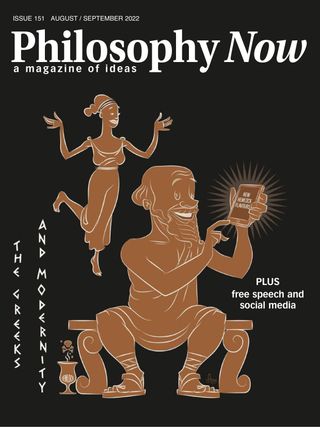
An Ancient Conversation About Motion
Philosophy Now
|August/September 2022
Matei Tanasă imagines the sort of conversation about change, motion, appearance and reality that philosophers were having in ancient Athens.

(Heraclitus, Parmenides, Zeno, and Pyrrhon are sitting at a table in Athens. A worried-looking Athenian approaches.)
Athenian: Oh, you who are the wisest of men, I long for freedom from illusion, the hardest of chains and cruellest of servitudes!
Heraclitus: Tell us your problem with no hesitation. We gladly help the ones who seek for knowledge.
Athenian: I have heard it said that many philosophers claim that movement - that which seems most evident of all - is not real, but a mere phantasm. Tell me now, you with the brightest minds, is this so or is it not?
Parmenides: You came to the right place, friend, and I shall answer your question. Tell me, is it not true that if something moves, it either moves itself or is moved by another?
Athenian: Indeed.
Parmenides: Yet all that moves does so as a result of either pulling or pushing, may it be in whatever direction. So, if something moves itself, something needs to either pull or push itself. But something cannot be behind itself, nor can it be in front of itself, above itself, or under itself. Thus nothing can push or pull itself. Therefore, nothing can be moved by itself.
Athenian: You seem not to be wrong.
Parmenides: So, the only way in which something can move is if it is moved by another. Yet nothing can move something if it does not itself move first. Since the mover needs to be moved, we need a second mover to move the first. The same we need for the second mover. And so we need an initial mover that is moved by nothing other than itself. Nothing can move itself, as said already, so such an initial mover cannot exist. Thus there is no movement, and any movement you may think you see is a mere illusion.
Athenian: By Zeus!

このストーリーは、Philosophy Now の August/September 2022 版からのものです。
Magzter GOLD を購読すると、厳選された何千ものプレミアム記事や、10,000 以上の雑誌や新聞にアクセスできます。
すでに購読者ですか? サインイン
Philosophy Now からのその他のストーリー

Philosophy Now
Bilbo Theorizes About Wellbeing
Eric Comerford overhears Bilbo and Gandalf discussing happiness.

9 mins
December 2025 / January 2026

Philosophy Now
What Women?
Marcia Yudkin remembers almost choking at Cornell
11 mins
December 2025 / January 2026

Philosophy Now
Islamic Philosophers On Tyranny
Amir Ali Maleki looks at tyranny from an Islamic perspective.
4 mins
December 2025 / January 2026

Philosophy Now
Peter Singer
The controversial Australian philosopher defends the right to choose to die on utilitarian grounds
5 mins
December 2025 / January 2026

Philosophy Now
Another Conversation with Martin Heidegger?
Raymond Tallis talks about communication problems.
7 mins
December 2025 / January 2026

Philosophy Now
Letters
When inspiration strikes, don't bottle it up. Email me at rick.lewis@philosophynow.org Keep them short and keep them coming!
17 mins
December 2025 / January 2026
Philosophy Now
The Philosophy of William Blake
Mark Vernon looks at the imaginative thinking of an imaginative artist.
9 mins
December 2025 / January 2026

Philosophy Now
Philosophical Haiku
Peering through life’s lens God in nature is deduced: The joy of being.
1 mins
December 2025 / January 2026

Philosophy Now
Philosophy Shorts
More songs about Buildings and Food' was the title of a 1978 album by the rock band Talking Heads. It was about all the things rock stars normally don't sing about. Pop songs are usually about variations on the theme of love; tracks like Rose Royce's 1976 hit 'Car Wash' are the exception. Philosophers, likewise, tend to have a narrow focus on epistemology, metaphysics and trifles like the meaning of life. But occasionally great minds stray from their turf and write about other matters, for example buildings (Martin Heidegger), food (Hobbes), tomato juice (Robert Nozick), and the weather (Lucretius and Aristotle). This series of Shorts is about these unfamiliar themes; about the things philosophers also write about.
2 mins
December 2025 / January 2026

Philosophy Now
Hedonic Treadmills in the Vale of Tears
Michael Gracey looks at how philosophers have pursued happiness.
8 mins
December 2025 / January 2026
Translate
Change font size