試す 金 - 無料
The secret history of flowers
Country Life UK
|August 07, 2024
With no written records, the earliest inhabitants of these isles left a living dossier of cultural history in the folklore attached to our wildflowers
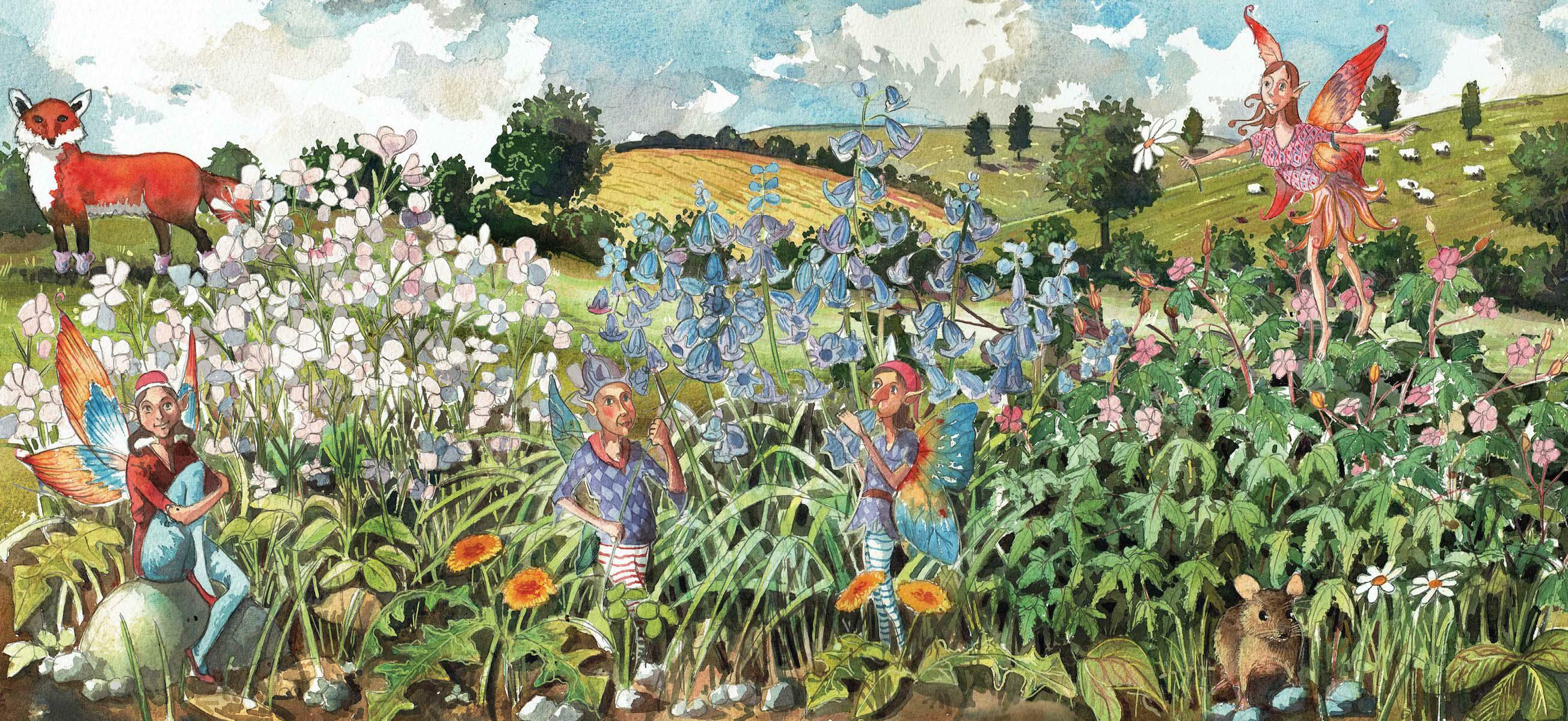
WHAT’S in a name? If that name is the old cognomen of a British wildflower, then it is the epigraph of the lore concerning the plant, the superstitions, traditions and knowledge linked to it over decades, centuries, millennia. Our wildflowers are deeply rooted in ancient myth and experience, their naming and their lore telling of their qualities —whether good or bad for human health, for example—but also, when we dig a little deeper, reflecting our own cultural history.
Pick a buttercup and play the childish game of holding it under someone’s chin to see the yellow sheen that betrays whether they like butter or not and you are enacting a relic belief of the West Country. There, long, long ago, farmers rubbed the udders of their cows with buttercup flowers on May Day, to increase the yield and richness of their milk. The ritual rubbing also protected the cattle from theft by faeries, who were always desirous of improving their herds of fairy cattle by interbreeding with cows from mortal fields.
The lore of the plants is a window into the mind of the past, even the far past, when spirits, elves and even the Devil were abroad. To cut foxgloves—or ‘fairy bells’ or ‘witches thimble’—for the prettification of the home was an offence against the fae people who lived in the flowers, inviting death. Conversely, for diabolical animals such as the fox, the bell-shaped flower, put on the paws, allowed it to prey on poultry in sorcerous silence.
Many of the earliest inhabitants of these isles, those of druid time, had no writing, left no record on stone or paper, but floral folklore is their memorial. To know the stories and legends of the wildflowers connects us with our forebears, but also with the plants, in a manner more profound today than merely studying their botany—or using their Latin, scientific names, which are invariably prosaic, based on the flora’s physical appearance.
The Latin name of meadowsweet is


このストーリーは、Country Life UK の August 07, 2024 版からのものです。
Magzter GOLD を購読すると、厳選された何千ものプレミアム記事や、10,000 以上の雑誌や新聞にアクセスできます。
すでに購読者ですか? サインイン
Country Life UK からのその他のストーリー

Country Life UK
Opposites can attract
As a big bookcase designed by Peter Waals proves large pieces of furniture can do well, a notable collection shows harmony can be born from difference

3 mins
June 03, 2026

Country Life UK
His green and pleasant land
Few artists travelled as little as John Constable, but his deep knowledge of the parts of England he loved gave him insights that others missed. Susan Owens explores the places that delighted him
6 mins
June 03, 2026

Country Life UK
Dreaming of roses
A thousand English roses now bloom in the restored walled garden that forms the heart of this 27-acre estate, writes Charles Quest-Ritson
4 mins
June 03, 2026

Country Life UK
Ring for peace
A COPIOUS quantity of apple strudel became the unintended consequence of a winter walking holiday in the Austrian Tyrol.
2 mins
June 03, 2026
Country Life UK
Best of the pests
Pity the feral pigeon: long campaigned against as an urban nuisance, it is the descendant of birds lured into human service, some of which distinguished themselves in wartime
3 mins
June 03, 2026

Country Life UK
Red alert
The time is ripe for tomatoes in every form. We are days into British Tomato Fortnight (June 1–14) and weeks from Royal Ascot (June 16–20), where Bright Tomato has been declared the inaugural Colour of the Year by Ascot creative director Daniel Fletcher.
1 mins
June 03, 2026
Country Life UK
Totally tropical
I FIRST grew pineapple guava, also called feijoa (Acca or Feijoa sellowiana) almost a quarter of a century ago, when there were few nurseries stocking them.
3 mins
June 03, 2026

Country Life UK
Brewed awakening: where London learnt to talk
Rupert Clague explores how caffeine-fuelled conversation in Hanoverian London’s ‘penny universities’ helped shape the modern world—and where that same spirit still lingers today
5 mins
June 03, 2026

Country Life UK
The legacy Percy Shaw and cat's eyes
BEHIND the retina in a cat’s eyes lurks the tapetum lucidum, a layer of tissue that acts as a mirror, or a retroreflector, and allows the animal to see in the dark.
1 mins
June 03, 2026

Country Life UK
Britain is told to spill the beans
HOME-GROWN legumes have a vital role to play in strengthening national food security and reducing the UK's increasing reliance on imported food, the audience heard at last month's UK Legume Research Community Conference, held at the James Hutton Institute in Invergowrie, Perthshire.
2 mins
June 03, 2026
Listen
Translate
Change font size