
Magzter GOLDで無制限に
10,000以上の雑誌、新聞、プレミアム記事に無制限にアクセスできます。
試す 金 - 無料
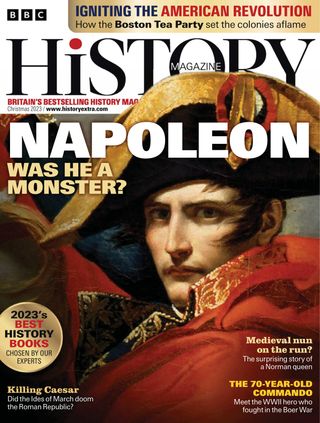
The long death of the Roman republic
BBC History UK
|Christmas 2023
Julius Caesar’s murder is often seen as the event that ushered in the age of emperors. Yet structural weaknesses had plagued Rome’s republic long before his death

Few events in the long span of Roman history were as bold or as shocking as the murder of Julius Caesar. On 15 March 44 BC, in the consecrated space of Pompey’s theatre, the life of the man who had come to utterly dominate Rome’s political landscape in the middle decades of the first century BC was brought to an end in a flurry of assassins’ blades. The repercussions for Rome and its expanding empire were immense.
Historians have been fascinated with the killing ever since – not just because of its audacity, but also because of what it meant for the future of Rome. When Marcus Junius Brutus and his fellow conspirators attacked Caesar on the Ides of March, Rome had been organised around a system of government called the ‘republic’ for almost five centuries. Within 15 years of Caesar’s death, that republic had been transformed by a tidal wave of recriminations and civil war – to be replaced by the age of the emperors.
It is this very reason that Caesar’s death has been seen as a decisive break in Rome’s history: when one period came to an end and another – dominated by men such as Augustus, Nero and Hadrian – began. Yet to ascribe the fall of the republic solely to the upheaval that followed the events of 44 BC would be a mistake. The republic was a system of government already under immense structural pressure from a range of forces, and those forces had begun pulling at the system’s fabric long before the rise of Caesar.
To understand the long roots of the republic’s demise, it is first worth setting out what the republic was. Its name comes from the Latin term

このストーリーは、BBC History UK の Christmas 2023 版からのものです。
Magzter GOLD を購読すると、厳選された何千ものプレミアム記事や、10,000 以上の雑誌や新聞にアクセスできます。
すでに購読者ですか? サインイン
BBC History UK からのその他のストーリー

BBC History UK
On the skids
Richard Rodgers and Oscar Hammerstein II's smash musical Oklahoma! opened on Broadway on 31 March 1943.

1 min
Christmas 2025

BBC History UK
Small pleasures
Memory is imperfect, but what if you could get a professional model maker to recreate a moment from the past?
1 min
Christmas 2025

BBC History UK
Bath in five places
In the Georgian era, Bath became arguably Britain's most fashionable destination. KIRSTEN ELLIOTT promenades five historic highlights
3 mins
Christmas 2025
BBC History UK
End times
Why do civilisations that dominated their epoch fail? In an era of autocracy, climate change, the rise of Al and a first-hand understanding of how deadly pandemics can be, it's a question that seems pertinent.
1 min
Christmas 2025

BBC History UK
What are the origins of the Yule Lads?
To learn about the Jólasveinar (Yule Lads), we must start with their mother, the terrifying ogress Grýla. Her name appeared in Icelandic texts as early as the 13th century, although it wasn’t until later that those 13 mischievous lads became associated with her. Folk tales and poems tell how she descends from the mountains with an empty sack to stuff full of children. Grýla owns the monstrous Jólaköttur (Yule Cat), which roams the countryside on Christmas Eve, searching for children to gobble up if they're not wearing new clothes.
1 mins
Christmas 2025

BBC History UK
Santa Claus v Father Christmas
The true identity of the white-bearded, red-robed figure who fills children's stockings at Christmas has long been debated. Thomas Ruys Smith sizes up the merry contenders
8 mins
Christmas 2025

BBC History UK
Frontier friction
Set in Washington Territory in 1854, The Abandons is a Western that's unusual for having two matriarchs, women whose lives become entangled, at its centre.
1 min
Christmas 2025

BBC History UK
The Last Days of Pompeii: The Immersive Experience
Delve into the culture of daily Roman life, witness the momentous eruption of Mount Vesuvius, and follow its fallout in Immerse LDN's new exhibition. In a blend of cutting-edge technology and vivid storytelling, this exhibition launches visitors into Pompeii's rich history with recreations of the ancient city's beautiful pre-eruption landscape, a 360-degree virtual reality Roman amphitheatre experience, and a digital metaverse recreating Pompeii's 'Villa of Mysteries'.
1 min
Christmas 2025

BBC History UK
Elizabeth Marsh The corsair's captive
Taken hostage by a Barbary ship's captain in the 18th century, a young Englishwoman found herself fighting for her freedom in Marrakech. ADAM NICHOLS introduces a brave captive who later wrote a book about her dramatic experiences
6 mins
Christmas 2025

BBC History UK
29 DECEMBER 1170: Thomas Becket is murdered in Canterbury
Knights loyal to Henry II rid him of the “low-born cleric”
2 mins
Christmas 2025
Translate
Change font size