試す 金 - 無料
DEATH TO THE SHAH
The New Yorker
|August 11, 2025
Nobody expected the Iranian Revolution. Not even the revolutionaries.
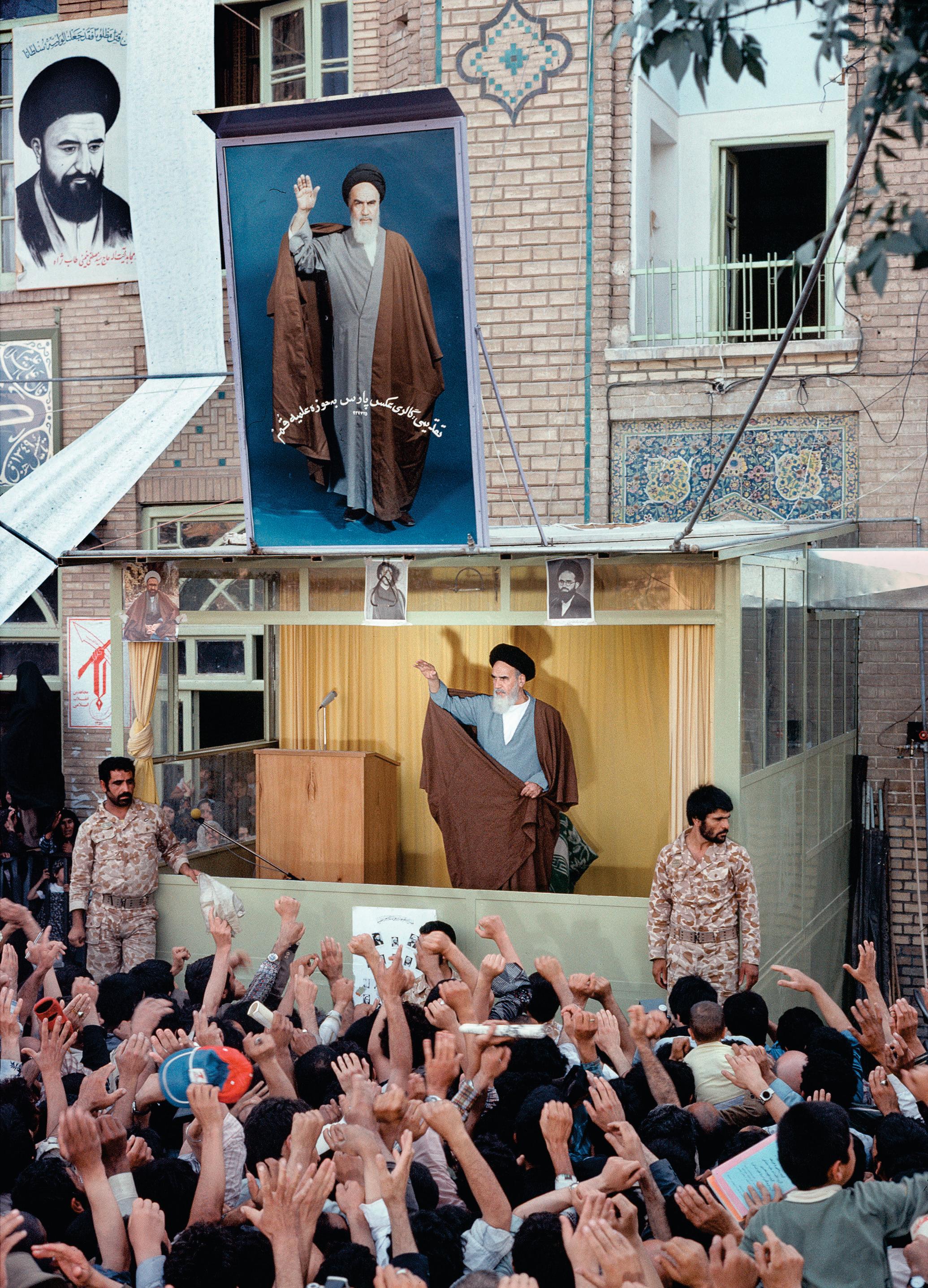
In 1979, Ruhollah Khomeini, pictured here at a rally in Qom, returned from exile to a revolution already in motion.
Strange to think, but there was a time when the United States’most steadfast ally in the Middle East was Iran. In 1953, the C.I.A. had backed a coup that ousted Mohammad Mossadegh, the popular Prime Minister, and restored power to the monarchy of Mohammad Reza Pahlavi, the Shah. For a quarter of a century thereafter, Washington watched in satisfaction as the Shah kept the peace while a U.S.-dominated consortium sold off Iran's oil.
There was rather a lot of oil, making the Shah one of the world’s wealthiest men. For his forty-eighth birthday, in 1967, he staged a glitzy coronation for himself. Standing before a golden throne, he steadied onto his head a crown rimed with 3,380 diamonds. His third wife, Empress Farah, processed in a bejewelled, mink-edged Christian Dior cloak that took eight attendants to carry. After the ceremony, the royal couple waved stiffly to the crowds from a horse-drawn gilded carriage that had been crafted in Vienna by one of Europe's last remaining coach-makers. Planes dropped 17,532 roses, one for each glorious day of the Shah's glorious life.
Iran’s display of floral ballistics hinted at another beneficiary of its oil revenues: the military. In 1972, President Richard Nixon gave the Shah carte blanche to buy any arms he desired short of nuclear bombs. The Shah amassed the world’s fifth-largest military, his toy chest brimming with supersonic jets, laser-guided bombs, and helicopter gunships. Reportedly, he relaxed by reading arms catalogues.

このストーリーは、The New Yorker の August 11, 2025 版からのものです。
Magzter GOLD を購読すると、厳選された何千ものプレミアム記事や、10,000 以上の雑誌や新聞にアクセスできます。
すでに購読者ですか? サインイン
The New Yorker からのその他のストーリー
The New Yorker
CONTRIBUTORS
Eliza Griswold (\"Young Americans,\" p. 12) is a contributing writer.

1 mins
June 29, 2026

The New Yorker
THE READERS
Early in my treatment, we decided that you wouldn't read my work.
24 mins
June 29, 2026

The New Yorker
URBAN LEGEND
Closing out a crime trilogy about a changing New York, Colson Whitehead excavates his own foundations.
33 mins
June 29, 2026
The New Yorker
ABOUT TOWN
POST-ROCK | Last year, the Chicago instrumental post-rock band Tortoise returned with \"Touch,\" its first album in nearly a decade, the further explorations of an inquisitive nature.
3 mins
June 29, 2026
The New Yorker
GOINGS ON JUNE 24-30, 2026
What we're watching, listening to, and doing this week.
1 min
June 29, 2026
The New Yorker
LONGING FOR ITHACA
There’s a reason Homer’s homecoming epic has long defeated the directors.
16 mins
June 29, 2026

The New Yorker
HOT PURSUIT
The repo man coming for your ride.
35 mins
June 29, 2026
The New Yorker
WILD THINGS
Why do animals have sex, anyway?
14 mins
June 29, 2026
The New Yorker
PRICKLY PAIRS - “The Invite.”
“The Invite” begins with an aphorism: “One should always be in love.
6 mins
June 29, 2026
The New Yorker
BRAVE NEW WORLD DEPT.INSTANCING
Wednesday evenings at Hex&Co., board-game café and bar in Morningside Heights, are dedicated to \"RPG Encounters,\" in which fans of role-playing games gather to create collaborative stories over espresso drinks.
3 mins
June 29, 2026
Listen
Translate
Change font size