
Magzter GOLDで無制限に
10,000以上の雑誌、新聞、プレミアム記事に無制限にアクセスできます。
試す 金 - 無料
Fodder flow planning for success
Farmer's Weekly
|5+12 April 2024
In order for beef farmers to remain profitable in terms of cow calf operations, it is critical to manage costs on farm level, says Henco Leicester of Cargill Animal Nutrition.

One way of managing cost is to increase the output at the same cost and thus generate higher income, or to reduce cost and maintain the same level of output. You can also look at finding the in-between to make sense.
My concern as a farmer is that most of us cannot do this. If you can’t quantify your cost of production and you don’t measure on-farm performance, you can’t predict or measure the outcome of your changes. In order to start doing this, you need to quantify what each decision is going to cost you and measure the improvement in performance or income.
Fodder flow is one of the key aspects in your farming enterprise that you need to consider, because every large stock unit will consume about 3,4t to 3,65t of roughage a year. This is why it is important to map out the different available fodder flow options.
For example, if you have 500ha of farm available, it is important to know what number of hectares is natural grazing, planted pastures, and maize residue. From this, you will then be able to calculate your monthly and yearly yield of forage available, and you can plan and calculate when you need to bank fodder and where to utilise the banked fodder for optimal production based of your herd structure requirements.
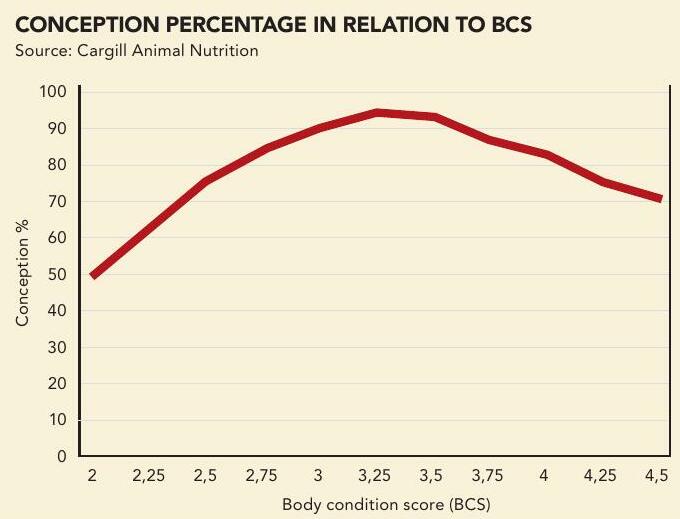
After this, it is important to set out a flexible supplementation system to fit in with your fodder flow to always try and maintain the ideal body condition score (BCS) in your herd depending on the stage in production cycle, season, and fodder available. BCS is directly correlated with fertility, as seen in the figure on the following page.
SUPPLEMENTATION


このストーリーは、Farmer's Weekly の 5+12 April 2024 版からのものです。
Magzter GOLD を購読すると、厳選された何千ものプレミアム記事や、10,000 以上の雑誌や新聞にアクセスできます。
すでに購読者ですか? サインイン
Farmer's Weekly からのその他のストーリー
Farmer's Weekly
Cash flow budgets: keeping farmers in control of liquidity, risk, and their survival
Profit doesn't guarantee a farm's survival - cash does. Cobus du Plessis explains why cash flow budgets are one of the most important yet underused financial tools on South African farms.

5 mins
February 27 - March 06, 2026

Farmer's Weekly
The toast of the Navy
The incredible story of the World War II-era Great Dane dog Nuisance being enlisted in the Royal Navy is well documented. Graham Jooste shared some entertaining anecdotes involving the canine shipmate.
6 mins
February 27 - March 06, 2026
Farmer's Weekly
Healthier soils deter destructive locusts
Locust swarms remain a serious global threat, capable of devastating crops, livelihoods and local economies across vast regions.
1 min
February 27 - March 06, 2026
Farmer's Weekly
Wheat crisis dominates Grain SA regional meetings
As the ongoing wheat crisis continues to erode producers' margins, emotions ran high at Grain SA's regional meeting in Moorreesburg in the Western Cape.
2 mins
February 27 - March 06, 2026

Farmer's Weekly
A FARMER'S EXPERIENCE
Street Wallet has been a game-changer for Mario Athanasopoulos, hydroponic production consultant and owner of Green City Farms.
1 mins
February 27 - March 06, 2026
Farmer's Weekly
Kesieberg Merino Stud Production Sale
The Kesieberg Merino Stud Production Sale was held on the farm Leeuwfontein on 4 February on behalf of Willie and Herman Henning.
1 min
February 27 - March 06, 2026

Farmer's Weekly
Not cheaper, just different: what you should know about farming in Mozambique
Although Mozambique is often viewed as a cheaper, easier farming location than South Africa, cost comparisons tell a more complex story. But while cross-border production presents real challenges, it also offers opportunities for complementary trade, diversification and regional food security, particularly when it comes to subtropical crops such as bananas.
10 mins
February 27 - March 06, 2026
Farmer's Weekly
The all-rounder anchoring South Africa's beef value chain
Louis Steyl, CEO of the Bonsmara Cattle Breeders' Society of South Africa, spoke to Octavia Avesca Spandiel about how the versatile Bonsmara breed anchors the country's beef value chain, delivering balanced performance, reproductive and feed efficiency, and carcass traits across extensive and intensive systems.
6 mins
February 27 - March 06, 2026

Farmer's Weekly
THE HITCHING POST
I'm a 60-year-old white woman who loves camping, animals, the outdoors, and watching sport.
2 mins
February 27 - March 06, 2026
Farmer's Weekly
Foot-and-mouth disease in pigs
Recently, the radio news mentioned an outbreak of foot-and-mouth disease (FMD) in pigs in South Africa.
2 mins
February 27 - March 06, 2026
Listen
Translate
Change font size