
Magzter GOLDで無制限に
10,000以上の雑誌、新聞、プレミアム記事に無制限にアクセスできます。
試す 金 - 無料
IRREPLACEABLE HUMAN TOUCH
BioSpectrum Asia
|BioSpectrum Asia July 2025
The trend of virtual and remote healthcare—including diagnostics and treatment—is gaining traction globally. Telemedicine, in particular, saw a rapid acceleration during COVID-19, when in-person consultations were often avoided due to the risk of virus transmission. Both healthcare providers and patients embraced remote care as a safer alternative. According to a GlobalData survey, 56 per cent of healthcare professionals believe that the growth of telemedicine and remote care has enhanced patients’ control over their health management. Among them, 13 per cent strongly agreed, while 26 per cent remained neutral. Only 2 per cent disagreed and 3 per cent strongly disagreed, showing widespread acceptance of this shift.

The trend is picking up significantly across Asia. Even Pakistan is exploring the use of artificial general intelligence (AGI) for diagnostics and nursing education. The Pakistan Nursing and Midwifery Council (PNMC) has partnered with a California-based AI company to address critical challenges in nursing education. The country faces a staggering shortage of skilled nurses—estimated at over 3 million—& without intervention, it would take more than 90 years to bridge this gap. AI, therefore, is being seen as a vital solution. The rise and spread of virtual care & treatment is also beneficial for the hospitals, as in several places in Asia, they are experiencing a shortage of beds. A recent report from Singapore mentioned that with rising demand for critical care, hospitals often experience a shortage of beds and experienced clinical staff, particularly for ICUs. Thus, the Singapore Health Services (SingHealth) is working on optimising the smart ICU's capacity. They can detect patient deterioration early, allowing treatments to be given even in non-ICU wards without the necessity of moving the patient to the ICU.
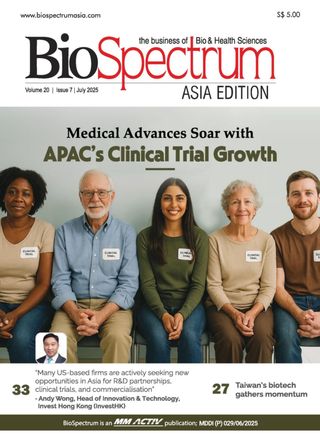

このストーリーは、BioSpectrum Asia の BioSpectrum Asia July 2025 版からのものです。
Magzter GOLD を購読すると、厳選された何千ものプレミアム記事や、10,000 以上の雑誌や新聞にアクセスできます。
すでに購読者ですか? サインイン
BioSpectrum Asia からのその他のストーリー
BioSpectrum Asia
India–EU FTA Paves Way for Expanded Healthcare Trade
On January 27, 2026, after years of negotiations, India and the European Union announced a landmark Free Trade Agreement.

4 mins
BioSpectrum Asia March 2026
BioSpectrum Asia
PreferCo and Glatt to open CoE for precision fermentation bioprocess scale-up in India
In a major boost to Government of India's BioE3 push, German major Glatt and India-based startup PreferCo have announced the launch of \"PreferCo-Glatt Centre of Excellence (CoE) for Bioprocess Scale-Up\" in Hyderabad's Genome Valley.
1 min
BioSpectrum Asia March 2026

BioSpectrum Asia
Women's Health Surge in APAC
The rising burden of diseases such as ovarian cancer, breast cancer, cervical cancer, infertility, etc. is emerging as the key driver of the women's healthcare market across the globe. While North America led the women healthcare market in 2025, Asia Pacific (APAC) is expected to witness the fastest growth this year onwards. As a result, governments across the APAC region, are recognising the importance of women's health and are launching initiatives, particularly under female leaders, to improve access to healthcare services. Moreover, a number of women-led startups are now developing new solutions to address this growing burden of women-associated diseases in the APAC region. Let's take a closer look.
6 mins
BioSpectrum Asia March 2026

BioSpectrum Asia
Hanchor Bio receives US FDA Orphan Drug Designation for HCB101 in gastric cancer
Taiwan-based biotech startup HanchorBio, Inc. has announced that the US Food and Drug Administration (FDA) has granted Orphan Drug Designation (ODD) to HCB101 for the treatment of gastric cancer.
1 min
BioSpectrum Asia March 2026

BioSpectrum Asia
Daiichi Sankyo names Dr John Tsai as Global Head of R&D
Japan-based Daiichi Sankyo Company has appointed Dr John Tsai to succeed Dr Ken Takeshita, who is stepping down as Global Head of R&D, effective April 1, 2026.
1 min
BioSpectrum Asia March 2026

BioSpectrum Asia
"The global trend is moving beyond centralised hubs toward distributed networks and domestic capability"
King Faisal Specialist Hospital & Research Centre (KFSHRC) and US-based Germfree Laboratories have announced a strategic partnership to develop Saudi Arabia's first fully integrated, modular Advanced Therapy Medicinal Product (ATMP) Manufacturing Campus.
4 mins
BioSpectrum Asia March 2026

BioSpectrum Asia
SEOUL'S RISKY DRUG PRICING RESET
Drug pricing has once again moved to the centre of policy debate in South Korea, with the government recently stepping back from its proposed generic drug pricing reform.
2 mins
BioSpectrum Asia March 2026

BioSpectrum Asia
Takeda and Iambic sign $1.7 B deal to advance AI driven design of small molecules
Iambic, a US-based clinical-stage life science and technology company developing novel medicines using its artificial intelligence (AI)-driven discovery and development platform, has announced a multi-year technology and discovery collaboration agreement with Japan-based Takeda Pharma that will use Iambic's industry leading AI drug discovery models to advance a select set of high-priority small molecule programmes, initially in Takeda's Oncology and Gastrointestinal and Inflammation therapeutic areas.
1 min
BioSpectrum Asia March 2026

BioSpectrum Asia
S.Biomedics announces partnership with Catalent to develop and manufacture TED-A9
US-based Catalent and South Korea-based S.Biomedics have announced a strategic partnership to support the development and manufacturing of TED-A9, S.Biomedics' allogeneic pluripotent stem-cell-derived ventral midbrain-specific dopaminergic precursor cell therapy being developed for the treatment of Parkinson's disease.
1 min
BioSpectrum Asia March 2026
BioSpectrum Asia
China revises drug administration regulations to spur innovation
China has revised regulations concerning drug administration in a bid to promote drug innovation, strengthen management of online sales of medicines and reinforce drug safety supervision.
1 min
BioSpectrum Asia March 2026
Listen
Translate
Change font size