
Magzter GOLDで無制限に
10,000以上の雑誌、新聞、プレミアム記事に無制限にアクセスできます。
試す 金 - 無料
Pulse Paradox
Down To Earth
|November 01, 2016
A record production of pulses is in the offing. But neither farmers nor consumers stand to benefit because the government is withdrawing procurement from farmers and flooding the market with imported pulses

WHEN KEY pulses started hitting record prices since May last year, millions of farmers across the country began to cultivate them anticipating high income. Anil Mandage, a small farmer from Pimpri Gawli village, Ahmednagar district, Maharashtra, is one of them. His 1.2 hectare (ha) farm helped him produce one tonne of moong dal (green gram) this season. Unfortunately, no trader could offer him a decent price—the wholesale price of green gram has today dropped to below I30,000 per tonne. It was I60,000 per tonne when Mandage started sowing. When he turned to the government procurement centre, his produce was rejected on the grounds that it had a high moisture content. “The Marathwada region received heavy rainfall at the fag-end of this monsoon season,” says Mandage. Only 12.5 tonnes of moong was procured from 7,000-odd farmers in seven villages of the district.
Mandage’s story repeats itself across India. For instance, in Harda district, Madhya Pradesh (MP), the market price dropped from I70,000 per tonne in May this year to around I35,000 in October. Conflicts are brewing across the country as government procurement centres are rejecting the bumper harvest. The district’s farmers produced over 39,600 tonnes of
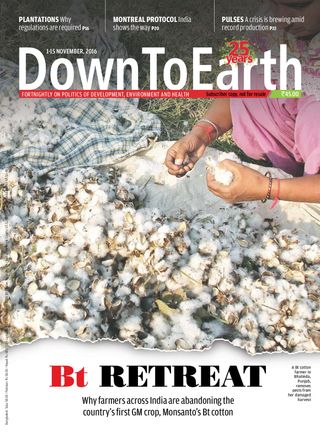

このストーリーは、Down To Earth の November 01, 2016 版からのものです。
Magzter GOLD を購読すると、厳選された何千ものプレミアム記事や、10,000 以上の雑誌や新聞にアクセスできます。
すでに購読者ですか? サインイン
Down To Earth からのその他のストーリー

Down To Earth
THINK TWICE BEFORE FELLING SAL TREES
Many trees considered to be affected by sal borer in the 1990s are still alive today

1 mins
February 16, 2026

Down To Earth
EDGE OF SURVIVAL
Caste divides deny marginalised communities land, resources and essential aid, leaving them more vulnerable to climate disasters
6 mins
February 16, 2026

Down To Earth
A WISH LIST?
Union Budget for 2026-27 conveys the impression of a roll-call of intentions and ambitious proposals, with little detail on their formulation
6 mins
February 16, 2026
Down To Earth
Break down the gender wall
THE RULING National Democratic Alliance (NDA) government has been heavily invested in the goal to make India a developed economy by 2047.
2 mins
February 16, 2026

Down To Earth
MENSTRUAL HEALTH, NOW A FUNDAMENTAL RIGHT
In a landmark judgement, the Supreme Court has recognised menstrual health and hygiene as a fundamental right under Article 21 of the Constitution of India, which guarantees the right to life and dignity.
8 mins
February 16, 2026

Down To Earth
Of devolution and new disasters
The 16th Finance Commission pushes for changes in view of new fiscal and climatic conditions
11 mins
February 16, 2026
Down To Earth
Rising risks of plastics
NEGATIVE IMPACTS on human health due to emissions linked to the plastic lifecycle could double by 2040, according to a study published in The Lancet Planetary Health in January.
1 min
February 16, 2026

Down To Earth
GAP BETWEEN EPIDEMICS NARROWING
A watershed-based and landscape-level approach is needed to address forest degradation
2 mins
February 16, 2026
Down To Earth
WAITING TO STRIKE
Sal heartwood borer is considered the biggest threat to forestry in India, especially to the sal tree, where it lives and breeds.
11 mins
February 16, 2026
Down To Earth
A SPRING DELIGHT
Mustard flowers are not meant only for the eyes. Invite them to your plate once in a while
3 mins
February 16, 2026
Translate
Change font size