試す 金 - 無料
Mobility redefined
Down To Earth
|July 16, 2020
The pandemic offers probably the last chance to reform our public transport and make way for walking and cycling
-

FEAR OF infection and the need for social distancing have altered the way we used to move around just a few months ago—in the pre-COVID times. Since then our activity and mobility patterns have changed dramatically, so much so that it has led to a near-collapse of the public transport in cities.
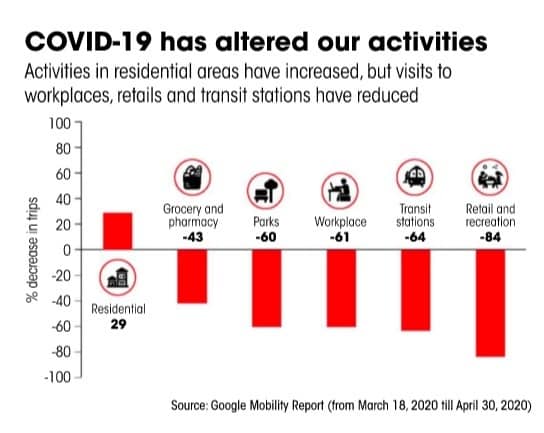
CSE’s analysis of Google Mobility Data for the period between February 15 and May 16 shows that activities in residential areas have increased by 29 per cent but visits to workplaces have reduced by 60 per cent and to retail and recreation by 84 per cent. Grocery and pharmacy visits also indicate a drop, though marginal. (see 'COVID-19 has altered our activities').
The data also shows a massive drop in visits to transit stops and nodes as the use of public transport has plummeted across the country. COVID-19, it seems, has stigmatised the public transport. And this has provoked more worries. Since opening up of the economy is not possible without transport, the fear is it might lead to an increase in the number of cars and two-wheelers on the roads, making the cities even more congested and polluted.
Clearly, there is an urgent need to organise mobility services. Here are a few steps that can help the authorities do this in a prudent manner.
REINVENT PUBLIC TRANSPORT Public transport ridership came to a halt due to complete lockdown in India. Other countries that did not impose a lockdown and kept their public transport functional have also faced drastic reduction in ridership—by as much as 70 to 90 per cent. This calls for an urgent need to rebuild confidence in the public transport.
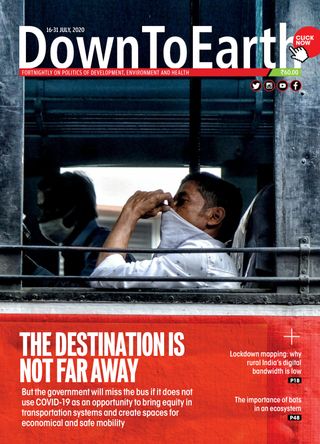

このストーリーは、Down To Earth の July 16, 2020 版からのものです。
Magzter GOLD を購読すると、厳選された何千ものプレミアム記事や、10,000 以上の雑誌や新聞にアクセスできます。
すでに購読者ですか? サインイン
Down To Earth からのその他のストーリー
Down To Earth
Popular distrust
THE WORLD seems to be going through a period of stasis despite facing an unfathomable polycrisis.

2 mins
February 01, 2026

Down To Earth
CONSERVE OR PERISH
Periyar Tiger Reserve has rewritten Indian conservation by turning poachers into protectors and conflict into coexistence
5 mins
February 01, 2026

Down To Earth
'Rivers need to run free'
From Tibet to West Bengal, the Brahmaputra is the pulse of communities and ecosystems along its course. But what are the risks the river faces through human interventions, particularly dams, discusses journalist, author and filmmaker SANJOY HAZARIKA in his new book, River Traveller.
4 mins
February 01, 2026

Down To Earth
India is facing up to its innovation lag
There are signs now that India is acknowledging the superior strides made by China in a frontier technology like Al
4 mins
February 01, 2026

Down To Earth
Competing concerns
What are the repercussions of the EU-Mercosur pact that have made European farmers protest against the free trade agreement?
4 mins
February 01, 2026

Down To Earth
From fryer to flight
Sustainable fuel made from used cooking oil can play a pivotal role in helping India achieve its aviation emission reduction goals. Measures to collect this oil must be revamped
4 mins
February 01, 2026

Down To Earth
ACCESS OPEN
An amendment to India's nodal forest conservation law opens up forests across India to commercial exploitation by the paper industry
6 mins
February 01, 2026
Down To Earth
DRINK FROM TAP CAN BE A REALITY
As cities across India struggle to supply safe piped water, Odisha offers a success story
2 mins
February 01, 2026

Down To Earth
GREAT DRYING
The Earth is hotter than at any point in the past 100,000 years, with 2023-25 becoming the warmest three-year period on record and also breaching the 1.5°C threshold for the first time. One fallout is dwindling freshwater.
22 mins
February 01, 2026

Down To Earth
Green redemption
Restoration of grasslands of Kerala's Pampadum Shola National Park, once dominated by invasive Australian wattles, see a return of streams and native species
1 mins
February 01, 2026
Translate
Change font size