試す 金 - 無料
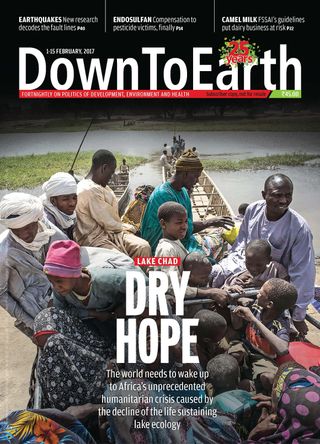
Lake Chad Forgotten Crisis
Down To Earth
|February 01, 2017
Ecological degradation in the Chad Basin has triggered Africa's latest humanitarian crisis. It's time, the basin countries looked beyond the excuse of insurgency.

LAST YEAR when Nigeria declared a nutrition emergency in Borno, indicating acute food insecurity in the state, and said the region stands to lose 80 children every day, it caught the world's attention. More than a dozen humanitarian organisations working in West Africa issued a joint statement, saying the ongoing conflict with the jihadist militant group Boko Haram has pushed the number of people facing severe hunger in the region to more than 6 million. In January this year, UN Emergency Relief Coordinator Stephen O’Brien informed the Security Council: “The humanitarian crisis across northeast Nigeria and parts of Cameroon, Chad and Niger, triggered by the horrendous, violent and inhuman campaign of Boko Haram, is deepening.” The UN has since revised its appeal and called for more funds for lifesaving humanitarian assistance in the region, also known as the Chad Basin. International organisations have also scaled up their response to ensure food security, reduce malnutrition and provide shelter to refugees and internally displaced people in the region.
While almost all the discussions seem to revolve around the immediate crisis, the humanitarian emergency unfolding in the basin has actually been in the making for decades. ªThe recent civil, armed conflict and related security threats only significantly exacerbate the pre-existing regional food insecurity and nutrition problems,” states a World Food Programme (WFP) report, released in 2016. ªWhile the security threats are undeniable aspects of the crisis, recent media and reports (SIC) on the alarming regional emergency situation attributing the crisis to Boko Haram activities, risk grossly oversimplifying the complicated interrelated socio-ecological issues at hand leading up to insurgency in the basin,” it says.
A protracted crisis

このストーリーは、Down To Earth の February 01, 2017 版からのものです。
Magzter GOLD を購読すると、厳選された何千ものプレミアム記事や、10,000 以上の雑誌や新聞にアクセスできます。
すでに購読者ですか? サインイン
Down To Earth からのその他のストーリー

Down To Earth
THE GREAT PIVOT
China's moves to transition to clean energy offer critical lessons to India

4 mins
March 01, 2026

Down To Earth
COAL V CORRIDOR
A proposal to mine coal along a corridor that links two tiger reserves in central India is a step away from getting final clearance. The move could affect movement and genetic diversity of tiger populations in the region
8 mins
March 01, 2026

Down To Earth
India's challenging AI predicament
Hobbled by lack of innovation and AI skills in its crucial technology sector, India is focusing on a ruinous plan to host data centres
4 mins
March 01, 2026
Down To Earth
China to implement zero tariffs across Africa
CHINA ON February 14 announced that it will implement zero tariffs for imports from all the 53 African nations it has diplomatic relations with, starting from May 1.
1 min
March 01, 2026
Down To Earth
Poverty, sans the threshold
MEASUREMENT OF poverty is a fundamental exercise, needed to direct development programmes.
2 mins
March 01, 2026

Down To Earth
A bridge across forever
For two decades, a Chhattisgarh village remains stuck in a loop of building temporary river crossings to access markets and sell forest produce
4 mins
March 01, 2026
Down To Earth
Liveable cities need a new model
CRY FOR my Delhi. This is my city—my family records many generations who have lived here.
3 mins
March 01, 2026

Down To Earth
Real impacts of the changing seasons
This refers to the article \"1,500 days, and an alarm for new climate\" (1-15 December, 2025).
1 mins
March 01, 2026

Down To Earth
‘It’s a systematic effort by US to dismantle climate policy’
The US, the world's largest historical emitter of greenhouse gases, has overturned its “endangerment finding”, the legal foundation for regulating emissions under the Clean Air Act since 2009.
4 mins
March 01, 2026
Down To Earth
Amazon turned carbon source in 2023 drought
EXTREME DROUGHT and a prolonged heatwave in 2023 pushed parts of the Amazon rainforest from acting as a carbon sink to becoming a carbon source for three months, according to a February 13 study published in the journal AGU Advances of the American Geophysical Union.
1 min
March 01, 2026
Translate
Change font size