
Magzter GOLDで無制限に
10,000以上の雑誌、新聞、プレミアム記事に無制限にアクセスできます。
試す 金 - 無料
Chambal In The Making
Down To Earth
|October 16, 2019
Soil erosion has triggered expansion of ravines in four districts of Gujarat, threatening agriculture and livelihood

The Ravines have always been there, lining the riverbank, but after the floods in 1973 they started expanding towards the village,” says 73-year-old Chaggan Bhoi of Sarnal village in Gujarat’s Kheda district. The village is barely a kilometre from the Mahi river in central Gujarat. “That year, it rained for 24 straight days and the water from the river entered the village, forming a maze of streams. Since then, massive soil erosion has happened, mostly on the periphery of the village. Residents fear that if left unchecked, the ravines would swallow the village and they might have to migrate,” Bhoi adds.
Kheda is one of Gujarat’s four districts—Panchmahal, Vadodara and Anand being the others—severly affected by expanding ravines (see ‘Unchecked spread’). This monsoon season, the region saw heavy rainfall due to which new ravines have been formed in Khadol, Gadia and Rania villages of Kheda and Nani Sherdi of Anand. In last four to five decades, ravines have increased by 60-70 per cent in the four districts, estimates Satish Macwan of Foundation for Ecological Security (FES), an Anand-based non-profit working to check soil erosion. “Nearly 30,000 hectares (ha) is currently affected by extreme land degradation and ‘ravination’ and the rate is increasing. A decade ago, the figure was 20,000 ha. Every year, there is a loss of about 0.58 million tonnes of soil due to erosion,” Macwan adds.
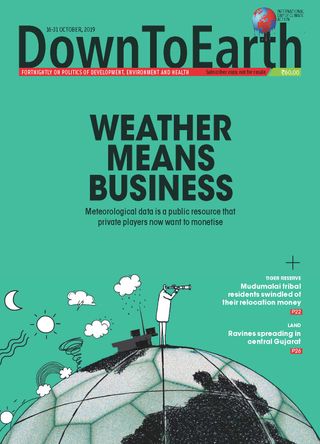

このストーリーは、Down To Earth の October 16, 2019 版からのものです。
Magzter GOLD を購読すると、厳選された何千ものプレミアム記事や、10,000 以上の雑誌や新聞にアクセスできます。
すでに購読者ですか? サインイン
Down To Earth からのその他のストーリー

Down To Earth
THINK TWICE BEFORE FELLING SAL TREES
Many trees considered to be affected by sal borer in the 1990s are still alive today

1 mins
February 16, 2026

Down To Earth
EDGE OF SURVIVAL
Caste divides deny marginalised communities land, resources and essential aid, leaving them more vulnerable to climate disasters
6 mins
February 16, 2026

Down To Earth
A WISH LIST?
Union Budget for 2026-27 conveys the impression of a roll-call of intentions and ambitious proposals, with little detail on their formulation
6 mins
February 16, 2026
Down To Earth
Break down the gender wall
THE RULING National Democratic Alliance (NDA) government has been heavily invested in the goal to make India a developed economy by 2047.
2 mins
February 16, 2026

Down To Earth
MENSTRUAL HEALTH, NOW A FUNDAMENTAL RIGHT
In a landmark judgement, the Supreme Court has recognised menstrual health and hygiene as a fundamental right under Article 21 of the Constitution of India, which guarantees the right to life and dignity.
8 mins
February 16, 2026

Down To Earth
Of devolution and new disasters
The 16th Finance Commission pushes for changes in view of new fiscal and climatic conditions
11 mins
February 16, 2026
Down To Earth
Rising risks of plastics
NEGATIVE IMPACTS on human health due to emissions linked to the plastic lifecycle could double by 2040, according to a study published in The Lancet Planetary Health in January.
1 min
February 16, 2026

Down To Earth
GAP BETWEEN EPIDEMICS NARROWING
A watershed-based and landscape-level approach is needed to address forest degradation
2 mins
February 16, 2026
Down To Earth
WAITING TO STRIKE
Sal heartwood borer is considered the biggest threat to forestry in India, especially to the sal tree, where it lives and breeds.
11 mins
February 16, 2026

Down To Earth
A SPRING DELIGHT
Mustard flowers are not meant only for the eyes. Invite them to your plate once in a while
3 mins
February 16, 2026
Translate
Change font size