試す 金 - 無料
Capital Conundrum
Down To Earth
|August 01, 2019
At the peak of Karnataka’s water crisis, the state’s deputy chief minister, G Parameshwara, made a desperate suggestion. He said the government was mulling over a moratorium on the construction of new residential complexes in Bengaluru for five years to tide over the water crisis. But are restrictions on construction or population an effective way to resolve the problem? Or are there simpler ways to strengthen water conservation? SUSHMITA SENGUPTA spoke to a range of experts

MASSIVE APARTMENT blocks have sprung up all across Bengaluru, especially in peri-urban areas, and particularly in the IT belt straddling across the eastern and southern extents of the metropolis. Much of this region does not get piped water from the Cauvery and so residents and commercial complexes depend on groundwater, which, over the past two decades, has seen rapid depletion.
To milk this perpetual demand, the unregulated tanker suppliers extract water from distant villages and supply it to the city. The carbon, financial and social footprints of this demand-supply phenomenon are unfathomable. The adverse impacts are extensively evident in the emergence of fallow agricultural fields around the city, as farmers prefer to sell water instead of farming. High labor costs and lack of labor, in any case, have made farming highly unviable.
Encroachment, contamination and destruction of lakes and canals in recent decades, and the extensive concretization of the city have fundamentally reduced the potential of groundwater recharge. As a result, even a small burst of rain—precious water that should have percolated into groundwater aquifers—floods the city. This is when groundwater dependence is growing exponentially.
There is also talk of diverting water from the faraway Yettinahole, Sharavathi, Netravathi and other Western Ghats rivers. People here have clearly stated that they will fight any diversion of water. When the Karnataka government proposed to build a dam at Mekedatu, where the Cauvery dives into an amazing gorge and creates a complex riverine forest, downstream Tamil Nadu lodged its protest with the Prime Minister. So expanding Bengaluru finds itself between a rock and a very hard place.
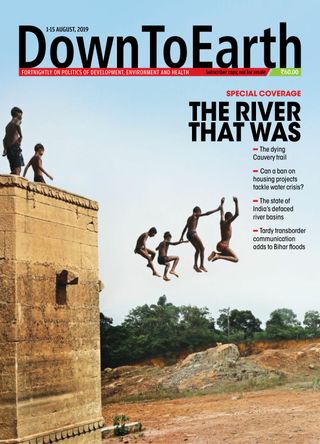

このストーリーは、Down To Earth の August 01, 2019 版からのものです。
Magzter GOLD を購読すると、厳選された何千ものプレミアム記事や、10,000 以上の雑誌や新聞にアクセスできます。
すでに購読者ですか? サインイン
Down To Earth からのその他のストーリー
Down To Earth
Popular distrust
THE WORLD seems to be going through a period of stasis despite facing an unfathomable polycrisis.

2 mins
February 01, 2026

Down To Earth
CONSERVE OR PERISH
Periyar Tiger Reserve has rewritten Indian conservation by turning poachers into protectors and conflict into coexistence
5 mins
February 01, 2026

Down To Earth
'Rivers need to run free'
From Tibet to West Bengal, the Brahmaputra is the pulse of communities and ecosystems along its course. But what are the risks the river faces through human interventions, particularly dams, discusses journalist, author and filmmaker SANJOY HAZARIKA in his new book, River Traveller.
4 mins
February 01, 2026

Down To Earth
India is facing up to its innovation lag
There are signs now that India is acknowledging the superior strides made by China in a frontier technology like Al
4 mins
February 01, 2026

Down To Earth
Competing concerns
What are the repercussions of the EU-Mercosur pact that have made European farmers protest against the free trade agreement?
4 mins
February 01, 2026

Down To Earth
From fryer to flight
Sustainable fuel made from used cooking oil can play a pivotal role in helping India achieve its aviation emission reduction goals. Measures to collect this oil must be revamped
4 mins
February 01, 2026

Down To Earth
ACCESS OPEN
An amendment to India's nodal forest conservation law opens up forests across India to commercial exploitation by the paper industry
6 mins
February 01, 2026
Down To Earth
DRINK FROM TAP CAN BE A REALITY
As cities across India struggle to supply safe piped water, Odisha offers a success story
2 mins
February 01, 2026

Down To Earth
GREAT DRYING
The Earth is hotter than at any point in the past 100,000 years, with 2023-25 becoming the warmest three-year period on record and also breaching the 1.5°C threshold for the first time. One fallout is dwindling freshwater.
22 mins
February 01, 2026

Down To Earth
Green redemption
Restoration of grasslands of Kerala's Pampadum Shola National Park, once dominated by invasive Australian wattles, see a return of streams and native species
1 mins
February 01, 2026
Translate
Change font size