試す 金 - 無料
Sites Of Battle
The Caravan
|September 2019
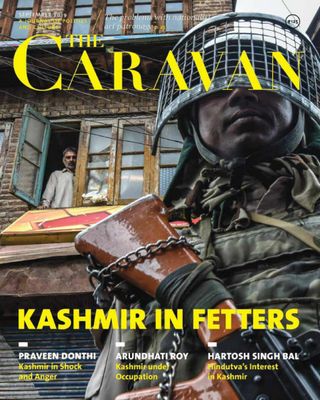
What Sri Lankan civil-war fiction tells us about the country’s political landscape

ONE DAY IN EARLY APRIL, after contemplating a shelf of local literature for an essay reflecting on the tenth anniversary of the official end of the Sri Lankan civil war, I walked through a Colombo neighbourhood, in defiance of the exceptional heat, giddy with joy to know again so comfortably the city of my childhood. The ease with which I moved through the streets was snatched away from every person in the country when churches in three locations around the island—Colombo, Negombo and Batticaloa—were attacked by suicide bombers on Easter Sunday, killing and injuring hundreds. These attacks were followed a few weeks later by anti-Muslim riots, and an elevated state of tension and distrust that persists months later. The pre-existing communalist sentiments that had preceded the attacks saw a sharp and more explicit rise.
These events spun the island’s people, within and afar, into a mix of horror at what was unfolding and a complex sense of trauma at how recognisable that horror is, and at the same time, different. Reading three recently-published novels, by authors of differing backgrounds and positionalities—Sharmila Seyyid’s Ummath (2014, English translation by Gita Subramanian, 2018), Rajith Savanadasa’s Ruins (2016) and Anuk Arudpragasam’s The Story of a Brief Marriage (2016)—set at the end of 26 years of war as events unfolded anew, I was intrigued by the foreshadowing they seemed to contain. Ummath explores women’s issues through the eyes of two cadres and an activist, Ruins looks at the frustrations of domesticity even when ordinary people can afford to look away from the conflict and The Story

このストーリーは、The Caravan の September 2019 版からのものです。
Magzter GOLD を購読すると、厳選された何千ものプレミアム記事や、10,000 以上の雑誌や新聞にアクセスできます。
すでに購読者ですか? サインイン
The Caravan からのその他のストーリー
The Caravan
ANY RESEMBLANCE TO ACTUAL EVENTS IS NOT COINCIDENTAL
INTERFAITH ROMANCE FICTION IN THE ERA OF LOVE JIHAD

31 mins
December 2025
The Caravan
Manufacturing Legitimacy
How a Washington Post columnist laundered the Sangh's violent history
7 mins
December 2025

The Caravan
DEATH of REPORTAGE
THE DISMANTLING OF OUTLOOK'S LEGACY
32 mins
December 2025

The Caravan
FOG LIGHT
Samayantar's two-and-half-decade fight against the shrinking of Hindi's world
22 mins
December 2025

The Caravan
THE FINE PRINT
ON 19 MARCH 2005, thousands came out on the streets of Udupi, in coastal Karnataka, to protest a gruesome incident that had shaken the region a week earlier.
23 mins
December 2025

The Caravan
CHARACTER BUILDING
The enduring language of Indian streets
5 mins
December 2025

The Caravan
THE CONVENIENT EVASIONS OF RAJDEEP SARDESAI
DRESSED IN A turban and white kurta pyjama, Narendra Modi sat in the passenger seat of a van crossing the Patan district of Gujarat, in September 2012. Next to him sat Rajdeep Sardesai, the founder-editor of the news channel CNN-IBN.
63 mins
December 2025

The Caravan
Ahmed Kamal Junina: “Every class we hold is a defiant refusal to surrender”
A professor in Gaza on teaching during a genocide / Conflict
11 mins
December 2025
The Caravan
Bangla Pride, Urdu Prejudice
The language wars have primed West Bengal for the RSS
8 mins
November 2025

The Caravan
THE INTERVIEW
\"The people are naked before the government but the government is opaque to them\"
16 mins
November 2025
Translate
Change font size