
Magzter GOLDで無制限に
10,000以上の雑誌、新聞、プレミアム記事に無制限にアクセスできます。
試す 金 - 無料
An Economist Goes To Shanghai
Reason magazine
|June 2017
LAST OCTOBER, I found myself in an Uber being whisked along a bank of the Huang pu River. I’d just arrived in Shanghai, and several of my students were eager to take me to see the sights. They wanted to show me the Bund (rhymes with fund). That’s the local, Persian-origin name for the promenade on which the Europeans a century ago erected a collection of 50 or so banks, trading companies, and insurance firms: the very heart of pre-Communist capitalism in China. The buildings, especially nice when illuminated at night, are done in 1920s Beaux-Arts or art deco style.

But what gobsmacked me when we got out of the car wasn’t the warmed-over continental architecture I’d been brought to admire. On the opposite side of the river rose the Pudong district. Thirty years ago Pudong was farmland, wretchedly farmed because it was collectivized. Then local Communist Party officials decided to plat it and put in water, sewerage, and a few roads—part of an experiment in opening up the economy that continues to this day. Officials were tempted to erect their own, state-financed version of the Bund in the new turf, but a professor from Hong Kong convinced them instead to offer 99-year leases and then let developers build whatever they wanted, with private finance and profit taking, doubtless with a little baksheesh on the side.
The result has been scores of immense modern skyscrapers, dwarfing the proud European buildings of the Bund. They now stretch for miles in that direction, typically 80 stories high, festooned along the river with garish advertisements and corporate logos, like the loveliness of Times Square or Piccadilly, though gigantically bigger. As I gawked, I realized that in Shanghai I was the rube (a term I later had to explain to my hosts). One colleague at Fudan University told me that when he arrived as a freshman in 1981, there were two modern skyscrapers in the city. Now there are 2,000.
Shanghai, about two-thirds of the way up the east coast, has been since the 1800s the most open place in China. It was forced open by Western governments establishing “concessions” where Europeans lived and traded in silk and opium and electric lights, out of reach of Chinese law. Aside from the so-called French Concession, which looks like a piece of Paris, Pudong and the rest of Shanghai are not beautiful, though the architectural standard is high. But taken as a whole it is immensely impressive and filled with meaning.
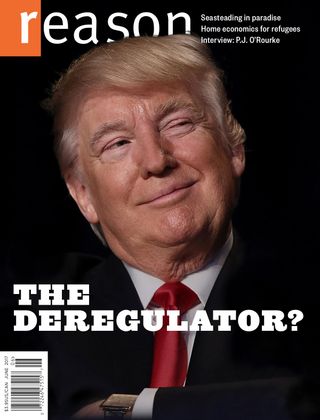

このストーリーは、Reason magazine の June 2017 版からのものです。
Magzter GOLD を購読すると、厳選された何千ものプレミアム記事や、10,000 以上の雑誌や新聞にアクセスできます。
すでに購読者ですか? サインイン
Reason magazine からのその他のストーリー

Reason magazine
A Nostalgic Read for Foreign Policy Elites
IF YOU WERE looking for a human avatar of America's unipolar moment, you couldn't do better than Michael McFaul. Picture a youthful, energetic McFaul with a newly minted Ph.D. bounding into the suddenly post-Soviet space of the early 1990s, full of bright ideas about democracy and faith in the end of history. As McFaul himself puts it, 1991 \"was a glorious moment to be a democratic, liberal, capitalist, multilateralist, and American....I was treated like a rockstar.\"

4 mins
January 2026

Reason magazine
TRUMP IS DEPORTING ENTREPRENEURS
THE TRUMP ADMINISTRATION'S MASS DEPORTATION EFFORT IS ROBBING THE U.S. OF IMMIGRANT BUSINESS OWNERS AND THEIR CONTRIBUTIONS.
9 mins
January 2026
Reason magazine
The First Information Revolution
PRINTING PRESSES AND LIBRARIANS INTERPRETED CENSORSHIP AS DAMAGE AND ROUTED AROUND IT.
11 mins
January 2026

Reason magazine
What Would Bill Buckley Do?
THE NATIONAL REVIEW FOUNDER'S FLEXIBLE APPROACH TO POLITICS DEFINED CONSERVATISM AS WE KNOW IT.
7 mins
January 2026
Reason magazine
MAHA Mandates Food Labels
BURDENSOME FOOD LABELING mandates were once the province of Democrats, who pushed for calorie count requirements on restaurant menus and insisted packaged food must feature warnings about genet- ically modified ingredients and trans fats. Now it's Republicans leading the charge- with equally foolish results.
2 mins
January 2026

Reason magazine
IS JAKE TAPPER DOOMED?
THE CNN ANCHOR ON THE WAR ON TERROR, THREATS TO FREE SPEECH, AND THE FUTURE OF MEDIA
14 mins
January 2026
Reason magazine
REPUBLICAN SOCIALISM
THE TRUMP ADMINISTRATION IS BUYING STAKES IN COMPANIES. THAT NEVER ENDS WELL.
13 mins
January 2026

Reason magazine
A Taste of Capitalism in Warsaw
WARSAW, POLAND, IS a living museum of economic systems. It's a city where concrete reliefs of stoic factory workers decorate a building that now houses a Kentucky Fried Chicken, where a Soviet-era apartment block stands beside a glass tower filled with coworking spaces.
2 mins
January 2026

Reason magazine
Robert Crumb's Roving Art and Life
IN THE SPRING of 1962, an 18-year-old Robert Crumb was beaned in the forehead by a solid glass ashtray. His mother, Bea, had hurled it at his father, Chuck, who ducked. Robert was bloodied and dazed, once again a silent and enraged witness to his family's chaos.”
5 mins
January 2026
Reason magazine
THE HOWARD ROARK OF COMICS
SPIDER-MAN CO-CREATOR STEVE DITKO WAS A GREAT EXAMPLE OF, AND DIRE WARNING TO, OBJECTIVIST POP ARTISTS.
12 mins
January 2026
Translate
Change font size