試す 金 - 無料
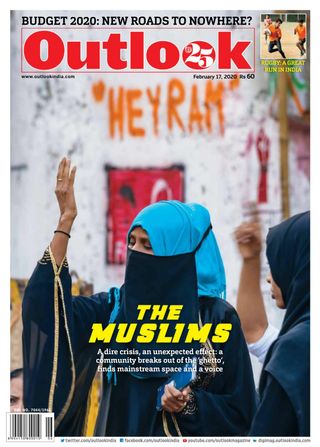
Muslims Qua MUSLIMS
Outlook
|February 17, 2020
Anti-CAA protests integrate pluralist traditions of popular religion with the idea of citizenship

ISLAM arrived in India from its classical origins in the Arabian lands via travels through Persia, Turkey, Central Asia, and Afghanistan, acquiring a variety of accretions at each stage. And, having arrived, it accrued even greater variety through its regional dispersal (Punjabi, Bengali, Hindustani, Mapilla, Gujarati, Odia…), and through a highly differentiated set of spiritual traditions of worship and scholarship that developed over some centuries. To name just a very miscellaneous few, there were figures of influence such as Shah Wali Allah of the Naqshbandi tradition located in the courtly ethos of princes, the more populist Chishti Sufi tradition consolidated by Shah Abdullah Latif Bhittai, Bulleh Shah, and the poets Mir and Dard, the reformist strain of Sir Syed Ahmad Khan; Chiragh Ali, the Shia thinker Ameer Ali, the novelist Nazir Ahmad, Shibli Nomani of the Ndwatul Ulema, the famous Deoband school providing traditional learning, the even more orthodox Al-i-Hadith school favouring strict Hanafilaw, down to the more relaxed Barelwi tradition stressing very local customary practices, the Ahmadi yyas who claimed that their leader Mirza Ghulam Ahmad was all at once the Muslim Mahdi, the Christian Messiah and the avatar of Krishna, and in the 20th century the poet Muhammad Iqbal and the refined and learned Maulana Azad, representing in the last few decades of his life the ‘composite culture’ of Hindus and Muslims.
I begin with this remarkable accumulation of accretions that characterise Indian Islam not only to point out what is often said—that Islam is many things in India, not one—but also to point to the vast conceptual distance of the

このストーリーは、Outlook の February 17, 2020 版からのものです。
Magzter GOLD を購読すると、厳選された何千ものプレミアム記事や、10,000 以上の雑誌や新聞にアクセスできます。
すでに購読者ですか? サインイン
Outlook からのその他のストーリー
Outlook
Turbulence in Tehran
To ignore or lampoon the attempts in Iran against the rule of clerics shrinks the space for the anti-imperialist Left to challenge other political ideologies, such as Hindutva

5 mins
March 21, 2026
Outlook
Not in Our Name
HE should have first corrected his own vices and then given us advice”.
3 mins
March 21, 2026
Outlook
Epic Faux Pas
For Iran, survival is victory. The martyrdom of Khamenei has had a rallying effect, and its strategy is built on domestic civil-military endurance and regional-global deterrence
6 mins
March 21, 2026

Outlook
'Winter Will One Day be Past'
This book is a true testament of friendship and an act of solidarity
4 mins
March 21, 2026
Outlook
‘Nolite Te Bastardes Carborundorum (Don't let the bastards grind you down)
\"There is more than one kind of freedom,\" said Aunt Lydia. \"Freedom to and freedom from.
4 mins
March 21, 2026

Outlook
Zan. Zendegi. Azadi
Are Trump and Netanyahu really interested in liberating Iranian women through this war?
5 mins
March 21, 2026
Outlook
Bruno ki Betiyaan
Whether future regimes sustain, reshape, or compete with Bihar's maternal welfare architecture will determine how deeply Nitish Kumar's political legacy shapes the state's democratic future
4 mins
March 21, 2026
Outlook
Capitalism Redux
The Global South must learn from the West Asian crisis that the persistence of neoliberalism alongside hyper-nationalism leads to brutality and genocidal war
4 mins
March 21, 2026
Outlook
The JNU Files
The immediate backdrop to the recent showdown at Jawaharlal Nehru University lay in earlier tensions
7 mins
March 21, 2026

Outlook
What is Trump's Endgame?
The Iran war looks like a high-stakes attempt by the US and Israel to reshape the balance of power in West Asia
6 mins
March 21, 2026
Translate
Change font size