
Magzter GOLDで無制限に
10,000以上の雑誌、新聞、プレミアム記事に無制限にアクセスできます。
試す 金 - 無料
Comprehensive National Power
Outlook
|May 15, 2017
India needs a strategic effort to understand that it is no longer competing with China, but seeking to cope with an increasing asymmetry of power

IT is no secret that there’s a delay in India’s current cycle of military modernisation. Ask the services and they will vaguely claim that the cycle will be completed by 2022 or maybe 2027. The effort is to induct the contemporary range of armoured vehicles, artillery, fighter jets, submarines, frigates and so on. Given the decades taken to achieve this, these systems will almost immediately become obsolete and another delayed cycle will begin.
As long as an indigent Pakistan was the principal adversary, this caused no big worry. But we now increasingly confront a risen China, whose plans work on schedule, and whose modernisation is relentlessly moving from copying western design and concepts towards leapfrogging to become technology leaders.
In recent years, China has systematically built up its military, and also undertaken a deep reorganisation of its structure. This is aimed at creating a force that, as Xi Jinping is never tired of repeating, is loyal to the Communist Party of China and capable of fighting and winning wars. The reorganisation has led to an integrated military divided into geographical theatre commands mimicking in many ways the organisation of its principal adversary: the United States.
The modernisation is top to bottom—it begins with the nuclear forces, the bedrock of Beijing’s status as a world power, and goes right down to the maritime militias that are used to swamp fishing grounds in the South China Sea. The Chinese are simultaneously aiming to deny the US access to its mainland through the socalled A2/AD (antiaccess area denial) syst ems, and at the same time organising their own forces for greater regional and even extraregional reach.
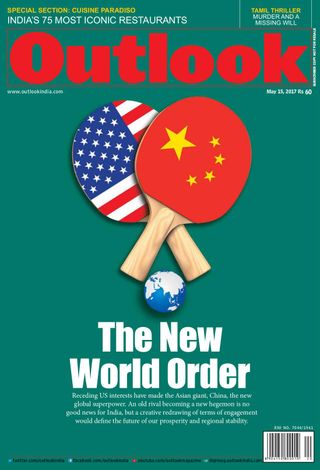

このストーリーは、Outlook の May 15, 2017 版からのものです。
Magzter GOLD を購読すると、厳選された何千ものプレミアム記事や、10,000 以上の雑誌や新聞にアクセスできます。
すでに購読者ですか? サインイン
Outlook からのその他のストーリー

Outlook
'Why GDP Growth Doesn't Always Translate Into Votes'
The recent election results have once again shown that economic growth alone does not guarantee electoral victory.

3 mins
June 06, 2026

Outlook
Lights, Camera, Othering
The establishment of Israel has been accompanied by a national cinema devoted to negating and erasing the Palestinian Other
5 mins
June 06, 2026

Outlook
Goodbye to All That
Booker-winning British author Julian Barnes' Departure(s) is a unique hybrid work: playful, philosophical, whimsical
4 mins
June 06, 2026

Outlook
Collapse of Trust
As the NEET-UG 2026 paper leak forced the cancellation of India’s biggest medical entrance exam, more than 22 lakh aspirants find themselves trapped in uncertainty
11 mins
June 06, 2026

Outlook
NO LONGER A TWELFTH MAN
Bihar cricket, which has languished in the shadows for long, is all set to improve its strike rate, thanks to Vaibhav Sooryavanshi, the new Bihari kid on the block
5 mins
June 06, 2026

Outlook
BLAZE OF GLORY
The challenges of being a celebrity cricketer at a young age can be tough to handle
5 mins
June 06, 2026

Outlook
THE SWASHBUCKLERS
A new generation of fearless stars is emerging and finding its feet at the very top of an extremely competitive cricketing environment
5 mins
June 06, 2026

Outlook
THE TEEN TORNAD
At the age of 15, Vaibhav Sooryavanshi is already a cricketing legend
10 mins
June 06, 2026

Outlook
A Journey to Remember
The prerecorded message crackled over the din in the compartment: ‘Welcome to the Shatabdi Express.
4 mins
June 06, 2026

Outlook
Crossing Borders
Ruth Martin is the translator of German-Iranian author Shida Bazyar’s novel The Nights are Quiet in Tehran (originally written in German), which has been shortlisted for the 2026 International Booker Prize.
4 mins
June 06, 2026
Translate
Change font size