試す 金 - 無料
Need For A Supportive Eco-system For The Defence Industry
Geopolitics
|August 2018
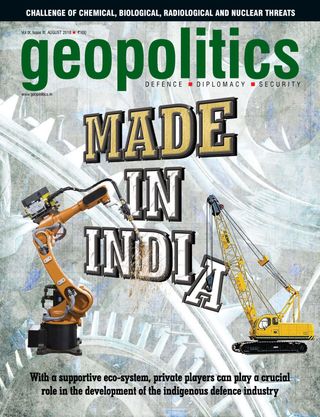
While indigenous industry must be given preference over imports, local products should be competitively priced because the defence budget cannot be made to sustain and bankroll an inefficient local production regime. Unless an indigenous product is priced attractively with a developed eco-system, mission ‘Make in India’ will remain a pipe dream, argues MRINAL SUMAN

In a recent response to a request for 83 Tejas Mark1A fighter jets from the Ministry of Defence (MoD), Hindustan Aeronautics Limited (HAL) has reportedly demanded ₹463 crore per jet. The unexpectedly hefty price tag has sent shock waves of incredulity through the corridors of MoD and the Air Headquarters. But for the knowledgeable, the exorbitant price tag is no surprise.
All public sector enterprises are notorious for ridiculously overpriced and terribly uncompetitive products. HAL is no exception. It sells indigenously assembled Sukhoi fighter to MoD for ₹415 crore while the imported ones cost ₹330 crore apiece. It means that for every hundred Sukhoi fighters procured from HAL (₹41,500 crore), the Air Force can get 126 imported fighters. When the requirement runs into hundreds of fighters, enormity of the cost penalty suffered by the defence budget can be well appreciated. Apparently, competitiveness means little to HAL.
With 41 ordnance factories, five undertakings and four shipyards, the public sector enjoys total monopoly over India’s defence industry. The products manufactured include arms, armoured vehicles, heavy vehicles, fighter aircraft, helicopters, warships, submarines, missiles, ammunition, electronic equipment, earth moving equipment, special alloys and special purpose steels. The private sector has been a peripheral player so far; its role is limited to the manufacture of sub-assemblies and components.

このストーリーは、Geopolitics の August 2018 版からのものです。
Magzter GOLD を購読すると、厳選された何千ものプレミアム記事や、10,000 以上の雑誌や新聞にアクセスできます。
すでに購読者ですか? サインイン
Geopolitics からのその他のストーリー
Geopolitics
Tata expands Morocco push with LAMV offer
After securing an order for its WhAP 8x8 armoured vehicle from the Royal Moroccan Army, Tata Advanced Systems Limited is now actively promoting its Light Armoured Multipurpose Vehicle in the same market.

1 min
February 2026
Geopolitics
Armenia eyes India's Astra Missile for Su-30SM fleet
Armenia is in advanced discussions with India to acquire the Astra beyond-visual-range air-to-air missile, signalling a deepening of defence ties between the two countries.
1 min
February 2026
Geopolitics
SUVI V1 becomes India's first Type-Certified UAV
In India's unmanned aviation sector has reached a significant regulatory milestone with Okulo Aerospace announcing that its SUVI V1 platform has received Type Certification from the Directorate General of Civil Aviation.
1 min
February 2026
Geopolitics
Swan Defence wins Oman naval training ship contract
Swan Defence and Heavy Industries has secured a defence export contract from the Government of the Sultanate of Oman for the construction and supply of an advanced naval training ship for the Royal Navy of Oman.
1 min
February 2026

Geopolitics
HAL'S 'DHRUV' BET
Hindustan Aeronautics Limited (HAL) is attempting a careful reset of the Dhruv helicopter narrative, positioning the platform simultaneously as a cornerstone of India's future civil helicopter market and as a rehabilitated workhorse returning to frontline maritime service.
2 mins
February 2026
Geopolitics
India Offers Su-30MKM Upgrade to Malaysia
India has offered a midlife modernisation package for Malaysia's fleet of 18 Sukhoi Su-30MKM fighters, marking a significant step in bilateral defence-industrial cooperation.
1 min
February 2026
Geopolitics
Astra upgrade rooted in indigenous R and D
Recent reports linking the Indian Air Force's Astra missile upgrades to Chinese PL-15 technology have been firmly dismissed by defence officials and scientists.
1 min
February 2026

Geopolitics
COMMAND OR COMPLIANCE? RECLAIMING THE SPIRIT OF MILITARY INITIATIVE
What does it truly mean to be a military leader in a democracy? It is a question sparked by the recent controversy surrounding General Manoj Naravane's memoir. While the government always has the final say, a great general shouldn't just wait for instructions; they must lead with confidence, give honest advice, and take decisive action on the battlefield. KARAN KHARAB highlights why India needs a military culture that rewards bold Initiative over hesitation and \"seeking orders.\"
8 mins
February 2026
Geopolitics
India's integrated air combat plan from Mk1A to MkIII
India's combat aviation landscape is entering a defining phase, marked by parallel developments in aircraft production and missile technology that together reflect a broader push toward operational self-reliance.
3 mins
February 2026

Geopolitics
DEFENCE BUDGET 2026-27: FOCUS ON CAPITAL ACQUISITIONS
While there is an overall increase in the latest defence budget, the statistics only tell half of the story, explains AMIT COWSHISH
11 mins
February 2026
Translate
Change font size