試す 金 - 無料
Big Challenge Of Non-Traditional Threats
Geopolitics
|August 2018
The Indian state has slowly evolved and is yet imperfect but nonetheless has viable capability to deal with low level casualties that might be caused by either a chemical, biological, radiological or nuclear attack or by a non-state actor or an incident caused either by accident or by deliberate action at a nuclear or chemical facility. There are, however, significant deficiencies in its response mechanisms that need urgent attention, writes SANJAY BADRI-MAHARAJ

India faces not only the risk of traditional nuclear attacks but also from the potential use of nuclear weapons through non-traditional means such as Chemical, Biological, Radiological and Nuclear (CBRN) attacks. This is as yet an inadequately explored area of vulnerability which could potentially be devastating. Among the threats that need to be considered include a terrorist strike using a nuclear weapon of lowyield or a so-called “dirty bomb” or even an attack involving either a nuclear or non-nuclear generated electro-magnetic pulse. Another potential method of attack could be the possible sabotage of a nuclear power plant with the potential for radioactive release.
Strictly military or retaliatory measures will not necessarily deter such attacks. In this case, a combination of active measures to detect and prevent such attacks and passive measures to deal with the impact of such attacks may have the best prospects of deterring or at the very least containing such attacks. To this end, it is important to determine how well prepared India is to respond to the impact of such attacks so as to minimise damage. Into this sphere we must assess the civil defence capabilities and emergency response systems of the Indian state.
The types of non-traditional may be broken down as follows:
1) A nuclear or non-nuclear generated electromagnetic pulse aimed at disrupting military and/ or civilian activities, networks, operations and infrastructure;
2) The use of CBRN agents by a nonstate actor aimed at creating either a mass casualty event or significant civilian fear and panic as well as disruption to society; or with the aim to stretching emergency, relief and economic resources with a view towards destabilisation of a state or to divert resources away from any military or diplomatic effort;


このストーリーは、Geopolitics の August 2018 版からのものです。
Magzter GOLD を購読すると、厳選された何千ものプレミアム記事や、10,000 以上の雑誌や新聞にアクセスできます。
すでに購読者ですか? サインイン
Geopolitics からのその他のストーリー
Geopolitics
Navy Flags Critical Engine Dependency Gap
Despite significant advances in indigenous warship construction, India's continued reliance on foreign marine propulsion systems remains a critical vulnerability in its defence framework.

1 mins
April 2026

Geopolitics
GTRE Advances Engine Testing With Su-30
India's aero-engine development programme is set to accelerate as GTRE proceeds to convert two Su-30 MKI fighters into dedicated flying testbeds, enabling real-time validation of indigenous propulsion technologies.
1 mins
April 2026
Geopolitics
Indigenous Anti-Tank Missile Nears Production Clearance
India's indigenous man-portable anti-tank guided missile is approaching final clearance for mass production following successful validation trials against moving targets.
1 min
April 2026
Geopolitics
A RE-LOOK AT INDIAN MILITARY LOGISTICS & THEATRE COMMANDS
JOSEPH P CHACKO explains why logistics systems must be integrated to be capable of seamlessly supporting modern warfare operations, which necessitate rapid, coordinated responses across multiple domains
14 mins
April 2026
Geopolitics
Defence Spending Drives Acquisition Surge
India's defence modernisation programme has entered a phase of rapid implementation, with FY 2025-26 seeing full utilisation of capital expenditure and a clear focus on addressing critical capability gaps across the armed forces.
3 mins
April 2026

Geopolitics
K9 Vajra Hits mega Indigenisation
India's India's flagship tracked artillery programme has reached a crucial turning point, with the K9 Vajra-T now achieving over 82 per cent indigenous content at the work package level, marking a fundamental shift in domestic defence manufacturing capability.
1 min
April 2026
Geopolitics
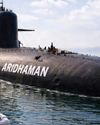
NUCLEAR SHARKS OF STEEL!
India’s third Arihant-class submarine, INS Aridhaman, was commissioned into the Indian Navy on April 3, 2026, at Visakhapatnam by Defence Minister Rajnath Singh.
2 mins
April 2026

Geopolitics
Army Eyes Tank-Launched Drone Strikes
The Indian Army is advancing a new concept to equip its main battle tanks with indigenous loitering munitions that can be deployed directly from existing 81mm smoke grenade launchers.
1 min
April 2026

Geopolitics
THE ANATOMY OF A POLARISED FRONTIER
West Bengal has changed from a longtime “Red Bastion” to one of the most hotly contested states in Indian politics.
2 mins
April 2026

Geopolitics
Navy Advances Drone-Ready Amphibious Carriers
India's next-generation amphibious warfare programme has entered a crucial -phase as the Navy advances its evaluation of four large-deck platforms designed to revolutionise expeditionary operations.
1 mins
April 2026
Translate
Change font size