試す 金 - 無料
The Limits of Computation
Philosophy Now
|February/March 2021
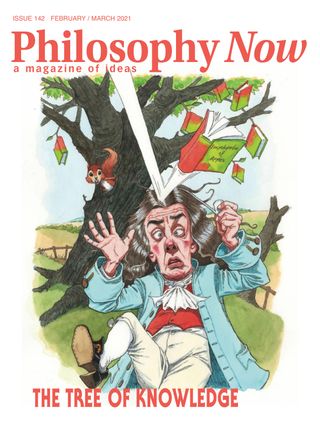
Apostolos Syropoulos goes back to BASICs to consider whether the human brain is a computer.

There is a school of thought that assumes that all intellectual problems can potentially be solved by computers [for example, see ‘The Future of Philosophy is Cyborg’, by Phil Torres in Issue 141]. However, is this really the case? Here I will try to explain why we do not know where the limits of computability are, and how this lack of knowledge affects our understanding in a number of areas.
Roughly, we can say that a computable (or solvable) problem is any problem that can be solved by a finite set of simple actions. Alternatively, we could say that a computable problem is anything that can be reduced to a mathematical equation and solved accordingly. For example, if someone has to travel to a number of towns and has to schedule her trip so that she has to go through each town only once, this is a mathematical problem. One may say that at first this does not look like a mathematical problem; but we can reduce it to, or transform it into, a mathematical problem (in topology). And if the number of towns that our pilgrim has to travel is small enough, then it is relatively easy to compute an answer. But when the number of towns becomes large enough, then it might not be possible to come up with a road map that goes through each town only once.
Although there are a number of seemingly precise definitions of ‘computability’, it is an imprecise and vague notion. Nevertheless, one can use a Turing machine to rigorously define

このストーリーは、Philosophy Now の February/March 2021 版からのものです。
Magzter GOLD を購読すると、厳選された何千ものプレミアム記事や、10,000 以上の雑誌や新聞にアクセスできます。
すでに購読者ですか? サインイン
Philosophy Now からのその他のストーリー

Philosophy Now
Bilbo Theorizes About Wellbeing
Eric Comerford overhears Bilbo and Gandalf discussing happiness.

9 mins
December 2025 / January 2026

Philosophy Now
What Women?
Marcia Yudkin remembers almost choking at Cornell
11 mins
December 2025 / January 2026

Philosophy Now
Islamic Philosophers On Tyranny
Amir Ali Maleki looks at tyranny from an Islamic perspective.
4 mins
December 2025 / January 2026

Philosophy Now
Peter Singer
The controversial Australian philosopher defends the right to choose to die on utilitarian grounds
5 mins
December 2025 / January 2026

Philosophy Now
Another Conversation with Martin Heidegger?
Raymond Tallis talks about communication problems.
7 mins
December 2025 / January 2026

Philosophy Now
Letters
When inspiration strikes, don't bottle it up. Email me at rick.lewis@philosophynow.org Keep them short and keep them coming!
17 mins
December 2025 / January 2026

Philosophy Now
The Philosophy of William Blake
Mark Vernon looks at the imaginative thinking of an imaginative artist.
9 mins
December 2025 / January 2026

Philosophy Now
Philosophical Haiku
Peering through life’s lens God in nature is deduced: The joy of being.
1 mins
December 2025 / January 2026

Philosophy Now
Philosophy Shorts
More songs about Buildings and Food' was the title of a 1978 album by the rock band Talking Heads. It was about all the things rock stars normally don't sing about. Pop songs are usually about variations on the theme of love; tracks like Rose Royce's 1976 hit 'Car Wash' are the exception. Philosophers, likewise, tend to have a narrow focus on epistemology, metaphysics and trifles like the meaning of life. But occasionally great minds stray from their turf and write about other matters, for example buildings (Martin Heidegger), food (Hobbes), tomato juice (Robert Nozick), and the weather (Lucretius and Aristotle). This series of Shorts is about these unfamiliar themes; about the things philosophers also write about.
2 mins
December 2025 / January 2026

Philosophy Now
Hedonic Treadmills in the Vale of Tears
Michael Gracey looks at how philosophers have pursued happiness.
8 mins
December 2025 / January 2026
Translate
Change font size