試す 金 - 無料
BEING AN EXCEPTIONAL TEACHER
Careers 360
|September 2020
Most engineering programmes hope to achieve what Jayashri Ravishankar does. Ravishankar, who teaches at Australia’s University of New South Wales, has found a way to keep a very large and diverse student body engaged by developing “research-led and professionally relevant” strategies that have now been adopted elsewhere. An electrical engineer with a special interest in renewable energy and micro-grids, Ravishankar earlier taught at Anna University, Tamil Nadu for a decade. In 2019, she received a citation from the Australian Awards for University Teaching for ‘Outstanding Contributions to Student Learning’. It acknowledges her as one of “Australia’s most exceptional university teachers”. She spoke to Careers360 about how engineering must be taught so that students are engaged and come out job-ready.

Q. You completed your graduate, postgraduate and doctoral studies from India. But you also went for another postgraduate programme at Royal Melbourne Institute of Technology. How did that happen?
A. I migrated to Australia with my husband in 1992, after completing my postgraduate degree at College of Engineering Guindy, Anna University. I received a scholarship from Royal Melbourne Institute of Technology, or RMIT University, and commenced my work in renewable energy integration. Although RMIT insisted that I complete my Ph.D. studies there, I chose master’s by research as I had a growing family with two kids of whom one was a newborn. In 1998 we returned to India and I continued working here till 2009. During this period, I was sponsored to undertake a part-time Ph.D. at Anna University. I completed my Ph.D. there in 2008.
Q. One of the comments in the citation describes you as a “tireless innovator”. What did you do differently?
A. When I joined UNSW in 2010, I faced different challenges compared to those in India. I was now teaching large advanced courses with a diverse mix of 150-250 local and international students. Delivering abstract engineering concepts through traditional face-to-face lectures in large theatres while also trying to cater to the diversity of students with a mix of cultural backgrounds and assumed knowledge meant students quickly became disengaged and had little interaction with their peers. This, I believe, prevented them from undertaking deeper learning, which in turn affected their employability.
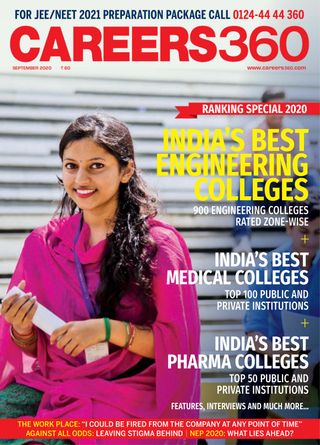

このストーリーは、Careers 360 の September 2020 版からのものです。
Magzter GOLD を購読すると、厳選された何千ものプレミアム記事や、10,000 以上の雑誌や新聞にアクセスできます。
すでに購読者ですか? サインイン
Careers 360 からのその他のストーリー

Careers 360
Women dominate NEET, not AIIMS
Even as women account for 58% of NEET qualifiers, AIIMS campuses continue to see heavily skewed gender ratio, reveals NIRF data; experts point to coaching patterns, emphasis on physics as contributing factors

3 mins
June 2026

Careers 360
Where medicine meets technology
IITs are introducing undergraduate programmes in biomedical engineering and allied fields to address the rising demand for indigenous medical devices and fill workforce gaps
5 mins
June 2026

Careers 360
THE COUNTRY'S BEST in medicine, dentistry, AYUSH, pharma
100 medical, 50 dental, 60 pharmaceutical colleges and leading AYUSH courses and colleges ranked
4 mins
June 2026
Careers 360
Becoming a 'major university' for the hills
Darjeeling Hills University is gradually shaping up into a major educational institution for the hills, with plans for a permanent campus at Jogighat in Mongpu and the introduction of employment-oriented and region-specific courses in the coming years. Debasis Dutta, controller of examinations, speaks to Pritha Roy Choudhury about the university’s functioning, future vision, infrastructure challenges, academic expansion, employment-focused initiatives and the overall goal of becoming a leading institution in the region. Edited excerpts:
4 mins
June 2026

Careers 360
A technical university failing on technicalities
A decade after Maharashtra made Dr Babasaheb Ambedkar Technological University the sole affiliating body for technical colleges, students are still waiting for their marksheets — and the state, for a fix
10 mins
June 2026

Careers 360
Paid on paper, broke in practice
NEET exam standardises entry into MBBS, but what students earn during internship remains a patchwork of state whims and private medical college manipulation; a Supreme Court order and NMC warnings have done little to nothing
4 mins
June 2026
Careers 360
'NIPERS are closing education-industry gap'
The National Institutes of Pharmaceutical Education and Research (NIPER) are revising their curriculum and launching programmes to better align pharma education with industry, both domestic and international. Shailendra Saraf, in charge of both NIPER Ahmedabad and NIPER Hyderabad, speaks to Sheena Sachdeva about the establishment of pharma hubs, centers of excellence, new courses, jobs and more. Edited excerpts:
4 mins
June 2026

Careers 360
Pharma college boom going bust?
With over 16,000 seats lying vacant and an alleged bribery scam with the national regulator, the unchecked expansion of Maharashtra’s pharmacy colleges is now threatening the livelihoods of graduates
7 mins
June 2026

Careers 360
The problem with cluster universities
Cluster university schemes, central and state, have found few takers. Funding strain, policy confusion, resource-sharing challenges have slowed implementation
4 mins
June 2026
Careers 360
‘Medical education will be tech-enabled, competency-driven & patient-centric'
SRM Medical College Hospital and Research Centre, Kattankulathur, is expanding its focus on interdisciplinary learning, AI-integrated healthcare education and research-driven medical training. Dr Jayanthi R, dean (medical), speaks to K Nitika Shivani about the institution’s leveraging its multidisciplinary university ecosystem to expose medical students to areas such as artificial intelligence, biomedical engineering, data science and translational research alongside conventional clinical education. SRM Medical College is also encouraging undergraduate students to participate in funded research, community health programmes and healthcare innovation initiatives. Edited excerpts from the conversation:
2 mins
June 2026
Translate
Change font size