
Magzter GOLDで無制限に
10,000以上の雑誌、新聞、プレミアム記事に無制限にアクセスできます。
試す 金 - 無料
How Safe Is Your Plane?
BBC Knowledge
|December 2016
So many of us take to the skies so often. Neil Ashton looks at the rigorous tests that planes undergo to ensure flying remains one of the safest modes of transport.

Air travel is more popular than ever. Although aeroplanes have made it easier for us to explore the world, nearly one in three of us claims to be anxious or fearful of f lying.
Is this fear justified?
US statistics taken from between 2000 and 2009 show that car drivers or passengers suffer 7.3 deaths per billion miles. In contrast, air travel comes in at just 0.07 deaths per billion passenger miles. Of course, statistics can’t cure someone’s fear of f lying, but they do prove that it’s one of the safest ways to get from A to B. This safety is thanks to the testing that every single part of the aircraft has to go through before it’s allowed to undertake its first f light.
IN THE FREEZER
While passengers get to enjoy the comfort of air conditioning, the engines have to be able to cope with temperatures as low as -55°C during cruise conditions. Here, one of the latest engines is being pushed to its limits at a General electric testing facility in Winnipeg, Canada. It’s being blasted with icy water from hundreds of nozzles at sub-zero temperatures to check that it will maintain power in cold environments. temperature tests are important to the airlines because they want to make sure that their planes can operate in as many environments as possible. each time they have to ground an aircraft because of bad weather, they lose money.
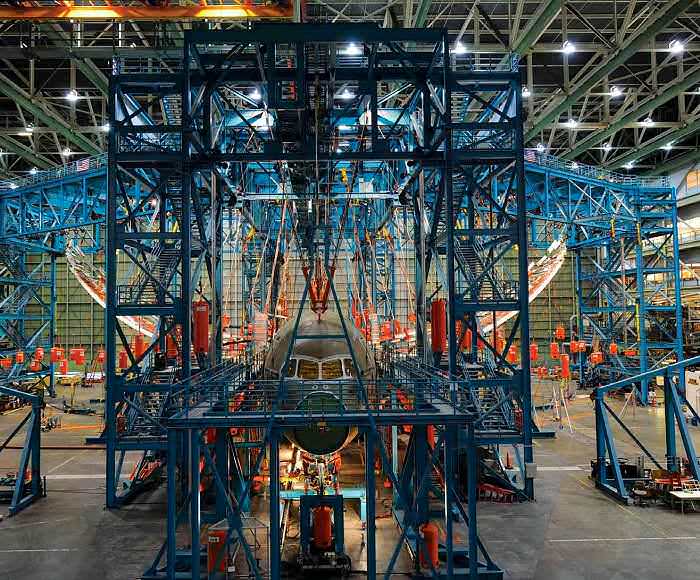
TURBULENT TIMES

このストーリーは、BBC Knowledge の December 2016 版からのものです。
Magzter GOLD を購読すると、厳選された何千ものプレミアム記事や、10,000 以上の雑誌や新聞にアクセスできます。
すでに購読者ですか? サインイン
BBC Knowledge からのその他のストーリー

BBC Knowledge
Are We Close To Making Our Home Away From Earth?
Our exploration of the cosmos is hampered by our bodies and minds, which struggle in space. So could we ever overcome our Biology and settle among the stars?

10 mins
August 2017

BBC Knowledge
The Viruses That Made Us Human
Viruses give us infections, from the common cold to Ebola and Aids. But new research shows that they may also have played a key role in shaping the evolution of homo sapiens.
9 mins
June 2017

BBC Knowledge
Can You Supercharge Your Brain?
Your brain is the finely-tuned machine that controls all your actions and emotions, so it makes sense to keep it well-oiled. But, asks Rita Carter, are there any scientifically proven methods to ensure it works better for longer?
7 mins
June 2017

BBC Knowledge
First Self- Balancing Robot
This robot is the Planar Elliptical Runner (PER).
1 min
August 2017

BBC Knowledge
Is Social Media Making You Anti-Social?
Many of us have experienced the ways in which social media has changed the online world. But should we be worried about it altering our behaviour too?
8 mins
August 2017

BBC Knowledge
What You Need To Know Before You Get In A Driverless Car
Autonomous vehicles can take much of the danger out of driving, but they also present us with new problems to solve. So what needs to be figured out before the technology gets the green light?
7 mins
August 2017

BBC Knowledge
Saadat Hasan Manto
Saadat Hasan Manto felt deeply and wrote strongly; his work invigorates and disturbs.
7 mins
August 2017

BBC Knowledge
King Of The Mountains
Picture a primate that grazes like a cow, climbs cliffs like a mountain goat and forms groups as big as shoals of fish. Noah Snyder-Mackler introduces Ethiopia’s gelada.
7 mins
December 2016

BBC Knowledge
Is Technology Changing Our Brains?
We increasingly rely on social media to talk to friends, GPS to navigate and the web for information. But, asks Jo Carlowe, is that wise?
10 mins
February 2017

BBC Knowledge
Are You a Genetic Superhero?
Recent research has revealed a handful of ‘superheroes’ walking among us, whose DNA gifts them with resistance against serious diseases. Now, as Kat Amey observes, just have to find them…
8 mins
February 2017
Translate
Change font size