
Magzter GOLDで無制限に
10,000以上の雑誌、新聞、プレミアム記事に無制限にアクセスできます。
試す 金 - 無料
Keeping Game Safe From Mineral Deficiencies And Poisoning
Stockfarm
|January 2021
Game kept in intensive systems and that are moved to larger camps or open farms, can suffer from mineral deficiencies.

Since game prices are not what they used to be, it is becoming harder to afford the expensive feed required for intensive systems. At the same time, some animals are genetically so superior that it would be unwise to get rid of them.
Many of the animals are moved to larger camps or even open farms where natural grazing and edible shrubs make up a much larger portion of their diet. To support animal performance, farmers should make use of the expert advice of nutritionists to analyse the estimated nutritional value of the veld, and to adjust licks and supplementation in such a way that mineral deficiencies are supplemented correctly.
Poisonous plants
Poisoning due to plants that are unknown to animals and/or which they would not eat in the wild, is another risk that game farmers must consider when game can no longer migrate as they did in the wild. When grazing is scarce, such plants become very attractive to animals, often with disastrous consequences.
Dr Johan Steyl from the Faculty of Veterinary Science at the University of Pretoria says there is a lot of information available pertaining to the complex action and interaction of minerals in ruminants, but little is known about mineral-related problems in game.
The biological and chemical form in which the minerals occur also affects their bioavailability. This means that the mineral analysis indicated on the bag of feed is not necessarily available to the animal for which it is intended. This makes it very difficult to identify the main cause of a mineral imbalance.
Copper
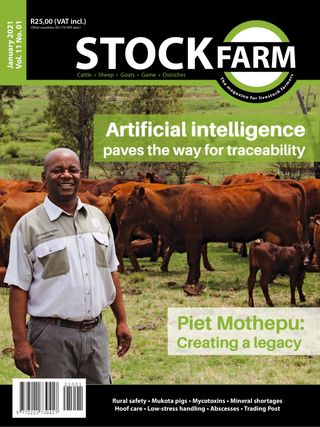

このストーリーは、Stockfarm の January 2021 版からのものです。
Magzter GOLD を購読すると、厳選された何千ものプレミアム記事や、10,000 以上の雑誌や新聞にアクセスできます。
すでに購読者ですか? サインイン
Stockfarm からのその他のストーリー
Stockfarm
Tackle mastitis in dairy COWS
Mastitis is one of the most significant challenges in the dairy industry, reducing milk yield and overall profitability.

5 mins
February 2026
Stockfarm
Ewe nutrition for a healthy lamb crop
Producers widely acknowledge that the success of any sheep enterprise depends heavily on the potential and management of the farm’s female animals.
4 mins
February 2026
Stockfarm
Does chop length really matter?
Chop length is a critical factor in producing successful silage. Mistakes made during this initial stage can have lasting, irreparable effects.
2 mins
February 2026
Stockfarm
Place these ticks on your autumn watch list
Heavy tick infestations and an increase in the incidence of tickborne diseases such as redwater, gallsickness, and heartwater remain a serious challenge for livestock producers in South Africa, particularly when environmental conditions favour these parasites. Effective control strategies and sound management practices are therefore essential.
2 mins
February 2026
Stockfarm
The grazing paradox: Towards better data
Producers are often under pressure to reassess their grazing strategies and consider dramatic management changes aimed at sustainability.
5 mins
February 2026

Stockfarm
Shearer training for improved performance
Lungani Maqakalana has sheep shearing in his blood. Both his father and uncle were shearers, and from a young age he aspired to follow in their footsteps.
4 mins
February 2026
Stockfarm
Misuse of an employer's property
An employer's property is an integral part of the business infrastructure. Any loss, damage, accidental misuse, intentional misuse, or waste of this property constitutes serious misconduct, placing unnecessary strain on the employer to repair or replace it.
2 mins
February 2026
Stockfarm
The dynamics of the South African lucerne hay industry: Grading and quality
In the January issue of Stockfarm, part one of this series explored the role of lucerne hay in South Africa's animal feed industry.
5 mins
February 2026
Stockfarm
Functional efficiency in small stock
Functional efficiency, the combination of structural soundness, adaptability, mobility, mothering ability, and reproductive capability, is as important as genetic merit for economically important, measurable traits.
3 mins
February 2026
Stockfarm
Managing breeding stock and unsold weaner calves
Persistent outbreaks of foot-and-mouth disease (FMD) have dealt a severe blow to the South African cattle industry.
1 mins
February 2026
Translate
Change font size