試す 金 - 無料
Where To Invest Now?
Outlook Money
|July 2017
The current stock market levels are synonymous with the old adage— many investors burn their fingers by investing when the markets are at an all time high. The S&P BSE Sensex has gained about 18 per cent in the first half of the year and is expected to go up a lot higher. However, the noise around the index levels being at an all time high is purely based on absolute figures. Let us understand this with an example—just the way ₹10,000 today will not have the same purchasing power ten years hence (it did not have the same purchasing power ten years ago), the constant mention to indices hitting all-time highs is an incorrect expression of gauging the real worth of the markets.

Smart investors, who have tracked the past, are not highly perturbed by the rising markets. Going by the average inflow of ₹4,000 crore a month into equity SIPs, there is no holding back investors from participating in this market rally. “I don’t see any risk at these levels and feel my investments are safe enough,” says Mumbai-based Minu Pandit. A doctor, she is pretty certain about her investments as she has predominantly invested in equities through mutual funds. “It is easy and convenient to invest through mutual funds than directly invest in stocks,” she explains.
She is not alone. Scores of investors in recent years have benefited from the wave of systematic investment plans (SIP) of mutual funds, which have changed the way in which small investors are participating in the stock markets. Regulatory changes and the reducing gains from investments in physical assets have made people view investments in stock markets through equities as an option that they just cannot ignore anymore.
Rising tide
In spite of the perceived impact of demonetisation, the macro indicators do look favourable for the overall health of the economy. The government is working on several developmental projects which are showing results in some sectors, even as others are turning around. The RBI is obsessively working towards checking inflation and there is surplus liquidity in the market, which is visible in the manner in which market participants are demonstrating their conviction in India’s growth story, which in turn is visible in the performance of the equity markets.
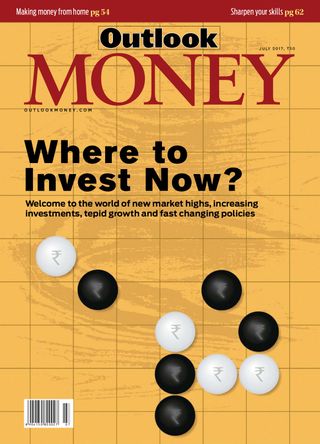

このストーリーは、Outlook Money の July 2017 版からのものです。
Magzter GOLD を購読すると、厳選された何千ものプレミアム記事や、10,000 以上の雑誌や新聞にアクセスできます。
すでに購読者ですか? サインイン
Outlook Money からのその他のストーリー
Outlook Money
How Budget Touches Your Life
There are two perspectives on how does the Union Budget impact us. One is that as a citizen, macro developments are relevant for us, as macro percolates in some way to make a micro impact.

4 mins
February 2026
Outlook Money
SIP Returns Beat Bank FDs' Over Long Term
I am 22 years old and have just started working. I want to invI am 22 years old and have just started working.
2 mins
February 2026

Outlook Money
Thematic Investing Without The Hype
How to turn trends into portfolios using discipline valuation checks and sensible sizing for investors
2 mins
February 2026

Outlook Money
Stop Raiding Your Long Term SIP
Short term goals need stability long term goals need equity. Time is what changes risk
2 mins
February 2026

Outlook Money
SIP VS SIP + Buying Market Dips: A Reality Check
It's common to assume that buying during market dips can enhance returns. We ran numbers to see what happens if you invest in a plain SIP and compared it with scenarios when you topped up during market dips. The results will shock you
7 mins
February 2026

Outlook Money
India's Evolving Equity Markets And The Design Of Flexi Cap Funds
India's market leadership rotates between large, mid and small caps, and flexi cap funds are built to rotate with it.
2 mins
February 2026

Outlook Money
Base Expense Ratio
The Securities and Exchange Board of India (Sebi) has changed how mutual fund expenses are disclosed by introducing the base expense ratio (BER). Sebi approved the change on December 17, 2025, under the new Sebi (Mutual Funds) Regulations, 2026. Previously, investors kept a track of their mutual fund expenses through the total expense ratio (TER), which combined fund management fees with taxes and statutory charges, such as goods and services tax (GST) and securities transactions tax (STT). This made it difficult for investors to see what fund houses actually charged. In contrast, BER includes only the core expenses of running a mutual fund scheme, and statutory charges are disclosed separately.
2 mins
February 2026

Outlook Money
Top-Up Solution To Piling Claims
Base policies are proving to be inadequate because of rising medical costs and premiums. To ensure a large coverage at affordable rates, they need to be combined with a super top-up insurance that takes care of rising family claims
7 mins
February 2026

Outlook Money
Retirement Is Not About Slowing Down
At 63, Murli Sundrani doesn't come across as the typical retired gentleman. He treks, goes on world tours, is pursuing multiple courses, and is financially savvy, too
5 mins
February 2026

Outlook Money
'Ideal Retirement' Lasts Only A Couple Of Years, Says Riley Moynes
Retirement is not just about cavorting on the beach with a glass of wine, but also about coming to terms with loss and trauma, and then re-picking yourself to find a purpose, believes Riley Moynes, a former public educator and financial advisor and now TED speaker, podcaster and author of many books, including The Four Phases Of Retirement. In an interview with Nidhi Sinha, Editor, Outlook Money, as part of the Wealth Wizards series, he talks about the challenges seniors face as they stare at around 30 years of retirement years
8 mins
February 2026
Translate
Change font size