試す 金 - 無料
Can Fintech Companies Replace Traditional Banking In India?
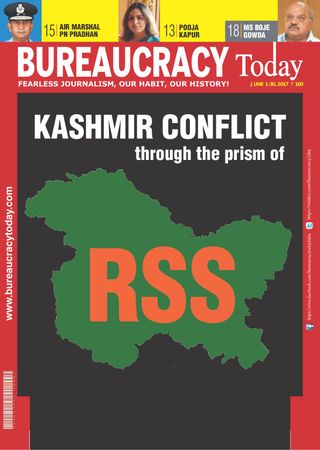
Bureaucracy Today
|June 1 - 31, 2017
This is one of the most exciting times for Indian banking and financial services industries. FinTech or financial technology companies have emerged as a new crop of firms which have a high growth potential and many opportunities for disruptive innovation. They can complement the traditional banking services and help in financial inclusion. In some quarters, they are seen as competition to the classical banks also. FinTech, a very trendy industry for start-ups, has the potential to take away 4.7 billion dollar of revenue from traditional financial services, according to a US-based Finance firm, Goldman Sachs. FinTech has evolved from startups that want to take on and compete with incumbents to a broader ecosystem of different businesses that are, in many cases, looking for partnerships. Bureaucracy Today analyses the pros and cons of this new financial phenomenon.

A CII-PwC report titled Inclusion 2.0: Leveraging technology disruptions to realise India’s digital economy highlights the role and importance of FinTech companies which are now enabling the mass adoption of technology by collaborating with various traditional banking and non-banking players and ensuring that services reach the rural strata of society quickly and efficiently. Such companies have been termed disruptors in the financial services space.
The scope of FinTech companies to co-exist with the traditional financial institutions (FIs) is immense since Indian banks face very structural challenges.
Inadequate infrastructure: People in the rural areas of India still have to travel miles to access a banking interface. Although ours is a vast country, it has only 2.3 lakh ATMs and 14 lakh point-of-sale terminals which are almost half the number of such facilities in other developing countries and one-fourth of that in the developed countries.
Financial literacy: According to a survey by Standard & Poor’s Financial Services LLC7, 76% of the Indian adults are unable to understand key financial concepts. Lack of adequate knowledge results in confusion, apprehensions and obstacles which prevent people from availing themselves of the many banking products and services.
Consumer security and fraud:

このストーリーは、Bureaucracy Today の June 1 - 31, 2017 版からのものです。
Magzter GOLD を購読すると、厳選された何千ものプレミアム記事や、10,000 以上の雑誌や新聞にアクセスできます。
すでに購読者ですか? サインイン
Bureaucracy Today からのその他のストーリー

Bureaucracy Today
Modi's ' make in India' & What Is Going Wrong With PSUs?
The year was 1930. The Great Depression had hit hard the world’s wealthiest and the mightiest nation, the United States of America.

9 mins
September 01 2016

Bureaucracy Today
After the Congress roadshow...
Congress President Sonia Gandhi’s Varanasi roadshow in August was important for more than one reason for both the party and its leaders. Banished from Uttar Pradesh governance for 27 long years, the Congress has been praying for an opportunity and a window that could start the process of its recovery and being relevant in State Assembly elections in 2017. A Bureaucracy Today report.
3 mins
September 01 2016

Bureaucracy Today
The Evolution of Fashion Retail in India
Organised retailing in India registered remarkable growth in the last decade owing to favourable demographics, growing consumer aspirations and brand consciousness. Correspondingly, the fashion category has a profound transformation over the years in terms of types and positioning of brands, formats, products and emergence of new players. The depth and variety of fashion brands took a quantum jump in shopping malls across all the sub-categories, including apparels, footwear, bags and accessories. Fashion retailers not only expanded in metros but also moved into Tier II and III cities as organised retail spaces started mushrooming in smaller towns.
3 mins
September 01 2016

Bureaucracy Today
Of Legal Quagmire and an Honest Bureaucrat
On august 16, 2016, the news of former coal secretary Hc Gupta, an accused in several coal scam cases, seeking to withdraw his personal bond to secure bail due to financial difficulties shook the entire bureaucracy. a week later, on august 27, he withdrew his petition seeking to take back his bail bond and agreed to “follow the normal legal procedure and practices”. observers opine that Gupta’s case is not just an incident of an “honest officer” finding himself unable to bear the huge cost of fighting litigation but it reflects “the deep-rooted malaise” in the indian administrative system which gives no protection to upright bureaucrats who are left all alone to fend for themselves for restoring their dignity and reputation. the incident, bureaucrats say, will demoralise officers to take any decision which will be detrimental to national interest. a Bureaucracy Today report.
3 mins
September 01 2016

bureaucracy today
how much protection is available to judges and magistrates?
after the recent supreme court observation that no public servant is entitled for the protective umbrella of section 197 of the code of criminal procedure, it is being debated whether this ruling applies equally to judges of the district courts or other subordinate courts in india.
3 mins
october 1-15,2016

bureaucracy today
five trends that will reshape the indian real estate market
among the many different factors influencing the way real estate is developed, transacted and used in india, there are five big major emerging trends that have both real-time and long-term significance.
4 mins
october 1-15,2016

Bureaucracy Today
Kill 19th Century Bureaucracy To Keep India Alive
On Independence Day this year, Indians heard Prime Minister Narendra Modi saying that his Government’s motto “is to reform, perform and transform”. On September 1, the US- headquartered think-tank, Carnegie Endowment for International Peace, noted: “India’s economy has grown rapidly in recent years, but the country’s bureaucratic quality is widely perceived to be either stagnant or in decline.” I think it is time to relook at overhauling the bureaucracy if we wish to realize the vision of Modi’s idea of India. Our country needs speed, efficiency and effectiveness in its entire chain of command. This is the prerequisite for realizing the vision of the greatest statesman of India.
4 mins
October 16-31, 2016

Bureaucracy Today
A Visit To Pakistan
A retired Indian Revenue Service officer, SK Goyal, reminisces here about his visit to Pakistan way back in 1978 and talks about the complex realities of the ties between the two nations.
3 mins
October 16-31, 2016

Bureaucracy Today
The man Behind the Successful Crackdown on Black Money Syndicate
Taking India a step closer towards making it a fully tax-compliant nation and unravelling the thick layers of the tax evasion circle, an Indian revenue Service officer, Dhruva Purari Singh, took upon himself the task of conducting a project based investigation under which he collected the database of money launderers, identified bogus companies and conducted a nationwide search to turn the “income Disclosure Scheme, 2016” into a grand success. While the nation was aware as to how Prime Minister Narendra Modi cracked a whip on tax defaulters, not many Indians knew about the intricacies of the undertaking by Dhruva Purari which makes it all the more pertinent to put him on the Cover Page of Bureaucracy Today.
6 mins
November 01 2016

Bureaucracy Today
India As An Oyster Of Global Dairy Industry
At present India is the largest milk producing and consuming country in the world with a compounded annual growth rate of 5%. The Government has been implementing the National Dairy Plan Phase I (201217). Its focus is on the development of the dairy industry for increasing its productivity, improving the village level milk procurement system and giving greater access to markets. However, it is also time for private sector players to provide extension services to farmers.
3 mins
November 01 2016
Translate
Change font size