試す 金 - 無料
Harnessing Science To Open More International Markets For SA Citrus
Farmer's Weekly
|July 27, 2018
The economic viability of Southern Africa’s citrus industry relies mostly on exports. Dr Vaughan Hattingh, CEO of Citrus Research International, says scientific research and development are essential to ensure that international markets remain open to Southern African citrus, conditions of access are optimised, and new markets become available. Lloyd Philips reports.

Southern Africa’s citrus industry, encompassing approximately 1 400 exporting growers, exports fresh fruit to the value of about R18 billion annually. This makes citrus one of the region’s top fresh produce export commodities by volume and value. In fact, after Spain, Southern Africa and Turkey compete for the position of the world’s second-largest citrus exporter in terms of volume.
Looking at the total areas planted to the major citrus varieties grown commercially in Southern Africa, Valencia leads the way at 37% (28 435ha), followed by navel at 21% (16 190ha), soft citrus (mandarins) at 17% (13 256ha), lemons and limes at 15% (11 909ha), and grapefruit at 10% (7 886ha).
“Compared with many other agricultural commodities grown in Southern Africa, the total of 77 676ha planted to commercial citrus is relatively small. But the region’s citrus production is highly intensive in terms of input, yield and economic return,” says Dr Vaughan Hattingh, CEO of Citrus Research International.
CITRUS PRODUCTION AND PRICE TRENDS
According to Hattingh, older Valencia orange varieties have traditionally been used for juicing, but newer Valencia varieties are now better suited for fresh consumption. Navel, especially on international markets, remains popular as a freshly consumed fruit.
While the volume of Southern Africa’s annual orange exports has remained fairly stable (between 900 000t and 1,1 million tons) over the past decade, the gross rand value per ton of exports has climbed significantly from approximately R3 400/t in 2008 to nearly R9 000/t in 2017.
“Soft citrus is seen as a more modern product,” Hattingh says. “It’s popular among consumers because it’s easy to peel and eat fresh, and has a flavour that’s attractive to children.
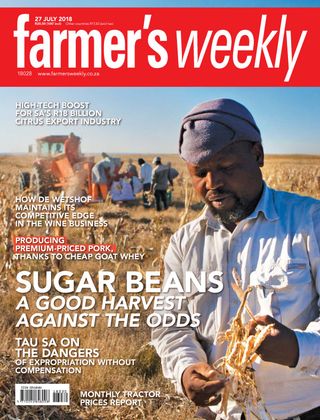

このストーリーは、Farmer's Weekly の July 27, 2018 版からのものです。
Magzter GOLD を購読すると、厳選された何千ものプレミアム記事や、10,000 以上の雑誌や新聞にアクセスできます。
すでに購読者ですか? サインイン
Farmer's Weekly からのその他のストーリー
Farmer's Weekly
Cash flow budgets: keeping farmers in control of liquidity, risk, and their survival
Profit doesn't guarantee a farm's survival - cash does. Cobus du Plessis explains why cash flow budgets are one of the most important yet underused financial tools on South African farms.

5 mins
February 27 - March 06, 2026

Farmer's Weekly
The toast of the Navy
The incredible story of the World War II-era Great Dane dog Nuisance being enlisted in the Royal Navy is well documented. Graham Jooste shared some entertaining anecdotes involving the canine shipmate.
6 mins
February 27 - March 06, 2026
Farmer's Weekly
Healthier soils deter destructive locusts
Locust swarms remain a serious global threat, capable of devastating crops, livelihoods and local economies across vast regions.
1 min
February 27 - March 06, 2026
Farmer's Weekly
Wheat crisis dominates Grain SA regional meetings
As the ongoing wheat crisis continues to erode producers' margins, emotions ran high at Grain SA's regional meeting in Moorreesburg in the Western Cape.
2 mins
February 27 - March 06, 2026

Farmer's Weekly
A FARMER'S EXPERIENCE
Street Wallet has been a game-changer for Mario Athanasopoulos, hydroponic production consultant and owner of Green City Farms.
1 mins
February 27 - March 06, 2026

Farmer's Weekly
Kesieberg Merino Stud Production Sale
The Kesieberg Merino Stud Production Sale was held on the farm Leeuwfontein on 4 February on behalf of Willie and Herman Henning.
1 min
February 27 - March 06, 2026

Farmer's Weekly
Not cheaper, just different: what you should know about farming in Mozambique
Although Mozambique is often viewed as a cheaper, easier farming location than South Africa, cost comparisons tell a more complex story. But while cross-border production presents real challenges, it also offers opportunities for complementary trade, diversification and regional food security, particularly when it comes to subtropical crops such as bananas.
10 mins
February 27 - March 06, 2026

Farmer's Weekly
The all-rounder anchoring South Africa's beef value chain
Louis Steyl, CEO of the Bonsmara Cattle Breeders' Society of South Africa, spoke to Octavia Avesca Spandiel about how the versatile Bonsmara breed anchors the country's beef value chain, delivering balanced performance, reproductive and feed efficiency, and carcass traits across extensive and intensive systems.
6 mins
February 27 - March 06, 2026

Farmer's Weekly
THE HITCHING POST
I'm a 60-year-old white woman who loves camping, animals, the outdoors, and watching sport.
2 mins
February 27 - March 06, 2026
Farmer's Weekly
Foot-and-mouth disease in pigs
Recently, the radio news mentioned an outbreak of foot-and-mouth disease (FMD) in pigs in South Africa.
2 mins
February 27 - March 06, 2026
Translate
Change font size