कोशिश गोल्ड - मुक्त
Let There Be Weapons
Scientific American
|July/August 2026
The Department of Energy’s new Genesis Mission promises AI-accelerated discovery. Seven of its first 26 challenges focus on nuclear weapons and national security
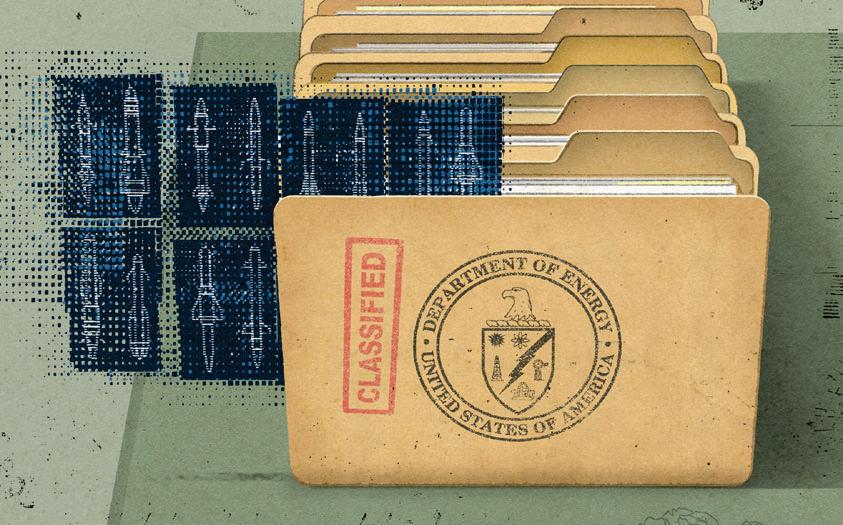
IN THE BEGINNING, PEOPLE CREATED COMPUTERS.
Some of them said, “Let there be software,” and it was mostly good. Then they said, “Let the software be more intelligent,” and they called that intelligence artificial. And in November of 2025 the White House launched an AI program called the Genesis Mission.
Last November, by executive order, President Donald Trump tasked the Department of Energy—which oversees the nation’s nuclear stockpile—with leading a “dedicated, coordinated national effort to unleash a new age of AI-accelerated innovation and discovery that can solve the most challenging problems of this century.”
Put more simply, the mission aims to build an AI platform, in partnership with universities and private companies, to tackle research in areas ranging from advanced manufacturing to biotechnology, nuclear energy to quantum information science, critical minerals to semiconductors.
Most public descriptions of Genesis emphasize its scientific mission, much as the DOE itself tends to foreground supernova research and disease modeling over the warheads it maintains. But the 26 challenges the department released present a more martial side to the mission: seven focus on nuclear weapons and national security.
It makes sense that the DOE would be in charge of a big AI-for-research project, says Bahrad Sokhansanj, a research scholar at the Institute for Law and AI in Boston, who used to work at Lawrence Livermore National Laboratory. Because of both its research on nuclear weapons and its existing basic-science portfolio, the agency already has the right infrastructure. “It has labs, it has computers,” Sokhansanj says. “It has a lot of resources that are relevant to the future of science and technology.” (Lawrence Livermore, Los Alamos National Laboratory and DOE headquarters did not respond to requests for comment.)

यह कहानी Scientific American के July/August 2026 संस्करण से ली गई है।
हजारों चुनिंदा प्रीमियम कहानियों और 10,000 से अधिक पत्रिकाओं और समाचार पत्रों तक पहुंचने के लिए मैगज़्टर गोल्ड की सदस्यता लें।
क्या आप पहले से ही ग्राहक हैं? साइन इन करें
Scientific American से और कहानियाँ
Scientific American
Let There Be Weapons
The Department of Energy’s new Genesis Mission promises AI-accelerated discovery. Seven of its first 26 challenges focus on nuclear weapons and national security

4 mins
July/August 2026

Scientific American
How to Fix Science
The federal funding system for scientific research in the U.S. needs reform
9 mins
July/August 2026

Scientific American
Robots Can Now Fold Your Laundry
Home-helper tasks are becoming easier for robotic assistants
4 mins
July/August 2026

Scientific American
50, 100 & 150 Years
NATURAL FISSION REACTOR
3 mins
July/August 2026

Scientific American
Anna Ho
Describing the characteristics of short-lived astrophysical events
1 mins
July/August 2026

Scientific American
THE SOLILOQUY OF SCHRÖDINGER'S CAT
A MEDITATION ON LIFE AND THE VON NEUMANN–WIGNER INTERPRETATION OF QUANTUM MECHANICS
1 min
July/August 2026

Scientific American
Mikhail Kolmogorov
Developing software to reveal large genetic changes that lead to cancer
1 mins
July/August 2026

Scientific American
Jaye Gardiner
Learning how the matrix around cells and tissues impacts cancers
1 mins
July/August 2026

Scientific American
Timnit Gebru
On safeguarding independent research in the age of big tech
3 mins
July/August 2026

Scientific American
A Youthful Illusion Sharpens Memory
By making people feel as if their face is a younger version of itself, researchers can bring childhood memories into sharper focus
4 mins
July/August 2026
Listen
Translate
Change font size