कोशिश गोल्ड - मुक्त
Humans Are Not So Special After All
Scientific American
|September 2025
Whales mourn, magpies exhibit self-awareness, and Venus flytraps make memories.
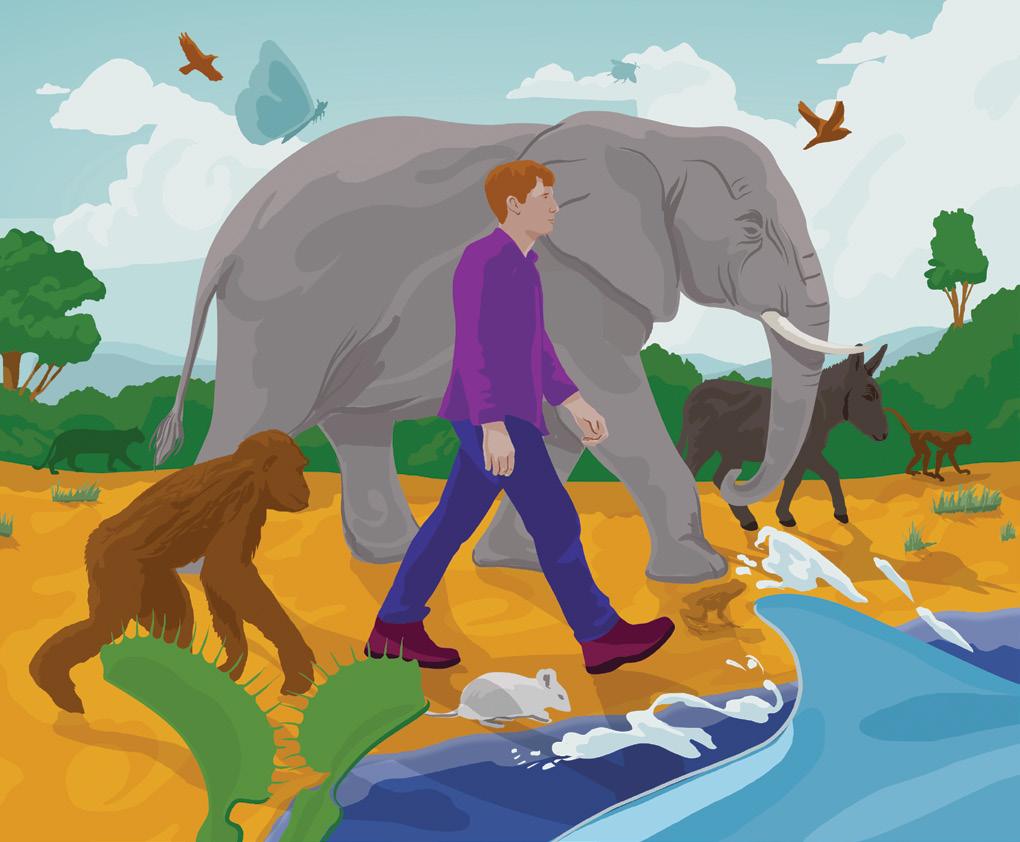
IT WAS THE TELEGRAM EXCHANGE that sparked an identity crisis for humankind. In 1960 a young Jane Goodall working in a remote forest in Tanzania observed a chimpanzee she named David Greybeard using blades of grass and twigs to fish nutritious termites out of their nest. The primatologist wrote to her mentor, Kenyan paleoanthropologist Louis Leakey, to tell him about her observation, which flew in the face of the conventional wisdom that held that only humans made tools.
For decades—centuries, even—scholars have attempted to draw a hard line between our kind and the other organisms with whom we share the planet. They have argued that only humans have culture—sets of learned behaviors, such as toolmaking, that are passed down from generation to generation. They have proposed that only humans think symbolically, using signs to represent objects or ideas. That our species alone is self-aware, capable of planning for the future and experiencing emotions such as joy and fear, love and grief. That only humans are conscious, possessed of an inner world of subjective experience.
For his part, Charles Darwin, writing in the late 1800s, opined that nonhuman animals have the same cognitive abilities and emotions that humans have and that any differences were a matter of degree and not kind. In the absence of any way to reliably read animal minds, however, scientists who studied animal behavior and cognition took the position that ascribing human thoughts, feelings and motivations to animals—anthropomorphism—was a cardinal sin. But in recent decades examples of other species demonstrating these capabilities have emerged from across the tree of life. The findings have spurred fresh thinking about what, exactly, distinguishes Homo sapiens, with our vaunted intellect, from every other species on Earth.


यह कहानी Scientific American के September 2025 संस्करण से ली गई है।
हजारों चुनिंदा प्रीमियम कहानियों और 10,000 से अधिक पत्रिकाओं और समाचार पत्रों तक पहुंचने के लिए मैगज़्टर गोल्ड की सदस्यता लें।
क्या आप पहले से ही ग्राहक हैं? साइन इन करें
Scientific American से और कहानियाँ

Scientific American
The Quiet Math Problem That Runs the Planet
How Diffie-Hellman key exchange secures everything from your text messages to government secrets

7 mins
May 2026

Scientific American
The Fog of Science
Did an adversary just invent a world-changing weapon, or are they making it up? DARPA is building an AI to instantly call their bluff
4 mins
May 2026

Scientific American
The Hubble Space Telescope Is Still Awesome
Hubble is going strong despite its decades in space and next-generation successors
4 mins
May 2026

Scientific American
Meet America's Native Bees
Scientists estimate there are about 4,000 species of native bees in the U.S.
5 mins
May 2026

Scientific American
The Chemistry of Desire
Inside the secretive laboratories where scientists build novel molecules to make luxury fragrance feel like pure emotion
5 mins
May 2026

Scientific American
Scanning the Stone
As ore gets harder to find, the mining industry is turning to subatomic-particle sensors to push deep underground
8 mins
May 2026

Scientific American
YOUR HEART IN FLAMES
Inflammation may be the true cause of cardiovascular diseaseand there's a drug to treat it
13 mins
May 2026

Scientific American
Ancient Lexicon
Stone Age art may reveal a 40,000-year-old precursor to writing
2 mins
May 2026

Scientific American
Thermal Breakthrough
A new super heat conductor challenges fundamental physics
2 mins
May 2026

Scientific American
How to Vacation in Space
Planned orbital hotels promise luxury, but can they deliver?
4 mins
May 2026
Listen
Translate
Change font size