कोशिश गोल्ड - मुक्त
Bright Spots
Scientific American
|July/August 2026
Science is flourishing in some labs and fields more than others
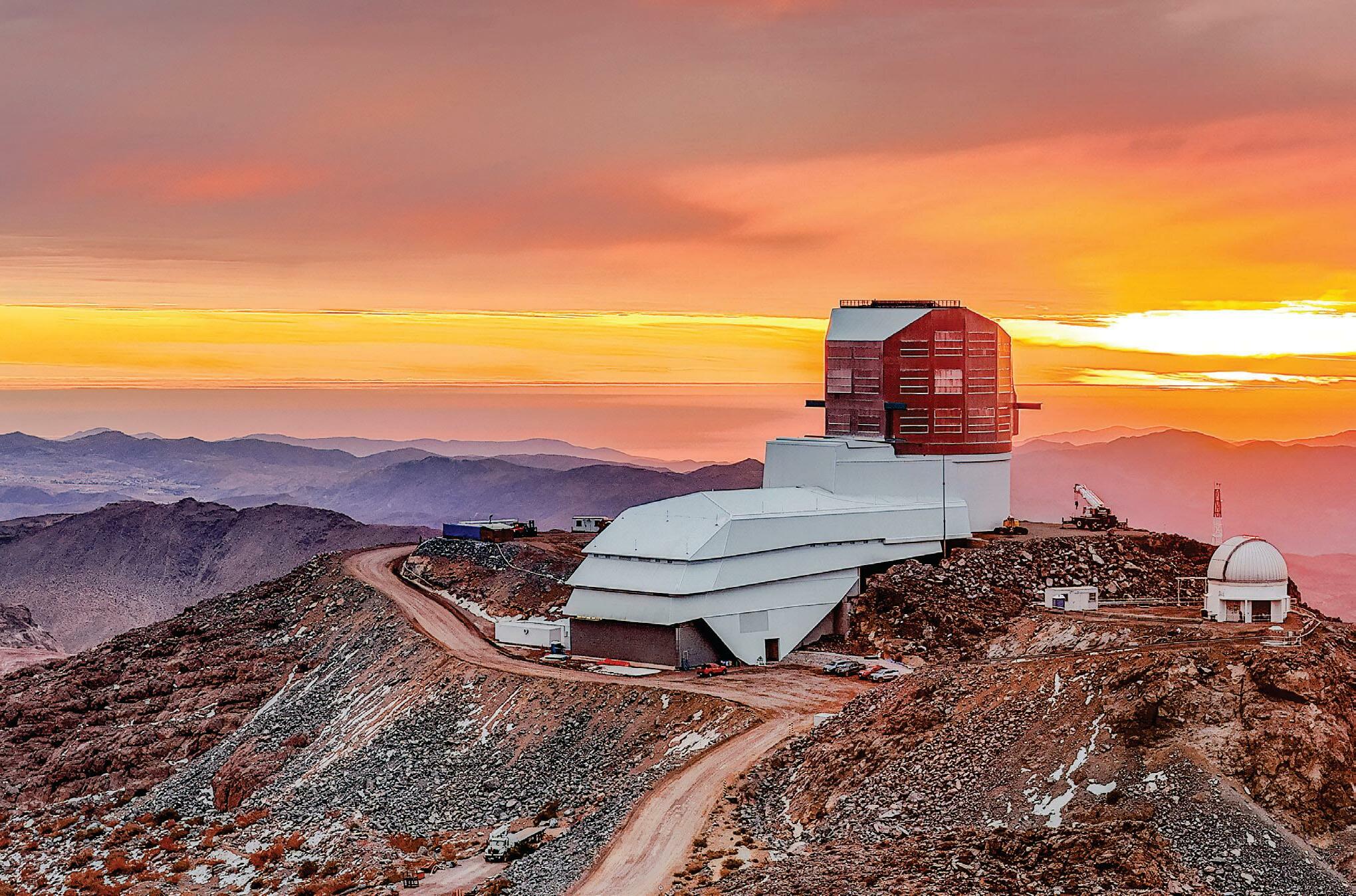
The sun sets behind the Vera C. Rubin Observatory in Chile in May 2024.
IN HER FIRST YEAR OF GRADUATE SCHOOL at Stanford University, back in 2021, Sydney Erickson knew only that she was going to be a physicist.
She rotated through different research groups, from particle physics to cosmology, until she started hearing buzz about a giant camera being built on campus for the Vera C. Rubin Observatory. “I was drawn toward that community,” she says, recalling those involved with the telescope, which turned on last summer in the Chilean Andes. “Rubin drove me into cosmology, I would say.”
Now Erickson is finishing her doctoral degree and developing new ways to pin down the universe’s accelerating rate of expansion. She focuses on huge astrophysical objects such as massive galaxies, whose gravity magnifies the light of more distant targets. By studying the arrival time of light from these so-called gravitational lenses, cosmologists can calculate how much the universe expanded during different time intervals. It’s an incredibly complex measurement requiring both lots of images captured repeatedly, which Rubin provides, and deep finesse, which Erickson and her computer models offer.
The $800-million Rubin observatory was designed and built largely with federal money. That federal purse has long been the primary source of funding for research and development in the U.S., growing from $21.3 billion in 1956 to $156.1 billion in 2024, adjusted for inflation, according to the National Science Foundation. The funds, which flow through numerous entities, from the NSF and the National Institutes of Health to NASA and the Department of Energy, have helped usher in a golden age of American science.

यह कहानी Scientific American के July/August 2026 संस्करण से ली गई है।
हजारों चुनिंदा प्रीमियम कहानियों और 10,000 से अधिक पत्रिकाओं और समाचार पत्रों तक पहुंचने के लिए मैगज़्टर गोल्ड की सदस्यता लें।
क्या आप पहले से ही ग्राहक हैं? साइन इन करें
Scientific American से और कहानियाँ
Scientific American
Let There Be Weapons
The Department of Energy’s new Genesis Mission promises AI-accelerated discovery. Seven of its first 26 challenges focus on nuclear weapons and national security

4 mins
July/August 2026

Scientific American
How to Fix Science
The federal funding system for scientific research in the U.S. needs reform
9 mins
July/August 2026

Scientific American
Robots Can Now Fold Your Laundry
Home-helper tasks are becoming easier for robotic assistants
4 mins
July/August 2026
Scientific American
50, 100 & 150 Years
NATURAL FISSION REACTOR
3 mins
July/August 2026

Scientific American
Anna Ho
Describing the characteristics of short-lived astrophysical events
1 mins
July/August 2026
Scientific American
THE SOLILOQUY OF SCHRÖDINGER'S CAT
A MEDITATION ON LIFE AND THE VON NEUMANN–WIGNER INTERPRETATION OF QUANTUM MECHANICS
1 min
July/August 2026

Scientific American
Mikhail Kolmogorov
Developing software to reveal large genetic changes that lead to cancer
1 mins
July/August 2026

Scientific American
Jaye Gardiner
Learning how the matrix around cells and tissues impacts cancers
1 mins
July/August 2026

Scientific American
Timnit Gebru
On safeguarding independent research in the age of big tech
3 mins
July/August 2026
Scientific American
A Youthful Illusion Sharpens Memory
By making people feel as if their face is a younger version of itself, researchers can bring childhood memories into sharper focus
4 mins
July/August 2026
Listen
Translate
Change font size