कोशिश गोल्ड - मुक्त
THE WORLD'S MOST POWERFUL LASERS
How It Works UK
|Issue 206
What happens when a beam of energy 100 times the power of the global electricity grid is concentrated onto a pinpoint?
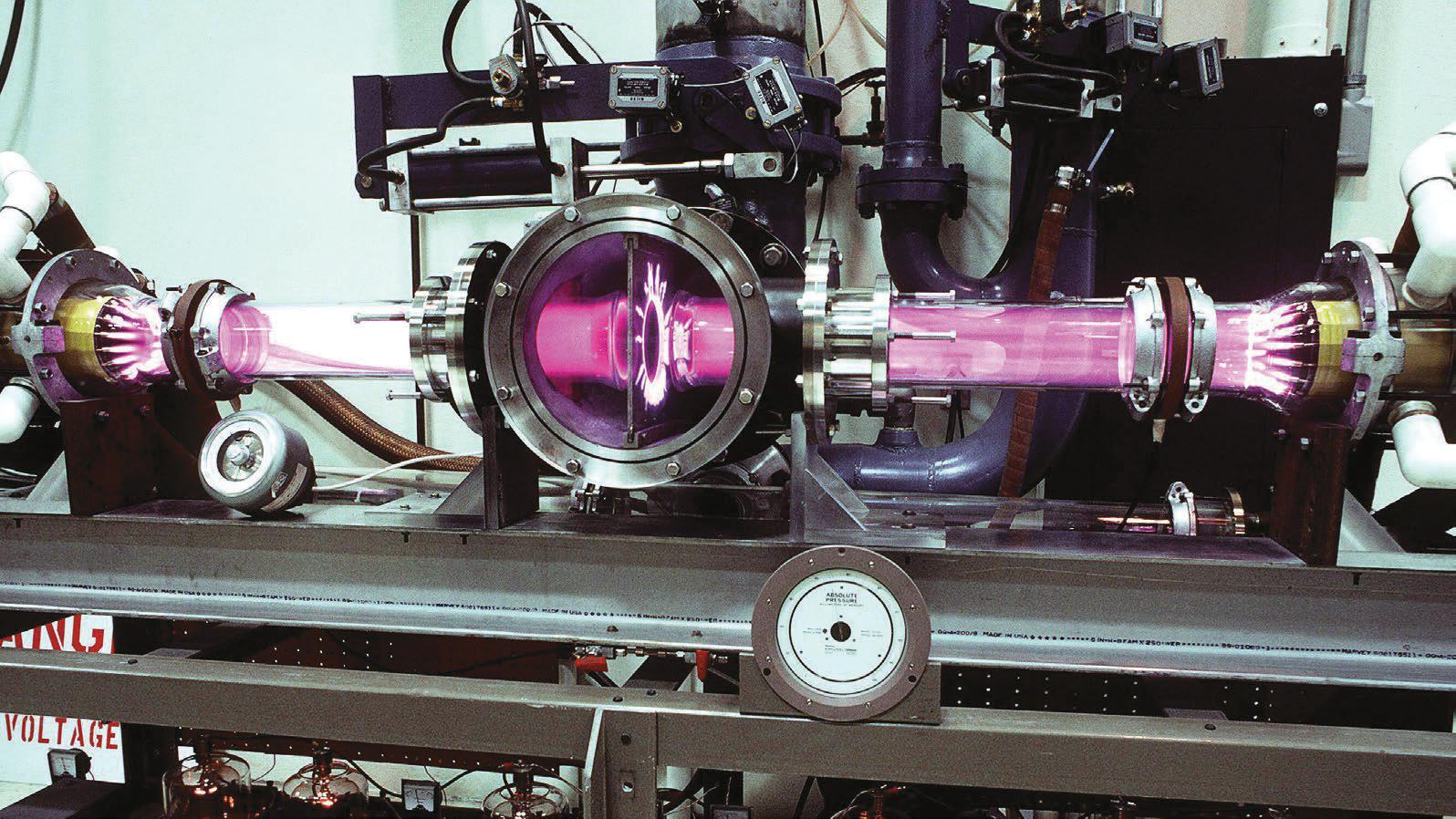
Lasers are devices that produce a narrow beam of polarised light. However, unlike the beam of a torch, a laser's light can carry extraordinary amounts of energy. When focused to a narrow point, lasers can cut or melt metal and even generate enough energy to replicate conditions in deep-space environments such as the inside of a star.
A laser's three main components are an energy source, a gain medium and an optical resonator. The first component, also known as a pump, is the energy that excites the medium, often using an electric current. The gain medium is a material that amplifies the light before it's directed through the optical resonator, an arrangement of mirrors, for further amplification as light is reflected multiple times through the gain medium.
Lasers are classified based on their strength, with the least powerful being class I and the most powerful being class IV. Their power is expressed in watts, with each watt the equivalent of one joule of energy emitted every second. Class I is not a hazard and poses no risk to human skin or eyes, while class IV lasers are those with a power output above 500 milliwatts. These can cause fires and are used for industrial applications.
The most powerful lasers can reach levels far above this, however, in the order of petawatts of power - a petawatt is 1,000,000,000,000,000 watts. With lasers this powerful, scientists can vaporise matter, create matter from light and mimic the conditions of a black hole. This means materials and conditions that usually only exist in the most extreme environments can be recreated on Earth, helping scientists better understand the nature of the universe.
DIFFERENT TYPES

यह कहानी How It Works UK के Issue 206 संस्करण से ली गई है।
हजारों चुनिंदा प्रीमियम कहानियों और 10,000 से अधिक पत्रिकाओं और समाचार पत्रों तक पहुंचने के लिए मैगज़्टर गोल्ड की सदस्यता लें।
क्या आप पहले से ही ग्राहक हैं? साइन इन करें
How It Works UK से और कहानियाँ
How It Works UK
MAKING ICE IN THE DESERT
This genius ancient Persian technique kept ice frozen in sweltering conditions

2 mins
Issue 216
How It Works UK
ROBERT H.GODDARD
This physics professor defied the doubters and proved that rocket engines could work in outer space
2 mins
Issue 216

How It Works UK
With continued continental shift, what will Earth look like in 200 million years?
Over the next 250 million years, scientists predict that our planet's continents will converge and form a new supercontinent dubbed 'Pangaea Ultima', echoing the supercontinent Pangaea that existed 250 million years ago.
1 min
Issue 216

How It Works UK
SICK SKATEBOARD PHYSICS
What forces are at play when skateboarders catch air and land a clean trick?
2 mins
Issue 216

How It Works UK
THE LIBRARY
The latest book releases for curious minds
5 mins
Issue 216

How It Works UK
WHAT ARE CONJOINED TWINS?
Very rarely, twins are born physically connected to each other, sharing tissues and even entire organs
3 mins
Issue 216

How It Works UK
WHAT DETERMINES WHICH WAY ‘UP' PLANET EARTH IS?
A hot-air balloon consists of the envelope (the balloon), the burner and the basket.
1 min
Issue 216

How It Works UK
WHY DO CREEPY CRAWLIES COME OUT WHEN IT'S RAINING?
Earthworms crawl out onto the pavement because their burrows become waterlogged.
1 min
Issue 216
How It Works UK
MAKE COLOUR-CHANGING FLOWERS
Learn how plants transport water through their stems in this vibrant experiment
1 min
Issue 216
How It Works UK
DEADLY RADIATION- EATING FUNGUS
How a fungus in Chernobyl is thriving on nuclear fallout
1 mins
Issue 216
Listen
Translate
Change font size