
मैगज़्टर गोल्ड के साथ असीमित हो जाओ
10,000 से अधिक पत्रिकाओं, समाचार पत्रों और प्रीमियम कहानियों तक असीमित पहुंच प्राप्त करें सिर्फ
कोशिश गोल्ड - मुक्त
FIVE WAYS THE UNIVERSE COULD END
How It Works UK
|Issue 212
We'd like to think that the universe will continue forever, but chances are, at some point it will cease to be. Here's how current thinking suggests the end may come to pass
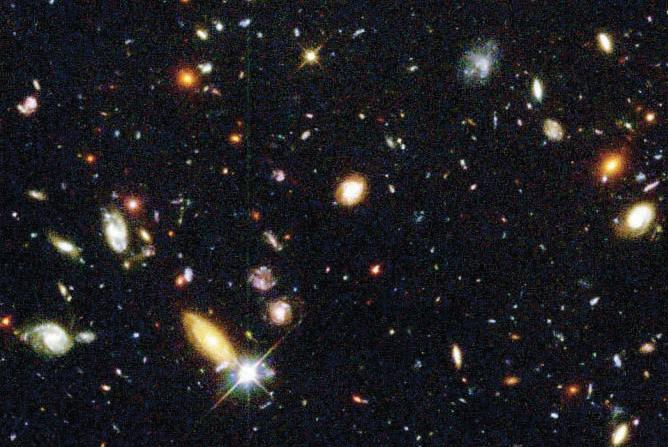
OVEREXPANSION
1 THE BIG RIP
Two of the biggest mysteries facing cosmologists today are dark matter and dark energy. Our models of the universe suggest dark matter exists, but we can't see it, and even if it's out there, we have no idea how it might interact with normal matter. Meanwhile, observations tell us that the universe is growing at an ever-increasing rate, but this is counter-intuitive – you'd expect the gravitational attraction between galaxies to keep this growth in check, or even pull them back together. Astronomers believe that dark energy is driving this expansion. As the galaxies move further apart, the gravitational force between them decreases. If this continues, the force exerted by dark energy would gradually overwhelm the force of gravity. Galaxies would fall apart, planets would leave the orbits of their stars and the planets themselves would disintegrate. This process would continue until the Big Rip, when the fundamental forces that hold the universe together would become obsolete and reactions would become impossible. The universe would be dead.
TOTAL CHAOS
2 HEAT DEATH

यह कहानी How It Works UK के Issue 212 संस्करण से ली गई है।
हजारों चुनिंदा प्रीमियम कहानियों और 10,000 से अधिक पत्रिकाओं और समाचार पत्रों तक पहुंचने के लिए मैगज़्टर गोल्ड की सदस्यता लें।
क्या आप पहले से ही ग्राहक हैं? साइन इन करें
How It Works UK से और कहानियाँ

How It Works UK
WHY ANIMALS PLAY DEAD
These species have mastered faking their own deaths for several different reasons

1 min
Issue 214

How It Works UK
THE JAMES WEBB SPACE TELESCOPE MAPS 3D AURORAE ON URANUS
An international team of researchers has uncovered new insights into the upper atmosphere of Uranus, where ions swirling above the ice giant's clouds meet its magnetic field.
1 min
Issue 214
How It Works UK
LASERS BEAM 'ARTIFICIAL STARS' INTO CHILE'S SKIES
The European Southern Observatory has released a breathtaking photo of the Milky Way shining over Paranal Observatory in Chile as lasers create artificial 'guide stars' in the dark sky above.
1 min
Issue 214

How It Works UK
WHISKERS AT WORK
How long hairs on a cat's face fine-tune their senses
2 mins
Issue 214

How It Works UK
HOW AI IMPROVES CAR SAFETY
The vehicle technology that saves lives today - and the innovations that will soon make the roads safer for everyone
4 mins
Issue 214

How It Works UK
APOLLO 17: THE LAST CREWED MOON LANDING
It's been over 50 years since the final Apollo mission, so why haven't we put astronauts on the Moon since then?
4 mins
Issue 214

How It Works UK
WHAT IS LIMESCALE?
Why 'hard' water leaves chalky, flaky deposits wherever it settles
2 mins
Issue 214

How It Works UK
Astronauts describe the moment a crack was discovered on their spacecraft
Chinese astronauts have described what happened when they were nearly stranded in space last year after a suspected piece of space junk struck their return capsule.
2 mins
Issue 214
How It Works UK
The Vera C. Rubin Observatory found 800,000 objects of interest in a single night
The newly commissioned Vera C. Rubin Observatory has issued 800,000 astronomy alerts in just one night, a staggering number of nightly discoveries that's expected to grow nearly tenfold by the end of this year.
2 mins
Issue 214

How It Works UK
RETURN TO THE MOON
Project Artemis is accelerating its push to put humans back on Earth's orbital dancing partner before the end of the decade
5 mins
Issue 214
Listen
Translate
Change font size