
मैगज़्टर गोल्ड के साथ असीमित हो जाओ
10,000 से अधिक पत्रिकाओं, समाचार पत्रों और प्रीमियम कहानियों तक असीमित पहुंच प्राप्त करें सिर्फ
कोशिश गोल्ड - मुक्त
In full retreat
Down To Earth
|April 16, 2025
Hindu Kush glaciers retreated 65 per cent faster in 2011-20, compared to previous decade. In a 2 °C warmer world, half of its glaciers could vanish
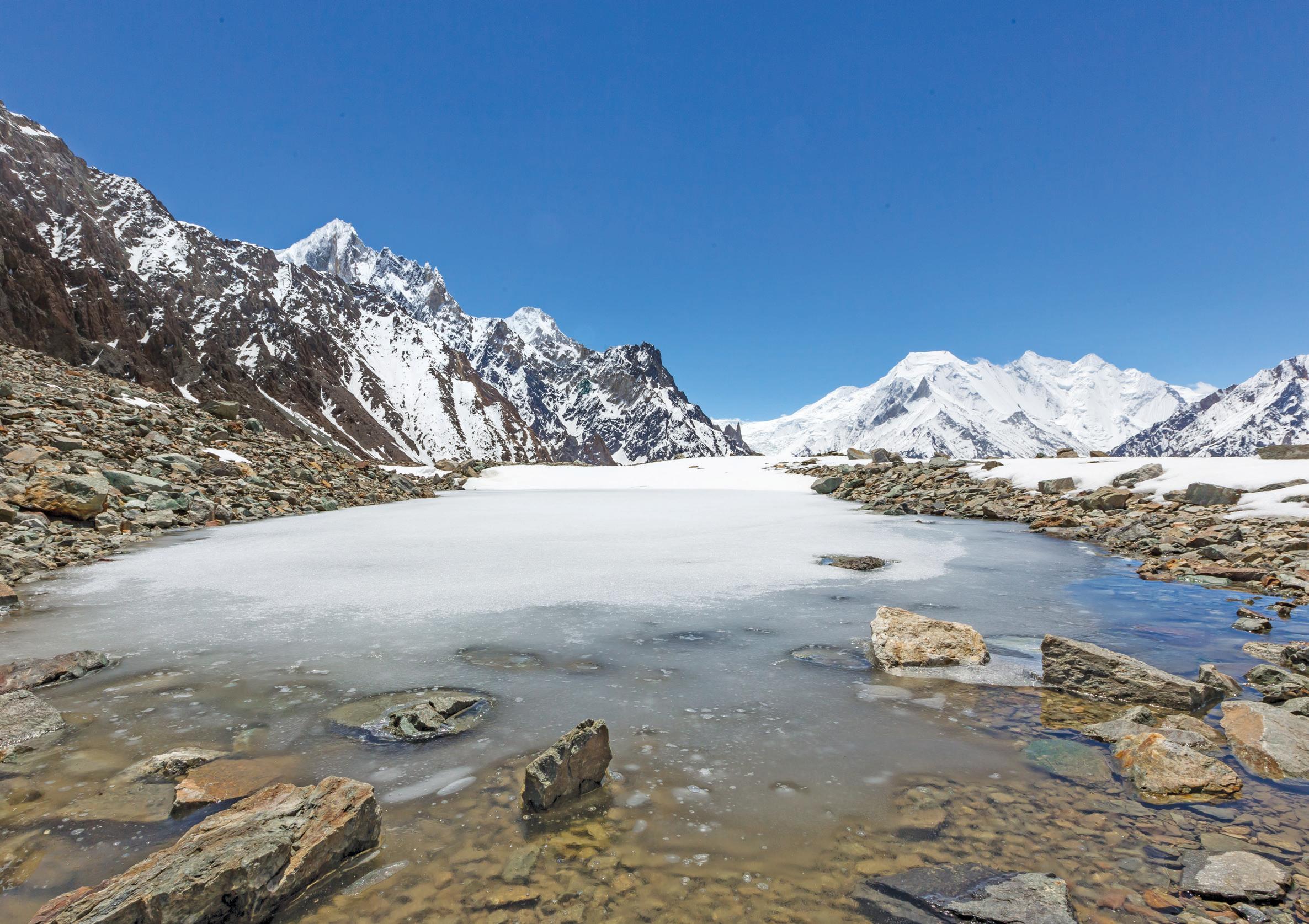
GLACIERS WORLDWIDE are thinning at an alarming rate, but nowhere is the crisis more pronounced than in the Hindu Kush Himalaya (HKH). Glaciers in the region retreated 65 per cent faster between 2011 and 2020 than in the previous decade, driven by climate change, says a report by the UN Educational, Scientific and Cultural Organization (UNESCO). Stretching across eight countries—India, Afghanistan, Bangladesh, Bhutan, Myanmar, China, Nepal and Pakistan—the HKH mountains feed 10 major river basins. Their waters sustain 240 million people in the mountains and another 1.65 billion downstream.
If global temperatures rise by 1.5°C to 2°C, HKH glacier volume could shrink by 30-50 per cent by 2100, says the “UN World Water Development Report 2025”, released on March 21. If warming exceeds 2°C, nearly half the region’s glaciers could vanish—jeopardising water security for a quarter of humanity. “We are also seeing melting in the Karakoram Anomaly,” says Sher Muhammad, remote sensing specialist at the International Centre for Integrated Mountain Development (ICIMOD), a regional inter-governmental nonprofit knowledge organisation based in Kathmandu. (In the 1990s, glaciologists noticed modest gains in the Karakoram Range glaciers, which earned it the nickname “Karakoram Anomaly”).
Speaking to Down To Earth (


यह कहानी Down To Earth के April 16, 2025 संस्करण से ली गई है।
हजारों चुनिंदा प्रीमियम कहानियों और 10,000 से अधिक पत्रिकाओं और समाचार पत्रों तक पहुंचने के लिए मैगज़्टर गोल्ड की सदस्यता लें।
क्या आप पहले से ही ग्राहक हैं? साइन इन करें
Down To Earth से और कहानियाँ
Down To Earth
CONSERVED BY COMMUNITY
How a desire to make snow leopard tourism sustainable helped a small Ladakhi settlement became the region's first Community Conserved Area

4 mins
May 16, 2026

Down To Earth
An 'open' and 'shut' case of Al's risky trajectory
Elon Musk's lawsuit against Sam Altman, OpenAl, Microsoft is crucially about open-source versus closed technology for corporate profit
4 mins
May 16, 2026
Down To Earth
Burden of transition
Clean energy transition is once again shifting environmental, human costs to the Global South, finds a UN university investigation
4 mins
May 16, 2026
Down To Earth
One step closer
India attains criticality in fast breeder reactor technology, reaching the second stage of the country's three- stage nuclear programme towards energy security
4 mins
May 16, 2026

Down To Earth
ZESTY SEEDS
Coriander seeds are a traditional antidote to summer heat
3 mins
May 16, 2026

Down To Earth
Sahyadri gets a bird village
Residents of Maharashtra's Pisavare village have embarked on a mission to protect birds in their vicinity through simple practices such as documenting species and building nests
2 mins
May 16, 2026

Down To Earth
CONFLICT IN THE BACKYARD
Across India, farmers are abandoning their fields as conflict with wild and stray animals intensifies. Conservation policy must move beyond protection alone to restore a workable coexistence between people and animals.
18 mins
May 16, 2026

Down To Earth
Capital punishment
Adequate compensation and proper rehabilitation remain a mirage for many displaced by the construction of Chhattisgarh's new capital, Nava Raipur, even two decades after the project began
3 mins
May 16, 2026
Down To Earth
Migrant workers are assets
MIGRATION HAS turned into a potent tool of political warfare across the world. For over a decade, domestic electoral politics across regions, from Europe and North America to Asia and Africa, have fuelled anti-immigration sentiments. This is also increasingly fuelling anti-immigrant vigilantism, as seen widely across Europe in 2015-16, coinciding with the refugee crisis.
2 mins
May 16, 2026

Down To Earth
Petri dish to plate
Synthetic meat production has seen a rise globally, even as environmental benefits of growing foods in laboratory remain debatable
10 mins
May 16, 2026
Listen
Translate
Change font size