कोशिश गोल्ड - मुक्त
GRAIN SIZE: SEED TROUBLE
Down To Earth
|April 01, 2023
An increase in number of days with extreme temperatures or rain has caused a decline in quality and size of seeds across India

WHEN A group of 20 farmers in Andhra Pradesh's Alluri Sitharama Raju district ventured into production of seeds of finger millet (ragi) and little millet (samai) in 2019, it had no idea what the future had in store. For the next two years, unusual weather events ensured that the crops did not have grains good enough for use as seeds. "The years 2020 and 2021 saw excess rain in July and August. This did not allow the plants to take nutrition from the soil. The resultant grains were weak and the endosperm-part of a seed that stores food for the development of a plant and is crucial for germination-was absent when the seeds were crushed open for inspection," says M L Sanyasi Rao, programme manager of Watershed Support Services and Activities Network, a non-profit working with tribal farmers in the area. The farmers had estimated 20 tonnes of produce, but the harvest in November 2021 resulted in only 15 tonnes, with the grains unusable as seeds. The harvest was then sold as crop for 25 per kg, while its sale as seed would have fetched 35 per kg.
There is no difference in the cultivation mechanism for producing seeds or for growing crops. Vast majority of farmers in India set aside a part of their field for growing seeds that can be used the next season. But climate change has posed a threat to seeds, which are essential for food security of the country. Grains of wheat and rice, the two staples distributed under the government's public distribution system and crucial to food security, have also seen a shrinkage in recent years, say farmers.
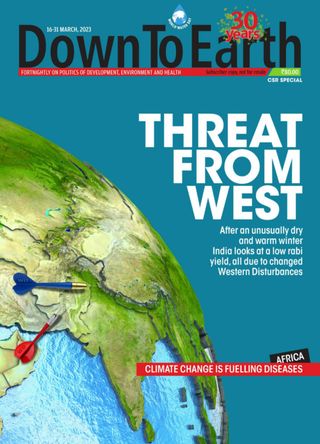

यह कहानी Down To Earth के April 01, 2023 संस्करण से ली गई है।
हजारों चुनिंदा प्रीमियम कहानियों और 10,000 से अधिक पत्रिकाओं और समाचार पत्रों तक पहुंचने के लिए मैगज़्टर गोल्ड की सदस्यता लें।
क्या आप पहले से ही ग्राहक हैं? साइन इन करें
Down To Earth से और कहानियाँ

Down To Earth
BEYOND COLLATERAL DAMAGE
Recent geopolitical conflicts are urging a reconsideration of what constitutes environmental harm in war and the limits of existing legal frameworks

3 mins
April 01, 2026

Down To Earth
Masterstroke
Residents of a small Kerala town reject an inadequate state-led development blueprint and create their own master plan that prioritises protection of historic water systems and urban commons
4 mins
April 01, 2026

Down To Earth
Rethinking E20
It is pertinent to explore potential of ethanol as high-value industrial feedstock
4 mins
April 01, 2026
Down To Earth
Food in the age of climate change
WHEN WE eat, we contribute to climate change. But food is also about livelihoods, about nutrition and about nature.
3 mins
April 01, 2026

Down To Earth
FADING WINTER
India's winters are warming, becoming shorter, shifting and spilling beyond their traditional bounds. The consequences are already evident in meltwater availability, forest-fire intensity and changes in flowering cycles and insect behaviour.
20 mins
April 01, 2026

Down To Earth
War on Iran strikes India's pharmaceuticals sector
Shortages of critical raw materials and rising input costs for the drug industry will have global consequences
4 mins
April 01, 2026

Down To Earth
POWER IN AN AGE OF INSECURITY
Energy transition is no longer solely about emission reduction but also about energy security
3 mins
April 01, 2026
Down To Earth
Re-discovery of fuelwood
THE WEST Asia conflict has made visible a multi-billion dollar energy market in India.
2 mins
April 01, 2026

Down To Earth
A CASE THAT RESHAPED INDIA'S ENVIRONMENT
The case of MC Mehta v Union of India stands as proof that a proactive judiciary can accelerate action even when the executive drags its feet
4 mins
April 01, 2026
Down To Earth
FOREVER DEPENDENT
India depends on global fertiliser supply chains for 70 per cent of its needs, leaving its food security exposed to geopolitical disruptions
6 mins
April 01, 2026
Translate
Change font size