कोशिश गोल्ड - मुक्त
Who is really Running the Show?
Heartfulness eMagazine
|April 2023
STANISLAS LAJUGIE challenges the myth that we make most of the decisions in our lives. Why do we keep encountering similar circumstances, relationships, and problems in life? Why is it so difficult to change our behavior? He explains why, and also how we can transform ourselves.

Who Is Running the Show? Your Conscious Mind or Your Subconscious Mind?
In his book, The Biology of Belief: Unleashing the Power of Consciousness, Matter and Miracles, Dr. Bruce Lipton explains that 95% of our daily cognitive activities and decisions are managed by our subconscious minds, meaning that only 5% are managed by our conscious minds. One reason is that the prefrontal cortex, the part of our brain dedicated to attention and conscious awareness, is only a small part of our brain, which can process only a limited amount of information. Translated into data, it can process the equivalent of 40 bits/second, while the subconscious mind can process 40 million bits/second. Quantitatively, the subconscious is one million times more powerful!
And the subconscious mind is mostly formed during the first six years of life, whereas the development of the prefrontal cortex is not complete until the age of twenty-five. The subconscious mind acts like a hard disk, downloading all the information we absorb from around us. This process is dependent to a large extent on external circumstances. Actually, at that young age there is no faculty to discriminate, as the prefrontal cortex is not fully developed. Therefore, aware or not, willing or not, good or bad, whatever comes is recorded. And the information we receive in that stage of super learning determines our belief system. This becomes the basis of the subconscious mind or the operating system from which our conscious mind operates.
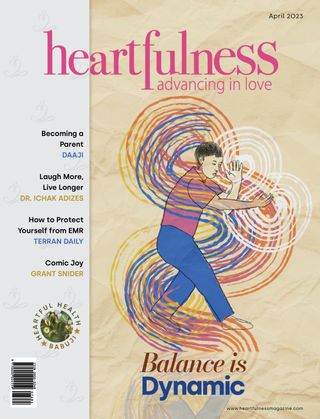

यह कहानी Heartfulness eMagazine के April 2023 संस्करण से ली गई है।
हजारों चुनिंदा प्रीमियम कहानियों और 10,000 से अधिक पत्रिकाओं और समाचार पत्रों तक पहुंचने के लिए मैगज़्टर गोल्ड की सदस्यता लें।
क्या आप पहले से ही ग्राहक हैं? साइन इन करें
Heartfulness eMagazine से और कहानियाँ

Heartfulness eMagazine
Brigid Goddess of the Gaels
RUBY CARMEN tells the story of Brigid, the Celtic goddess of fire and healing, a tale of compassion and strength that carries ancient wisdom for modern life.

3 mins
May 2026

Heartfulness eMagazine
The Secret of Life: Keep Moving
ELIZABETH DENLEY explores how joy supports our mental well-being in a troubled world, reshaping our response to pain and suffering.
4 mins
May 2026

Heartfulness eMagazine
The Red Fire Truck: The Day I Realized I Was the One Snatching
AAYUSHI KANSARA shares how one small parenting crisis became an invitation to conscious living-using Heartful Communication, pause, and self-awareness to transform reactive habits into connected family moments.
4 mins
May 2026

Heartfulness eMagazine
Story, Play, and Wonder
INGA MARIE RAMCKE shares her joyful approach to educating children through storytelling, puppetry, and hands-on exploration of the natural world. In this conversation with VANESSA PATEL, she reflects on how her work nurtures curiosity, imagination, and connection-an early foundation for conscious living.
6 mins
May 2026

Heartfulness eMagazine
Where is Happiness?
ICHAK ADIZES revisits the question of happiness and mental well-being, asking whether we have been looking in the right place.
2 mins
May 2026

Heartfulness eMagazine
The Eco-Guardians Nobody Sees
B. RATHINASABAPATHY shows how owls embody conscious living at Kanha Shanti Vanam, serving as silent nocturnal guardians whose precise hunting, cultural symbolism, and ecological balance invite a deeper reverence for coexistence with the natural world.
3 mins
May 2026

Heartfulness eMagazine
Knowing oneself Awareness through Action
ALEXANDRA MAZEK and THOMAS HIRT show how our movements reflect and reshape our inner condition, and how fostering the body–mind–spirit connection can transform the way we experience and respond to life.
5 mins
May 2026

Heartfulness eMagazine
Joy Without Conditions
DAAJI traces the path to unconditional joy through contentment—and suggests it may be closer than we imagine.
9 mins
May 2026

Heartfulness eMagazine
A Thing of Beauty: On Joy That Endures
What is a thing of beauty?
6 mins
May 2026

Heartfulness eMagazine
A Touch of Heaven
Irish singer and teacher, EILISH BUTLER, combines the mystical chant of Saint Hildegard von Bingen (1098-1176) with the evolutionary path of Uncovering the Voice, satisfying her passion for mystical spirituality and music.
2 mins
November 2025
Translate
Change font size