कोशिश गोल्ड - मुक्त
May Day: From the maypole to the picket line
Mail & Guardian
|May 02, 2025
Trade unions are still the best way of organising resistance to the violence of capitalism
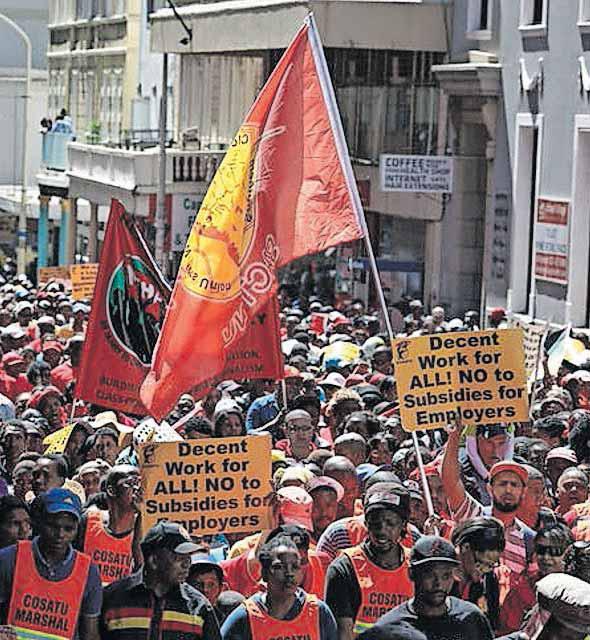
Long before the red flag waved from factory gates and trade union halls, 1 May was a day of greenwood misrule.
In medieval Europe, it marked the turning of the seasons. Villagers gathered around the maypole, to celebrate the fertility of the earth and renewal of communal life.
On this day, the usual hierarchies were unsettled. Peasants and nobles danced in the same space and the daily rhythm of labour briefly gave way to collective celebration.
Yet even these early rituals carried the seeds of organised struggle. As historian Peter Linebaugh reminds us, May Day was not only a tribute to spring, it was a rehearsal of freedom.
In the forests and commons surrounding early villages, people gathered herbs, cut wood, grazed animals and met to share knowledge and organise resistance. These communal forms of life represented early collective politics. Long before formal trade unions existed, there were forms of mutual obligation and shared labour that resisted exploitation.
As pioneering social historian EP Thompson argued in The Making of the English Working Class, these customs reflected a moral economy grounded in reciprocity and collective rights. In medieval England, peasants held woodland, marsh and pasture "in common", defending them through customary law and communal action.
When these spaces were enclosed and turned into private property, they were defended, often collectively, through early proto-union-style alliances between villagers.
But with the rise of capitalism, the commons were systematically dismantled. From the late 15th to the 18th century, enclosure laws stripped communities of access to shared land.
Hedges were raised, fences hammered into the soil and what was once held in common became the property of landlords and merchants. This was the beginning of what would become a generalised wage relation.

यह कहानी Mail & Guardian के May 02, 2025 संस्करण से ली गई है।
हजारों चुनिंदा प्रीमियम कहानियों और 10,000 से अधिक पत्रिकाओं और समाचार पत्रों तक पहुंचने के लिए मैगज़्टर गोल्ड की सदस्यता लें।
क्या आप पहले से ही ग्राहक हैं? साइन इन करें
Mail & Guardian से और कहानियाँ

Mail & Guardian
A love letter to La Concorde
The office park in Paarl has character, scale and history that cannot be replicated. Developers have listened to the building and acknowledged its story

4 mins
M&G 08 May 2026

Mail & Guardian
Inside the R1.1bn SA Steel Mills
Previously unreported affidavits have raised serious questions about the Industrial Development Corporation's R1.1 billion funding to SA Steel Mills, including allegations of weak due diligence, disputed financial records and internal accountability failures that have left more than 1100 jobs at risk
2 mins
M&G 08 May 2026

Mail & Guardian
Blocking NHI undermines transformation agenda
No class bias: NHI is a plan to close the gap in healthcare between the rich and poor.
4 mins
M&G 08 May 2026

Mail & Guardian
Rural community energy options amid climate change
Sustainable development goal 7 (SDG 7) envisions universal access to affordable and clean energy by 2030 — a key driver of communities’ health, well-being and sustainable development.
4 mins
M&G 08 May 2026

Mail & Guardian
D-Day for Ramaphosa
The case in the apex court concerns an application by the EFF and the ATM after parliament rejected a Section 89 panel report that found a prima facie case requiring further investigation into allegations linked to Phala Phala
5 mins
M&G 08 May 2026

Mail & Guardian
SA's Constitution at 30, a shared compact
The belief that a constitutional text alone can transform society is as misplaced as the claim that it is the primary barrier to transformation. The Constitution can be a powerful enabling instrument, depending on who wields it
5 mins
M&G 08 May 2026

Mail & Guardian
Isuzu's D-Max V-Cross could've been a premium bakkie but for this
Since I started motoring, I've had two Isuzus.
2 mins
M&G 08 May 2026

Mail & Guardian
Investment and discovery in Tunisia
Whether through high-level platforms like Fita or its vibrant tourism offerings, the country continues to position itself as a key player in Africa's future while inviting the world to discover its timeless charm
4 mins
M&G 08 May 2026

Mail & Guardian
Zimbabwe's patronage web: How oligarchs captured the State
Emmerson Mnangagwa's Zimbabwe is not merely a troubled polity; it is the quintessential laboratory of state capture in Africa.
5 mins
M&G 08 May 2026

Mail & Guardian
ANC faces local poll backlash
Political experts say fragmented opposition politics and worsening municipal governance will define South Africa's first post-GNU local elections and that it’s not looking good for the ANC
4 mins
M&G 08 May 2026
Listen
Translate
Change font size