कोशिश गोल्ड - मुक्त
Why Indus River System Is Pakistan's Real 'Jugular Vein'
Business Standard
|May 12, 2025
With India keeping the Indus Waters Treaty in abeyance, Pakistan's agricultural sector, the backbone of its economy, faces uncertainty. SANJEEB MUKHERJEE analyses
Even as New Delhi and Islamabad reached an understanding amid conflict, one of the things that still remained in the spotlight was the Indus Waters Treaty (IWT). India had put the treaty, signed between the two countries in 1960, in abeyance after the April 22 terrorist attack in Pahalgam.
The treaty between India and Pakistan was brokered by the World Bank and was considered one of the most durable trans-boundary water agreements signed anywhere in the world. India, according to the agreement, has rights over the three eastern rivers — Ravi, Beas and Sutlej — in the Indus Basin. Pakistan has partial rights over the remaining three: Indus, Jhelum and Chenab. The three rivers account for almost 80 per cent of the shared basin's water.
India has the right to use the water from Indus, Jhelum and Chenab for hydropower generation and irrigation. It cannot build any structure that diverts or impacts the downstream flow of these three rivers, according to the agreement. For Pakistan, these three rivers are virtually lifelines which not only provide irrigation for much of its cotton and paddy but also large sections of its horticulture production.
Pakistan's agriculture
With a population of over 220 million, Pakistan, according to estimates, is the fifth most populous country in the world.
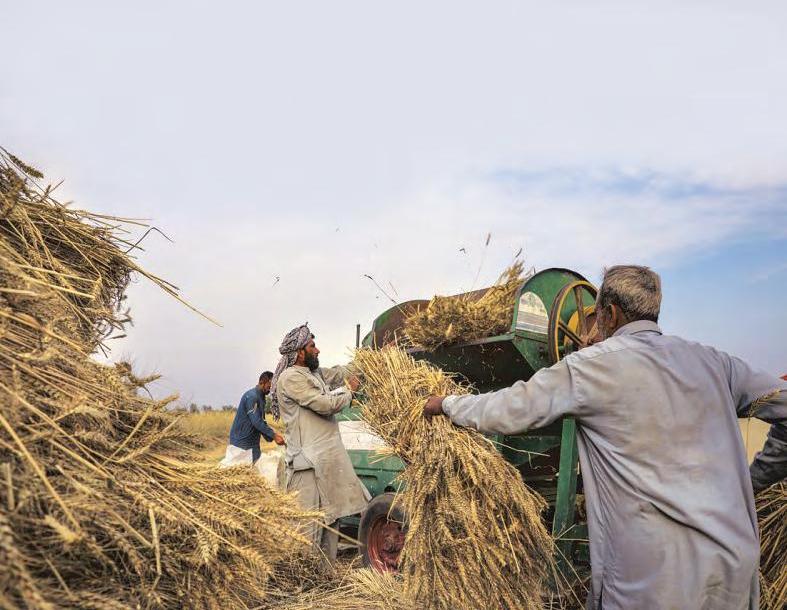
Agriculture, which contributes around 23 per cent to its gross domestic product (GDP) and employs over 40 per cent of its labour force, remains the backbone of Pakistan's economy.
Textiles, Pakistan's largest manufacturing and exporting sector, depends on agriculture for cotton, its core raw material. Over 75 per cent of the exports are linked to the farm sector.
More than 61 per cent of Pakistan's people reside in rural areas and are largely dependent on crop and livestock productions. Overall, two out of three employed women find work in the agri-food sector.

यह कहानी Business Standard के May 12, 2025 संस्करण से ली गई है।
हजारों चुनिंदा प्रीमियम कहानियों और 10,000 से अधिक पत्रिकाओं और समाचार पत्रों तक पहुंचने के लिए मैगज़्टर गोल्ड की सदस्यता लें।
क्या आप पहले से ही ग्राहक हैं? साइन इन करें
Business Standard से और कहानियाँ
Business Standard
FinMin in talks with Sebi, RBI on crypto exchanges
The Ministry of Finance (FinMin) is in discussions with the Securities and Exchange Board of India (Sebi) and the Reserve Bank of India (RBI) ahead of the Union Budget 2026-27 to firm up a regulatory framework for crypto exchanges, official sources said.

2 mins
January 14, 2026
Business Standard
Meta to fire 10% of VR unit staffers to focus on AI division
Meta plans to cut around 10 per cent of the employees in its Reality Labs division who work on products including the metaverse, according to three people with knowledge of the discussions, as the company shifts priorities to build next-generation artificial intelligence.
1 min
January 14, 2026

Business Standard
Training citizens out of reality
What use is infinite information if no one can tell truth from performance?
3 mins
January 14, 2026

Business Standard
Work-life balance tops job wish list for India's Gen Z
Infosys co-founder N R Narayana Murthy may still be extolling the virtues of a 72-hour work week. But Gen Z — broadly defined as those born between 1997 and 2012 — appears to be marching to a very different drumbeat: In a latest survey, nearly half of the 23,000 respondents from this age group said that the single most important factor when evaluating a job offer is, quite simply, “work-life balance”.
2 mins
January 14, 2026
Business Standard
German Chancellor visits Bosch campus in Bengaluru
German Chancellor Friedrich Merz's visit to the Bosch campus here on Tuesday underscored the deep economic and technological ties between India and Germany in the areas of mobility, manufacturing and innovation, the company said.
1 min
January 14, 2026
Business Standard
On table: Licence regime for corporate biz correspondents
The Reserve Bank of India (RBI) is likely to consider introducing a licensing regime for corporate business correspondent (BC) channels, a move that would bring currently unregulated fintech companies operating in the segment under the regulator's direct oversight, according to three people familiar with the matter.
2 mins
January 14, 2026
Business Standard
Elie Saab forays into Indian branded residence market with M3M group
ELIE SAAB IS PREPARING TO OPEN ITS FIRST READY-TO-WEAR BOUTIQUE SHOP IN INDIA LATER THIS YEAR
1 mins
January 14, 2026
Business Standard
Govt bonds won't be in Bloomberg Index, for now
Operational, mkt infra issues key reasons; next update by mid-2026
2 mins
January 14, 2026
Business Standard
Building partnerships
German Chancellor's visit raises hopes of EU FTA
2 mins
January 14, 2026
Business Standard
World Bank raises FY27 India growth forecast to 6.5%
‘The World Bank on Tuesday upgraded its FY27 growth forecast for India to 6.5 per cent from 6.3 per cent projected in October last year on the back of firmer domestic demand and export performance, which has proved more resilient than earlier expected.
2 mins
January 14, 2026
Listen
Translate
Change font size