कोशिश गोल्ड - मुक्त
The digital labor revolution
Time
|January 27, 2025
OVER THE PAST TWO YEARS, WE'VE WITNESSED advances in AI that have captured our imaginations with unprecedented capabilities in language and ingenuity. And yet, as impressive as these developments have been, they're only the opening act. We are now entering a new era of autonomous AI agents that take action on their own and augment the work of humans. This isn't just an evolution of technology. It's a revolution that will fundamentally redefine how humans work, live, and connect with one another from this point forward.
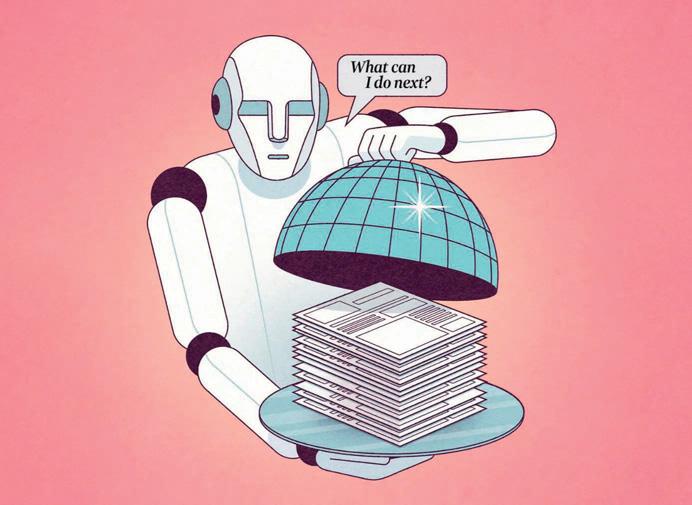
Today, we're already used to “predictive AI”—which analyzes data to provide recommendations, forecasts, and insights—and “generative AI,” which learns from data and uses patterns to seamlessly generate text, images, music, and code. Agents are software components that go far beyond this. They can perform tasks independently, make decisions, and even negotiate with other agents on our behalf. And unlike the traditional tech transformations of the past, which required years of costly infrastructure buildout, these new AI agents are easy to build and deploy, unlocking massive capacity.
This is a new horizon with radical implications. For the first time, technology isn't just offering tools for humans to do work. It's providing intelligent, scalable digital labor that performs tasks autonomously. Instead of waiting for human input, agents can analyze information, make decisions, and take action independently, adapting and learning as they go.
Take, for example, a large retailer during the holiday season. Traditionally, human workers or preprogrammed software might handle customer inquiries or inventory updates. But now, intelligent digital agents can respond to customer questions in real time, monitor stock levels, reorder inventory, and even coordinate with shipping providers—all without human intervention. These agents are enabling an entirely new scale of operations that was previously not possible.
This shift to intelligent digital labor is already unlocking capacity across industries. It's no longer constrained by human availability or physical limits, allowing businesses to scale their operations while driving down costs and improving responsiveness, or by geographical limits—opening opportunities previously limited by location.

यह कहानी Time के January 27, 2025 संस्करण से ली गई है।
हजारों चुनिंदा प्रीमियम कहानियों और 10,000 से अधिक पत्रिकाओं और समाचार पत्रों तक पहुंचने के लिए मैगज़्टर गोल्ड की सदस्यता लें।
क्या आप पहले से ही ग्राहक हैं? साइन इन करें
Time से और कहानियाँ

Time
Thierry Diagana
A NEW TREATMENT FOR MALARIA

2 mins
February 23, 2026

Time
Mike Doustdar
MULTIPLYING WEIGHT-LOSS MEDS
2 mins
February 23, 2026

Time
THIS ISN'T OVER
TODAY, THE ISLAMIC REPUBLIC OF Iran resembles a half-lifeless body collapsed on the ground, but holding a gun.
3 mins
February 23, 2026
Time
OUR AGE OF DISTRUST
In 1624, the English poet John Donne wrote, “No man is an island entire of itself.” And yet in 2026, the Edelman Trust Barometer finds that 7 out of 10 people across 28 nations are hesitant or unwilling to trust people who have different values, approaches to societal problems, or backgrounds than they do. For most people, distrust is now the default instinct. Only one-third tell us most people can be trusted.
3 mins
February 23, 2026

Time
MAN IN THE MIDDLE
How Mayor Jacob Frey is navigating Trump's immigration crackdown
9 mins
February 23, 2026

Time
The most under- appreciated movies of the 21st century
WHENEVER I BROWSE THROUGH SOCIAL MEDIA or Letterboxd to see what movies young film lovers are discovering, I often see the usual suspects: pictures made by Hitchcock, Coppola, and Scorsese, with a smattering of classic films noir or romantic comedies thrown in.
10 mins
February 23, 2026

Time
TOUGH AND TENDER
Alexander Skarsgard stars in Pillion's surprisingly sweet tale of bikers in love
6 mins
February 23, 2026

Time
Young adults in China are learning to live alone
TIRED FROM WORK AND CRAVING A SWEET TREAT OR a spa day? Young people in China have a new mantra for that: “Ai ni laoji!”
5 mins
February 23, 2026

Time
THE ORIGINS OF AN OBSESSION
How Greenland became both a prize and a marker in a world Trump is reordering
6 mins
February 23, 2026

Time
The D.C. Brief
PRESIDENT DONALD TRUMP LAST year successfully wrestled control of one of the nation's dominant performing-arts stages with unheard-of efficiency. He ousted its leader, installed a loyalist at the helm, made himself the chairman of its reconstituted board, scrambled its programing calendar, alienated cultural leaders, exiled its resident opera company, declared himself the M.C. of its biggest fundraising gala, and treated it like an annex of the White House for events that cast him as the headliner.
4 mins
February 23, 2026
Listen
Translate
Change font size