कोशिश गोल्ड - मुक्त
Can America lead?
Time
|January 24, 2024
SECRETARY OF STATE ANTONY BLINKEN AND THE TEST OF U.S. POWER

IT WAS 2:15 A.M. ON OCT. 16, AND BENJAMIN NETANYAHU couldn't figure out how to work the copy machine. Six floors underground, in the Tel Aviv bunker from which Israel's war cabinet was directing its battle against Hamas, Secretary of State Antony Blinken waited to be handed a sheet of paper outlining the results of a nine-hour negotiating session with the Israeli Prime Minister. Even Blinken's sleep-deprived advisers had no idea what the two men had agreed to behind closed doors.
Less than 24 hours earlier, Blinken had been in Cairo, preparing to return to Washington after a six-country dash across the Middle East. The visit had started off with a show of U.S. support after the brutal Hamas attack on Oct. 7, followed by talks with Arab allies. But as Israel intensified its bombing campaign in Gaza, Blinken decided to make a U-turn. Cut off from water, food, medicine, and fuel, the enclave was spiraling into a humanitarian crisis. Arriving back in Israel, Blinken conveyed to Netanyahu the anger he had heard from regional leaders and urged him to allow aid into Gaza. In a tense meeting punctuated by an air-raid siren, Netanyahu was intractable. Israel would not tolerate "one drop of water, not one ounce of fuel" across the border, a senior Administration official said. As it grew dark, Blinken and his aides followed Netanyahu from the Kirya, Israel's version of the Pentagon, to the underground command center. Huddled around two laptops and a mobile printer, in a small room with no cell service, the U.S. team traded proposals with the Israeli cabinet next door. Some came back with Netanyahu's hand-scribbled edits.
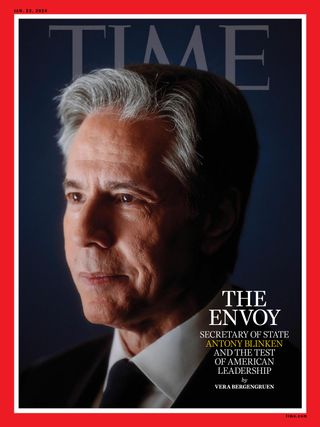

यह कहानी Time के January 24, 2024 संस्करण से ली गई है।
हजारों चुनिंदा प्रीमियम कहानियों और 10,000 से अधिक पत्रिकाओं और समाचार पत्रों तक पहुंचने के लिए मैगज़्टर गोल्ड की सदस्यता लें।
क्या आप पहले से ही ग्राहक हैं? साइन इन करें
Time से और कहानियाँ

Time
CO₂ Leadership Report
THE ENVIRONMENTAL PROTECTION Agency's Feb. 12 repeal of its “endangerment finding”—which underpins all of its noteworthy climate rules—was framed by the Trump Administration as a big win for American industry.

1 mins
March 09, 2026

Time
Sentencing of Hong Kong publisher raises fears in Taiwan
WHEN A HONG KONG COURT HANDED media tycoon and pro-democracy leader Jimmy Lai a 20-year jail term on national-security grounds on Feb. 9, his son called it a “death sentence” given Lai’s age, 78, and deteriorating health. Others saw the same bleak implications for freedoms in Hong Kong—and a glimpse into what could be in store for others Beijing views as troublesome.
1 min
March 09, 2026

Time
James Van Der Beek
James Van Der Beek, best known for playing Dawson Leery in the '90s teen drama Dawson's Creek, \"passed peacefully,\" his family said, on Feb. 11 at age 48, after a battle with colorectal cancer.
1 min
March 09, 2026

Time
Love Story tries too hard to be The Crown for America
IF THE KENNEDYS ARE THE CLOSEST THING AMERICA has to a royal family, then Carolyn Bessette Kennedy was our Princess Diana. Like her British counterpart, she was an outsider—albeit a beautiful, stylish, blond, privileged one—to the palace intrigue that consumed the family she married into. She was stalked by paparazzi and alternately worshipped and vilified. And then she died, in her mid-30s, in a horrible accident, only to have her legacy dissected for decades to come. We never let either woman rest in peace.
2 mins
March 09, 2026

Time
VARIATIONS ON A THEME
A new Wuthering Heights adaptation joins a rich history of cinematic reimaginings
5 mins
March 09, 2026

Time
Why you should warm up your feet before bed
GETTING COLD FEET IS INCONVE-nient in many situations—including when you go to bed.
2 mins
March 09, 2026
Time
In the Loop
For 15 years, Dex Hunter-Torricke worked near the pinnacle of the tech industry.
1 min
March 09, 2026

Time
The People VS. AI
THE GRASSROOTS BIPARTISAN MOVEMENT TO REIN IN AN INDUSTRY
15 mins
March 09, 2026

Time
16 LEADERS WORKING TOWARD A BETTER, MORE EQUITABLE WORLD
TEYANA TAYLOR IS BALANCING A WORKLOAD that borders on ridiculous.
28 mins
March 09, 2026

Time
Breezy Johnson The U.S. skier on winning Olympic gold, that mountain marriage proposal, and Lindsey Vonn's example
After your super-G race on Feb. 12, your boyfriend Connor Watkins proposed at the bottom of the slope.
2 mins
March 09, 2026
Listen
Translate
Change font size