कोशिश गोल्ड - मुक्त
Yesterday's Idea of a Modern Man
The Atlantic
|January 2026
Sam Shepard, a self-made cowboy, was also a poet of masculine angst.
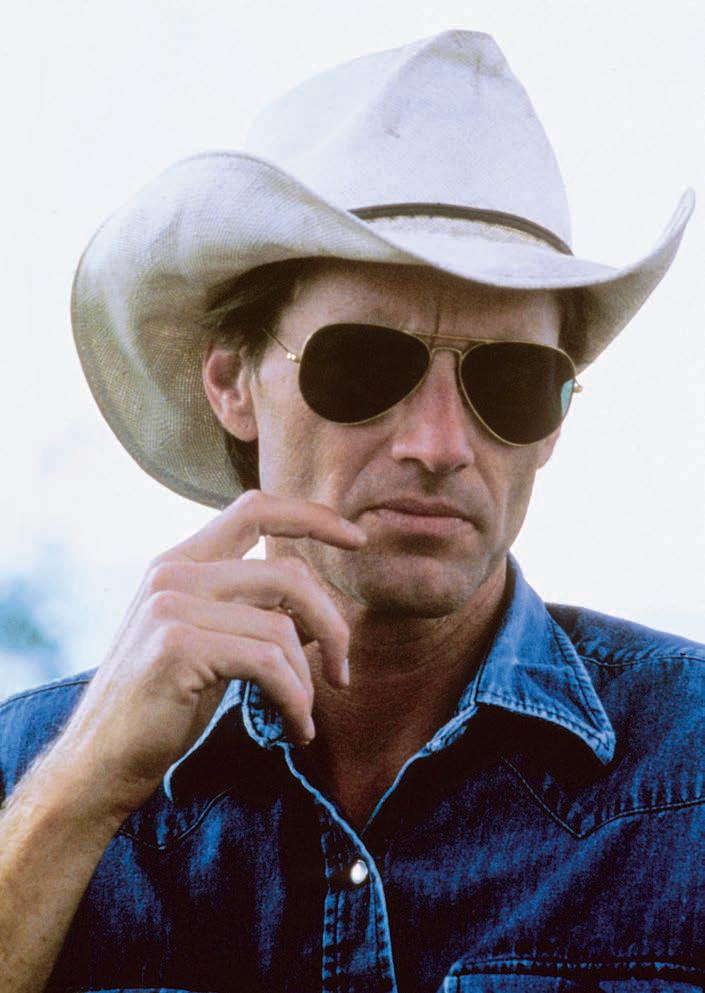
Sam Shepard wasn't born a cowboy.
The actor and writer made himself into one. The dusty blue jeans, cattle drives, and folksy drawl suited his taciturn profile, giving Reagan-era America someone rugged to admire.
Yet the people who knew Shepard best poked fun at his Western persona, which began to emerge in the 1970s and endured for the rest of his life. The singer and poet Patti Smith, a former paramour, called him "a man playing cowboys," and Shepard indeed acted in a number of Westerns. Late in his career, in Andrew Dominik's movie The Assassination of Jesse James by the Coward Robert Ford, Shepard portrayed the outlaw's prickly brother. (He'd named his first child, Jesse, after the legend.) A line of narration from the movie seemed to sum up the complicated man behind the character: "wrought up, perplexed, despondent." The cowboy image may have been cultivated, but it was not false. You might say it was earned, the vaquero as self-made man. Shepard reluctant movie star, poet of masculine angst, and rock-and-roll hero of the American theater-thought Broadway and Hollywood were full of middlebrow nonsense. Born in suburban Illinois and raised in Southern California, he sought out an authentic country, far from New York City or Los Angeles, where he could hear himself think.
He found it in Kentucky, New Mexico, and Texas, places where he lived or set his stories. Framing his work in elemental terms of self-sufficiency, Shepard considered his analog tools: "When you go to ride a horse, you have to saddle it. When you use a typewriter, you have to feed it paper." Like his friend Cormac McCarthywho grew up in a Tennessee suburb but likewise drifted west-Shepard found in open spaces a wellspring of bracing truth.

यह कहानी The Atlantic के January 2026 संस्करण से ली गई है।
हजारों चुनिंदा प्रीमियम कहानियों और 10,000 से अधिक पत्रिकाओं और समाचार पत्रों तक पहुंचने के लिए मैगज़्टर गोल्ड की सदस्यता लें।
क्या आप पहले से ही ग्राहक हैं? साइन इन करें
The Atlantic से और कहानियाँ
The Atlantic
You Had to Be There
An emerging field of history asks if we can ever really understand how our forebears experienced love, anger, fear, and sorrow.

23 mins
January 2026

The Atlantic
By the Horns
The week before the biggest bullfight of her career, in Cádiz, Spain, this past July, 24-year-old Miriam Cabas posted a carefully produced video on Instagram.
1 mins
January 2026

The Atlantic
The New German War Machine
After World War II, Germany embraced pacifism as a form of atonement. Now the country is arming itself again.
18 mins
January 2026
The Atlantic
The Eloquence
The prime minister was watching a disaster movie when we found him.
4 mins
January 2026

The Atlantic
What's for Dinner, Mom?
The women who want to change the way America eats
12 mins
January 2026
The Atlantic
How Terror Works
A 1947 German novel explores the sometimes corrosive, sometimes energizing nature of fear.
8 mins
January 2026

The Atlantic
Yesterday's Idea of a Modern Man
Sam Shepard, a self-made cowboy, was also a poet of masculine angst.
7 mins
January 2026

The Atlantic
ACCOMMODATION NATION
America's colleges have an extra-time-on-tests problem.
11 mins
January 2026

The Atlantic
Respect the Drummer
A new history of rock, told through its overlooked heroes
5 mins
January 2026

The Atlantic
THE MOST POWERFUL MAN IN SCIENCE
WHY IS ROBERT F. KENNEDY JR. SO CONVINCED HE'S RIGHT?
42 mins
January 2026
Listen
Translate
Change font size