कोशिश गोल्ड - मुक्त
Synth Hero: Where Synth Legends Are Made
Circuit Cellar
|October 2025
Creating a Retro Game Using a Raspberry Pi RP2040 MCU
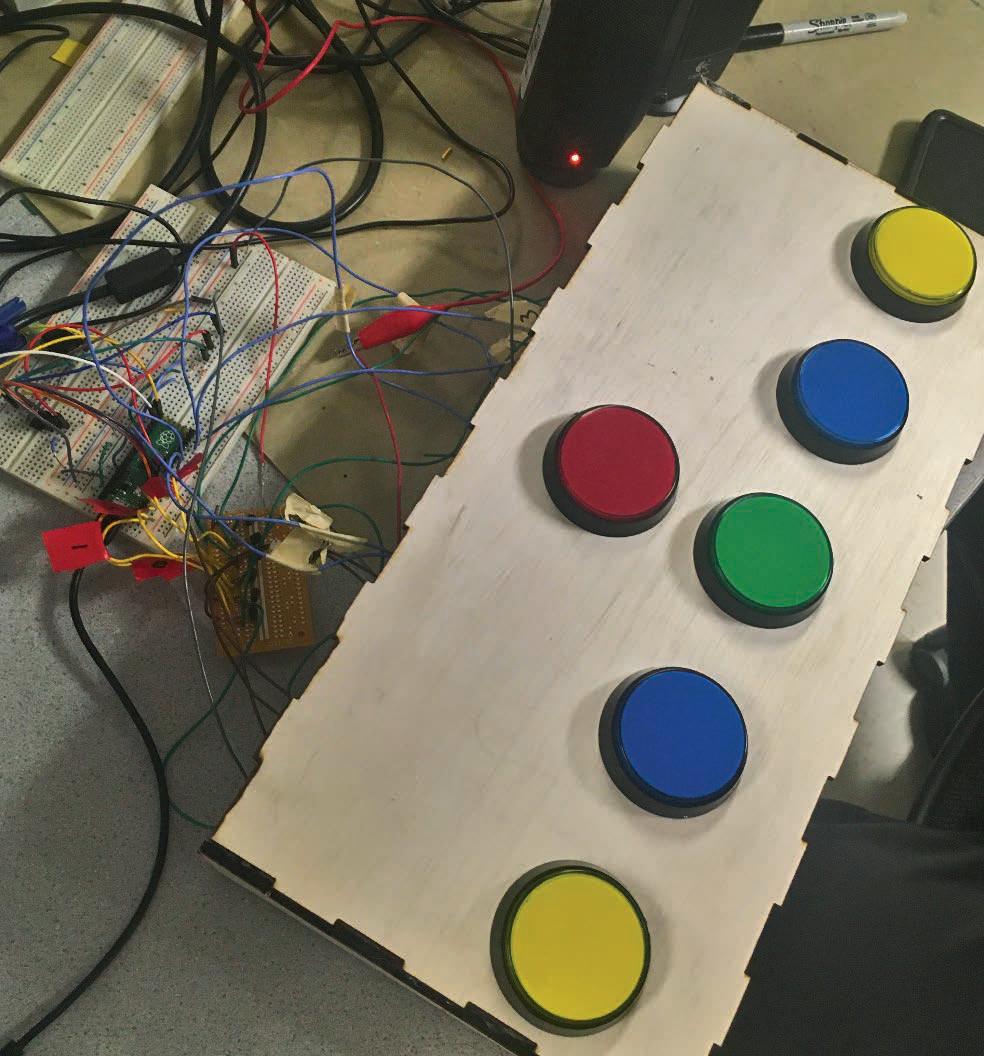
FIGURE 1 The physical apparatus of the game. This includes the laser-cut frame, solder board, and breadboard with wire connections. See also Figure 5.
A novel rhythm game—a cross between Piano Tiles and Guitar Hero—created by two Cornell University undergraduates, combines interests in gamified music and electronics prototyping with a project that has lessons for many makers.
We started this project with the intention of making a game that could teach people to play an instrument using songs and a button system. The project was inspired by rhythm games such as Piano Tiles and Guitar Hero. Our interface looks like a simplified version of these games, with tiles (called “NoteBars”) that progress down the screen. When you press one of the buttons, it plays a corresponding note. The goal is to press the notes of each song correctly at the right time, until the song ends. Correctly pressing a note increases your score, and the goal is to get the highest score possible. A player knows when the button needs to be pressed because the tile overlaps with the score line on the Video Graphic Array (VGA) screen, and the button illuminates.
USER EXPERIENCE
The user plays the game with the physical apparatus shown in Figure 1, which is composed of five LED pushbuttons. When the game begins, a menu screen appears. The user navigates through this menu with the middle green and red buttons on a physical game board (Figure 1). The green button cycles through each option, and the red button selects the option highlighted.
From the main menu, the user can access the difficulty, song selected, or leave the game. When the user eventually selects “Start Game,” the song starts and NoteBars begin to flow down the screen, until either the user presses the red button—which pauses the game—or the song ends.

यह कहानी Circuit Cellar के October 2025 संस्करण से ली गई है।
हजारों चुनिंदा प्रीमियम कहानियों और 10,000 से अधिक पत्रिकाओं और समाचार पत्रों तक पहुंचने के लिए मैगज़्टर गोल्ड की सदस्यता लें।
क्या आप पहले से ही ग्राहक हैं? साइन इन करें
Circuit Cellar से और कहानियाँ
Circuit Cellar
The Future of Sensors in Safety Systems Sensing the Stop
How Magnetic Sensors Are Enabling the Next Generation of Braking Systems

5 mins
December 2025

Circuit Cellar
Alif Semiconductor Elevates Generative AI at the Edge with New Support for ExecuTorch Runtime in Its Ensemble MCUs
Alif Semiconductor, the leading global supplier of secure, connected, power efficient Artificial Intelligence and Machine Learning (AI/ML) microcontrollers (MCUs) and fusion processors, announced that developers can now use the ExecuTorch Runtime, a quantization extension of the popular PyTorch ML framework, for AI applications built to run on its Ensemble E4/E6/E8 series of MCUs and fusion processors.
1 min
December 2025

Circuit Cellar
Encrypted MQTT Protocol for Critical Sectors
Mechanisms, Challenges, and Best Practices
3 mins
December 2025

Circuit Cellar
Datasheet: Small Size, Big Power
Smaller Microcontrollers Bring New Possibilities
9 mins
December 2025

Circuit Cellar
Analog Devices Launches ADI Power Studio and New Web-Based Tools
Analog Devices, Inc. (ADI), a global semiconductor leader, announced the launch of ADI Power Studio, a comprehensive family of products that offers advanced modeling, component recommendations, and efficiency analysis with simulation.
1 mins
December 2025
Circuit Cellar
Compact IBR300 2.5" SBC Powered by NXP i.MX 93 from IBASE
IBASE Technology, Inc., a leading provider of rugged embedded computing platforms, announced the release of the IBR300, a 2.5\" RISC-based single board computer (SBC) powered by the NXP i.MX 93 processor with dualcore ARM Cortex-A55 (up to 1.7GHz) and a Cortex-M33 MCU.
1 min
December 2025
Circuit Cellar
Sensors in the Spotlight
The Next Decade of Embedded Sensor Systems
12 mins
December 2025

Circuit Cellar
Bob's Wrap Up
In Bob's last article with Circuit Cellar, he attempts to wrap up a career of more than 50 years as an embedded systems engineer and 14 years with Circuit Cellar. He looks at each of his 58 articles by category and provides some recommendations for his fellow engineers.
7 mins
December 2025

Circuit Cellar
Designing Embedded Software Architectures That Last
I've reviewed hundreds of firmware projects over the years, and one thing always stands out: the most successful projects have a clear, deliberate architecture.
10 mins
December 2025

Circuit Cellar
Broadcom Introduces Industry's First Wi-Fi 8 Silicon Ecosystem Powering the AI Era
Broadcom, Inc. unveiled the first Wi-Fi 8 silicon solutions for broadband wireless, targeting residential gateways, enterprise access points, and smart mobile clients.
1 mins
December 2025
Listen
Translate
Change font size