कोशिश गोल्ड - मुक्त
What lies beneath
BBC History UK
|Christmas 2025
Sea monsters have haunted human imaginations for millennia. From the Akraken to killer serpents, Prema Arasu explores what five mythical creatures reveal about our deepest fears
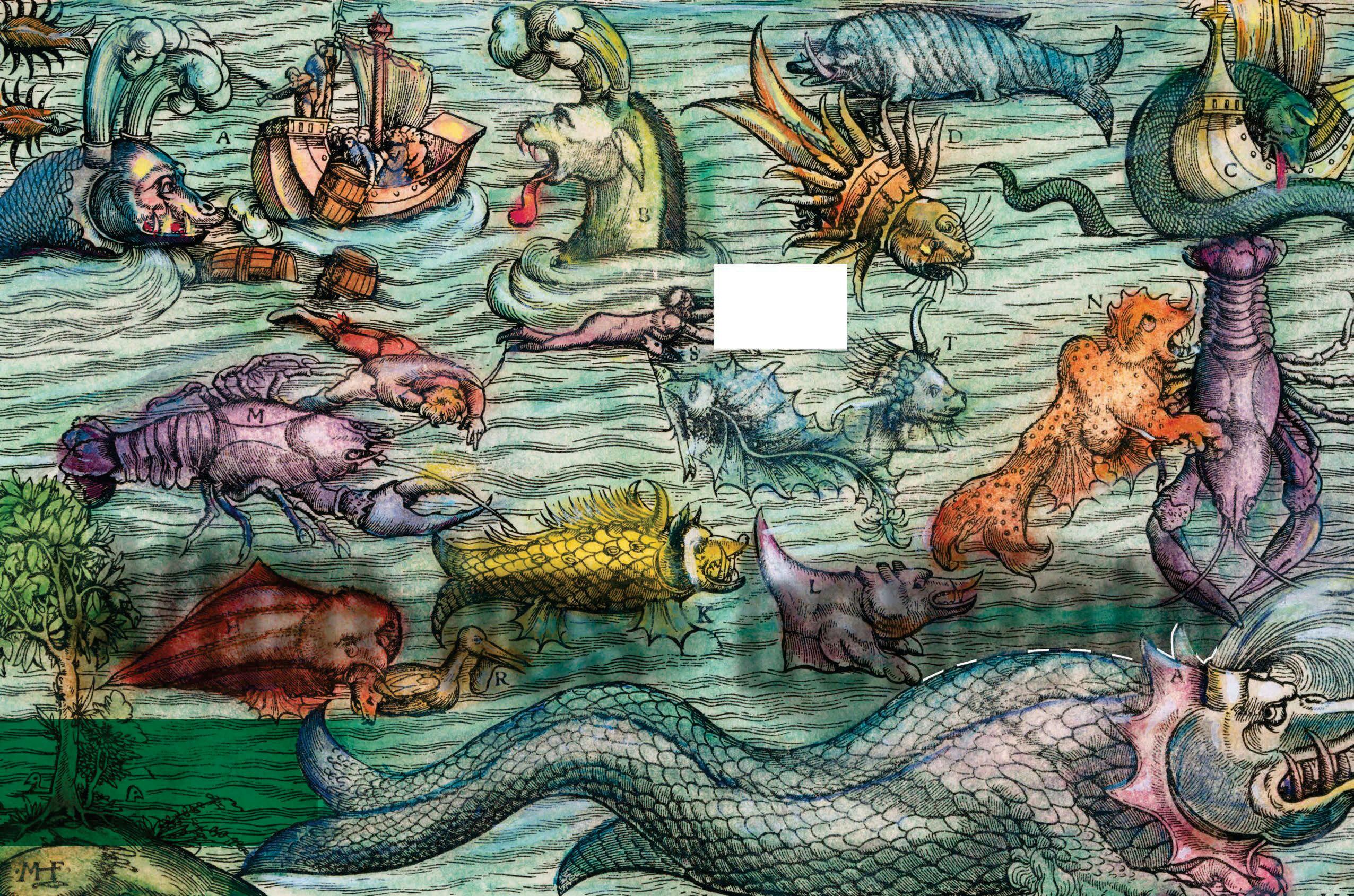
1 Armed and dangerous
The writhing tentacles of the kraken inspired horror and disgust
Sea monsters have fired our imaginations – and chilled our blood – for as long as humanity has sailed the seas. The Babylonian epic Enûma Eliš, which dates back to at least 1200 BC, describes the creation of the world from two fearsome primordial beings: Apsû, the embodiment of subterranean fresh water, and Tiamat, the sea. Like the many mythical aquatic creatures that have occupied our dreams and our nightmares, Apsû and Tiamat reveal much about how the Babylonians saw the world, acting as projections through which their anxieties about nature could be expressed, examined and, perhaps, mastered.
Fast forward more than a thousand years and, in Naturalis Historia (c77 AD), the earliest extant work of natural history, the Roman author Pliny the Elder argued that the largest animals found in the sea “exceed in size any of the terrestrial animals” because of the “superabundance of moisture with which they are supplied”.
One such giant creature is the kraken, its origins lying in Nordic mythology and folklore. In his 1752–53 proto-scientific work The Natural History of Norway, Danish bishop Erik Pontoppidan described the “Kraken, Kraxen, or, as some world name it, Krabben” as an island-sized creature, “round, flat, and full of arms, or branches”.
Alfred, Lord Tennyson was so energised by reports of this monster of the deep that, in 1830, he wrote a poem in its honour, describing an ancient, giant-armed creature slumbering “Below the thunders of the upper deep; Far, far beneath in the abysmal sea.”
British naturalist Henry Lee offered a more rational perspective. In Sea Monsters Unmasked (1883), he stated that kraken sightings by sailors were most likely exaggerated reports of giant squid (Architeuthis dux), described a quarter of a century earlier by the Danish biologist Japetus Steenstrup.

यह कहानी BBC History UK के Christmas 2025 संस्करण से ली गई है।
हजारों चुनिंदा प्रीमियम कहानियों और 10,000 से अधिक पत्रिकाओं और समाचार पत्रों तक पहुंचने के लिए मैगज़्टर गोल्ड की सदस्यता लें।
क्या आप पहले से ही ग्राहक हैं? साइन इन करें
BBC History UK से और कहानियाँ

BBC History UK
On the skids
Richard Rodgers and Oscar Hammerstein II's smash musical Oklahoma! opened on Broadway on 31 March 1943.

1 min
Christmas 2025

BBC History UK
Small pleasures
Memory is imperfect, but what if you could get a professional model maker to recreate a moment from the past?
1 min
Christmas 2025

BBC History UK
Bath in five places
In the Georgian era, Bath became arguably Britain's most fashionable destination. KIRSTEN ELLIOTT promenades five historic highlights
3 mins
Christmas 2025
BBC History UK
End times
Why do civilisations that dominated their epoch fail? In an era of autocracy, climate change, the rise of Al and a first-hand understanding of how deadly pandemics can be, it's a question that seems pertinent.
1 min
Christmas 2025
BBC History UK
What are the origins of the Yule Lads?
To learn about the Jólasveinar (Yule Lads), we must start with their mother, the terrifying ogress Grýla. Her name appeared in Icelandic texts as early as the 13th century, although it wasn’t until later that those 13 mischievous lads became associated with her. Folk tales and poems tell how she descends from the mountains with an empty sack to stuff full of children. Grýla owns the monstrous Jólaköttur (Yule Cat), which roams the countryside on Christmas Eve, searching for children to gobble up if they're not wearing new clothes.
1 mins
Christmas 2025
BBC History UK
Santa Claus v Father Christmas
The true identity of the white-bearded, red-robed figure who fills children's stockings at Christmas has long been debated. Thomas Ruys Smith sizes up the merry contenders
8 mins
Christmas 2025

BBC History UK
Frontier friction
Set in Washington Territory in 1854, The Abandons is a Western that's unusual for having two matriarchs, women whose lives become entangled, at its centre.
1 min
Christmas 2025

BBC History UK
The Last Days of Pompeii: The Immersive Experience
Delve into the culture of daily Roman life, witness the momentous eruption of Mount Vesuvius, and follow its fallout in Immerse LDN's new exhibition. In a blend of cutting-edge technology and vivid storytelling, this exhibition launches visitors into Pompeii's rich history with recreations of the ancient city's beautiful pre-eruption landscape, a 360-degree virtual reality Roman amphitheatre experience, and a digital metaverse recreating Pompeii's 'Villa of Mysteries'.
1 min
Christmas 2025
BBC History UK
Elizabeth Marsh The corsair's captive
Taken hostage by a Barbary ship's captain in the 18th century, a young Englishwoman found herself fighting for her freedom in Marrakech. ADAM NICHOLS introduces a brave captive who later wrote a book about her dramatic experiences
6 mins
Christmas 2025
BBC History UK
29 DECEMBER 1170: Thomas Becket is murdered in Canterbury
Knights loyal to Henry II rid him of the “low-born cleric”
2 mins
Christmas 2025
Listen
Translate
Change font size