कोशिश गोल्ड - मुक्त
What Waiting for Godot Taught Me About Setting the Scene
Writer’s Digest
|July/August 2025
Author Danai Christopoulou discusses tapping into techniques used in theater and film to write effective liminal spaces in fiction.
The first time I watched Samuel Beckett's Waiting for Godot, I was 7 years old. I was bored, baffled. “Nothing happens in this play,” I whispered to my dad, who'd brought me along despite the fact that this was definitely not a children's theater. “They just keep waiting.” “Look closer,” my dad whispered back, eyes crinkling. “Pay attention. The waiting is the point.”
So, I looked closer at the black-curtain clad stage; at the solitary bench the two actors occupied, exchanging quips, a naked tree next to them; at the strategic spotlights that highlighted their faces while the rest of the stage almost disappeared from sight, fading to black. And while I was about three decades too young to make sense of it all—and part of me was miffed we didn't go watch some Disney musical instead—a seed was planted there and then.
A seed that would later sprout and bloom as I began to write fiction.
The waiting was, indeed, the point.
Learning to See the Stage Before Setting It
Growing up in the theater taught me more than I could ever have imagined about storytelling.
My actor parents raised me on a diet of Sophocles and Shakespeare, Chekhov and Brecht—not that they had to try to get me interested in the theater plays that were stacked around our house like precarious Pisa towers. I always had my nose buried in one.
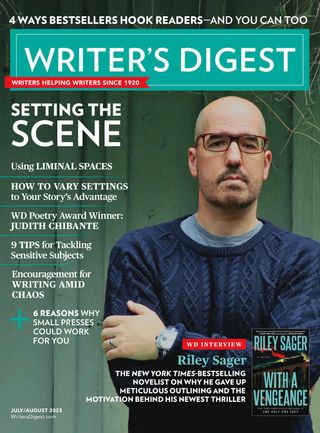

यह कहानी Writer’s Digest के July/August 2025 संस्करण से ली गई है।
हजारों चुनिंदा प्रीमियम कहानियों और 10,000 से अधिक पत्रिकाओं और समाचार पत्रों तक पहुंचने के लिए मैगज़्टर गोल्ड की सदस्यता लें।
क्या आप पहले से ही ग्राहक हैं? साइन इन करें
Writer’s Digest से और कहानियाँ
Writer’s Digest
100 Best Markets for Writers
A list of print and online publications looking for freelancers to contribute their knowledge on everything from pet care to finance and beyond.

65 mins
Yearbook 2026

Writer’s Digest
Memoir Plus
Add a bonus to your personal narrative for a marketing boost.
8 mins
Yearbook 2026
Writer’s Digest
Surefire Ways to Sell Your Children's Book
In my 28 years editing children's books, I've learned that publishing exists at the intersection of art and commerce.
5 mins
Yearbook 2026
Writer’s Digest
The ABCs of Freelance Success
Many freelance writers, especially those at the beginning of their careers, tend to place almost all of their professional focus on one specific component: craft.
5 mins
Yearbook 2026
Writer’s Digest
How to Write in Different Genres
Emiko Jean and Yulin Kuang share tips and strategies for how they successfully write in different genres and mediums.
8 mins
Yearbook 2026
Writer’s Digest
Small But Mighty
Why small presses might be the perfect home for your book.
8 mins
Yearbook 2026

Writer’s Digest
The Story Behind the Story
What's backstory, and what's it doing here anyway?
6 mins
Yearbook 2026

Writer’s Digest
2025 Year in Review
Publishing expert Jane Friedman recaps the biggest news in the industry.
8 mins
Yearbook 2026

Writer’s Digest
What Is Your Story Question?
When a story isn't working—when you know it's not quite coming together, when beta readers and critique partners confirm your fears but can't put a finger on why, or you're not getting offers from agents or publishers—savvy authors start trying to diagnose the issue by examining its component parts, like characterization, plot, and stakes.
6 mins
Yearbook 2026
Writer’s Digest
Writer's Digest 27th Annual 101 Best Websites for Writers
For the 27th year, Writer's Digest is shining a light on 101 websites with a goal of helping writers in a variety of ways.
26 mins
Yearbook 2026
Listen
Translate
Change font size