कोशिश गोल्ड - मुक्त
Tommy Orange
Writer’s Digest
|March - April 2024
The award-winning author on the power and limits of fiction and the breakthrough moment for his second novel, Wandering Stars.

In 2018, Tommy Orange took the literary world by storm with his debut novel, There There, which told the story of 12 people from Native communities slowly discovering how their lives are connected as they all work to get to the present-day Big Oakland Powwow. In addition to being named one of the best books of the year by such varied organizations as The New York Times, The Washington Post, NPR, Time, GQ, Entertainment Weekly, and O, The Oprah Magazine (among many others), it was also a Pulitzer Prize finalist and winner of the National Book Critics Circle John Leonard Prize, Center for Fiction First Novel Prize, and the PEN/Hemingway Award.
Orange's highly anticipated second novel, Wandering Stars, is out now, and will firmly establish Orange as one of the most talented writers of our time. It begins with Jude Star, a member of the Southern Cheyenne Tribe, remembering his survival of the Sand Creek Massacre in 1864 and his subsequent imprisonment at Richard Henry Platt's prison-castle in Florida, an early precursor to the Carlisle Indian Industrial School. Gradually, it shifts to Star's son Charles, who is forced to attend the Carlisle school, and follows four additional generations until it meets up with Orvil Red Feather's story, shortly after the closing events of There There.
Wandering Stars, therefore, serves as both a prequel and sequel to There There-though it could just as easily be read as a standalone novel-and features the same deceptively simple, lyrical writing style, with Orange's trademark repetition of words and phrases (e.g., "Such Indian children were made to carry more than they were made to carry" or "He has forgotten that he has forgotten things on purpose"). Orange says this style is "kind of an unconscious thing. I hope it's not some kind of writerly tic that becomes annoying.... I do like the way you can deepen words through repetition and deepen meaning if you're using the same words in the same sentence.
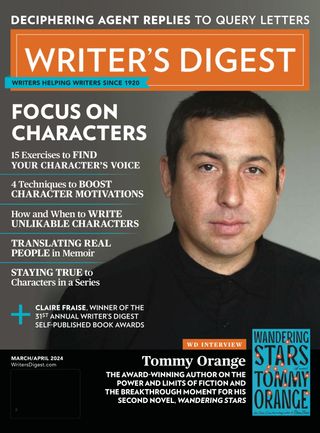

यह कहानी Writer’s Digest के March - April 2024 संस्करण से ली गई है।
हजारों चुनिंदा प्रीमियम कहानियों और 10,000 से अधिक पत्रिकाओं और समाचार पत्रों तक पहुंचने के लिए मैगज़्टर गोल्ड की सदस्यता लें।
क्या आप पहले से ही ग्राहक हैं? साइन इन करें
Writer’s Digest से और कहानियाँ
Writer’s Digest
Fate and Prophesy
Defying destiny may be just as hazardous as succumbing to it.”

5 mins
May / June 2026

Writer’s Digest
How to Pitch in Person Without Losing the Plot
Conference-ready tips to make sure your story stands out.
5 mins
May / June 2026
Writer’s Digest
How to Handle Money as a Writer
That is, in case you actually make any ...
8 mins
May / June 2026

Writer’s Digest
Dress Your Manuscript for the Job You Want It to Have
Dress Your Manuscript for the Job You Want It to Have How often have you heard the adage “dress for the job you want”? Probably often enough that it’s a cliché.
5 mins
May / June 2026

Writer’s Digest
Mike Chen
The award-winning science-fiction author discusses the importance of fandom, writing for IP giants like Star Wars, and tackling his biggest project yet: a space opera.
13 mins
May / June 2026
Writer’s Digest
Outlaw Openers
There was a time when starting a sentence with And, But, or So felt like breaking the law.
2 mins
May / June 2026
Writer’s Digest
Collaborate to Create
Why co-authoring nonfiction is a pro strategy worth considering.
7 mins
May / June 2026
Writer’s Digest
The Life-Changing Magic of Tidying Up Your Writing Portfolio
Creating an organized online home for your nonfiction writing samples gives you a strategic advantage.
5 mins
May / June 2026
Writer’s Digest
20 Elevator Pitches for Recently Published Books
One of the most important professional skills an author can develop is the ability to craft an enticing elevator pitch for their book.
5 mins
May / June 2026
Writer’s Digest
On Writing & Newsroom Autobiography
Today, the rise of 24-hour cable news has dramatically reshaped how we consume information.
2 mins
May / June 2026
Listen
Translate
Change font size