कोशिश गोल्ड - मुक्त
Classy Ways to Use Connections
Writer’s Digest
|September/October 2025
As the author of many books my family hates and a longtime journalism prof, I love helping aspiring writers get published, paying forward the kindness of my mentors. When people approach me for advice, assistance, and names of my agents and editors, I try to be generous, even when they're basically asking, “How can I have your career?” But there are good ways to connect—and ways not to.
I was miffed when a student who'd taken my class multiple times enrolled in my five-week Zoom course on how to publish an essay, then launched her own five-week publish-an-essay class, without giving me a heads-up, charging one dollar less. Another ex-pupil called every editor I'd paid to visit my course to speak at her events, using my name without checking in first. More recently, a West Coast author copied the title, design, and lettering I'd used for the cover of the New York Times-bestselling addiction book I'd coauthored in 2012. When confronted, he admitted that since my book had only 148 reviews on Amazon, he didn't think mine had enough “presence to matter,” adding, “I'd imagine your book will get a sales bump from my book’s marketing push.”
Although imitation is supposedly the sincerest form of flattery, I felt fleeced. Over the decades I've been a freelancer and teacher known for sharing contacts, here's the code of ethics I adhere to and some quick remedies if you accidentally blow it.
1. ATTRIBUTION IS ESSENTIAL:
Attribute any words you publicly appropriate to their source, whether it’s in a class you lead, speech you give, social media post, article, or book you publish. Even mentioning in print that I subtitled my teaching technique “the instant gratification takes too long” method, I added “with a nod to the late, great Carrie Fisher,” who'd originated the quip. After I created an idiosyncratic expression in 2010, I was surprised to see the phrase I invented in a piece a former student published in 2025, as if it were hers.
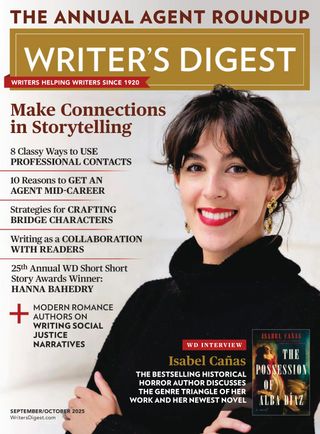

यह कहानी Writer’s Digest के September/October 2025 संस्करण से ली गई है।
हजारों चुनिंदा प्रीमियम कहानियों और 10,000 से अधिक पत्रिकाओं और समाचार पत्रों तक पहुंचने के लिए मैगज़्टर गोल्ड की सदस्यता लें।
क्या आप पहले से ही ग्राहक हैं? साइन इन करें
Writer’s Digest से और कहानियाँ
Writer’s Digest
Fate and Prophesy
Defying destiny may be just as hazardous as succumbing to it.”

5 mins
May / June 2026

Writer’s Digest
How to Pitch in Person Without Losing the Plot
Conference-ready tips to make sure your story stands out.
5 mins
May / June 2026
Writer’s Digest
How to Handle Money as a Writer
That is, in case you actually make any ...
8 mins
May / June 2026

Writer’s Digest
Dress Your Manuscript for the Job You Want It to Have
Dress Your Manuscript for the Job You Want It to Have How often have you heard the adage “dress for the job you want”? Probably often enough that it’s a cliché.
5 mins
May / June 2026

Writer’s Digest
Mike Chen
The award-winning science-fiction author discusses the importance of fandom, writing for IP giants like Star Wars, and tackling his biggest project yet: a space opera.
13 mins
May / June 2026
Writer’s Digest
Outlaw Openers
There was a time when starting a sentence with And, But, or So felt like breaking the law.
2 mins
May / June 2026
Writer’s Digest
Collaborate to Create
Why co-authoring nonfiction is a pro strategy worth considering.
7 mins
May / June 2026
Writer’s Digest
The Life-Changing Magic of Tidying Up Your Writing Portfolio
Creating an organized online home for your nonfiction writing samples gives you a strategic advantage.
5 mins
May / June 2026
Writer’s Digest
20 Elevator Pitches for Recently Published Books
One of the most important professional skills an author can develop is the ability to craft an enticing elevator pitch for their book.
5 mins
May / June 2026
Writer’s Digest
On Writing & Newsroom Autobiography
Today, the rise of 24-hour cable news has dramatically reshaped how we consume information.
2 mins
May / June 2026
Listen
Translate
Change font size