कोशिश गोल्ड - मुक्त
Protect Profits by Managing Ear Rots
Successful Farming
|August 2025
Preventative management is key to high-quality grain production.
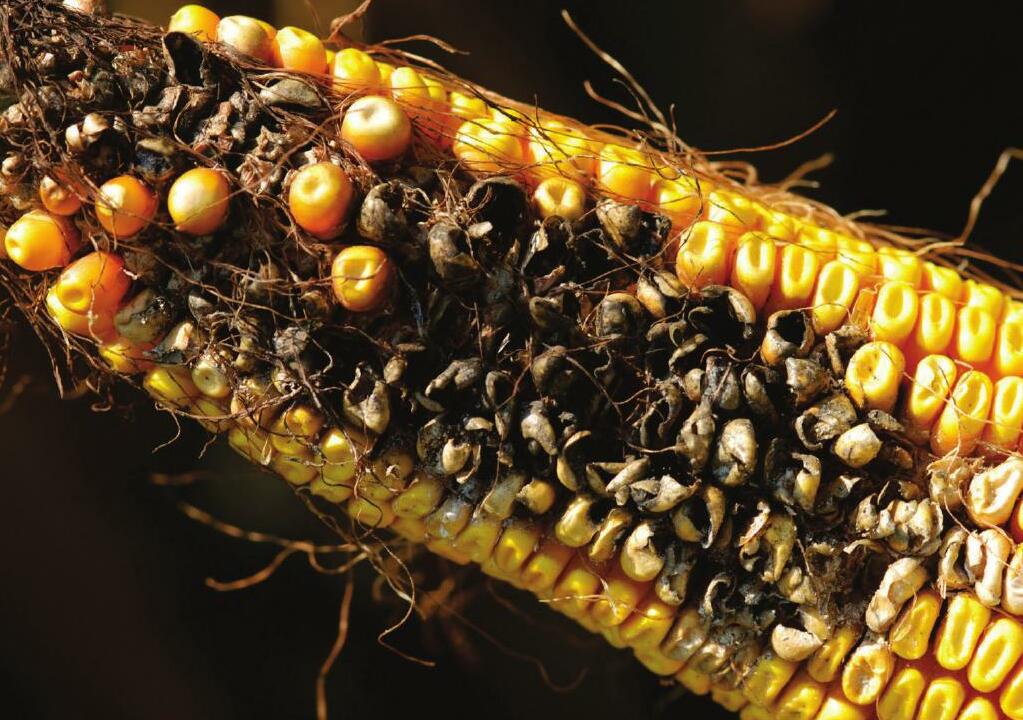
Corn ear rots pose a significant challenge for farmers across the country.
From 2012-2024, ear rot fungi cost farmers $8.6 billion in yield loss, according to the Crop Protection Network (CPN). Reduced grain quality due to the presence of mycotoxins can cut even further into the farm’s bottom line.
With no rescue treatments, management for ear rots must start early and last season-long to prevent profit loss.
"While infections can be variable [year to year], losses overall are going up," said Tyler Harp, a technical product lead for Syngenta. "If you haven't done any management before you have an infection and mycotoxin accumulation, there's not a lot you can do."
Common Ear Rots and Mycotoxins
In the U.S., there are several problematic ear rot diseases that are caused by different fungi.
"Even if you don't see visual symptoms of ear rot, most of these fungal species produce toxins," said Pierce Paul, a cereal pathology professor at Ohio State University. "Toxins are secondary chemical compounds that help the fungi cause damage to the ear," he said. "Once those toxins cause problems in terms of human and animal health, they're considered mycotoxins."
Risk Management
While ear rot diseases are seen nationwide, the level of infection and mycotoxin contamination can vary greatly.
"Knowing what drives the disease is also informative in terms of what you can do to minimize those risks," Paul said.
Manage Residue


यह कहानी Successful Farming के August 2025 संस्करण से ली गई है।
हजारों चुनिंदा प्रीमियम कहानियों और 10,000 से अधिक पत्रिकाओं और समाचार पत्रों तक पहुंचने के लिए मैगज़्टर गोल्ड की सदस्यता लें।
क्या आप पहले से ही ग्राहक हैं? साइन इन करें
Successful Farming से और कहानियाँ

Successful Farming
Make Forested Land Pay Without Cutting a Tree
Landowners can grow high-value, nontimber crops, like ginseng, under existing trees.

4 mins
February 2026
Successful Farming
New Fendt Optimum With Precision Planting Tech
The Optimum is available in five configurations, with a variety of options.
1 mins
February 2026

Successful Farming
The Widening Net
Experts discuss how government aid can inflate input costs.
4 mins
February 2026
Successful Farming
Opportunity Is Knocking
It’s a good time to buy if you’re in the market for a high-horsepower tractor.
4 mins
February 2026

Successful Farming
SUPERCYCLE SLUMP
What will it take for corn and soybean prices to climb again?
5 mins
February 2026

Successful Farming
Ready, Set, Plant!
New research from universities, on-farm trials, and seed companies is reshaping how growers decide which crop to plant first.
8 mins
February 2026

Successful Farming
Get Planting Prep Right
Spending time servicing your planter during the winter pays off when conditions are right to head to the field.
2 mins
February 2026

Successful Farming
Leaving Lasting Impact
A central Iowa community came together to support FFA, agricultural education, and the next generation of leaders in agriculture.
2 mins
February 2026
Successful Farming
Dwight Mogler
This Iowa producer shares how his family stays united as the multigenerational farm grows.
3 mins
February 2026

Successful Farming
Diagnosing Equipment Repairs
Off-the-shelf and manufacturer AI tools can help farmers repair machinery faster.
3 mins
February 2026
Listen
Translate
Change font size