कोशिश गोल्ड - मुक्त
Will the future be Consolidated Platforms or Expanding Niches?
DataQuest
|August 2025
The enterprise SaaS industry is experiencing a major shift. What was once a chaotic assortment of niche tools is coalescing into a wave of consolidation, unified platforms, and AI-native reimagination. With companies evaluating their software stacks due to changing business priorities, inflation, and the potential of generative AI, the central question is whether the future of SaaS will reside in all-in-one giants or in a colourful ecosystem of specialised, modular offerings.

Enterprise Software as a Service (SaaS) has reached a strategic inflection point. On the one hand, surging demand for cloud, AI, and digital transformation continues to drive growth in the space. On the other hand, rapid disruption from AI-native competitors and shifts in capital market pressures continue to change the landscape for scaling or exiting SaaS businesses. The industry must ask itself: will the future of growth be primarily through expansion, increasing customer numbers, verticals and geography or will future growth primarily be through consolidation with larger players adding niche capabilities and then abandoning competition?
MARKET EXPANSION: THE CASE FOR GROWTH
1. Massive Market Growth Ahead
- The global SaaS market is projected to reach US$370 billion by 2025, growing to US$842 billion by 2030, at a 17.9% CAGR by 2030, mostly tied to enterprise migration to cloud-native, pay-as-you-go consumption models. (Mordon Intelligence)
- Within B2B SaaS general space that is even stronger, size of the market is expected to continue to rise 26.9% CAGR from US$390 billion to over US$1.3 trillion between 2025 and 2030.
2. AI Integration as a Growth Multiplier
- AI is already integrated into 40-54% of software solutions aimed at automation, analytics, or intelligent agents, a 2023-24 trend driving engagement, predictive capabilities, and upsell velocity. (Market Growth Reports)
- Enterprise customers are on a growing adoption curve towards AI-driven copilots and business-outcomes based pricing models, paving the way from seat-based licensing to modeled business value.
3. Geographic and Vertical Expansion
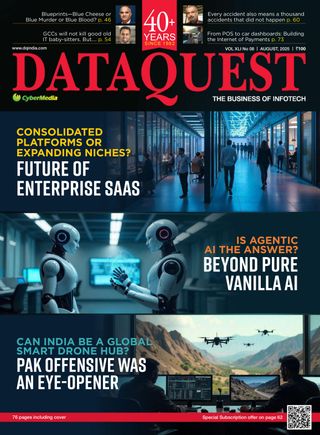

यह कहानी DataQuest के August 2025 संस्करण से ली गई है।
हजारों चुनिंदा प्रीमियम कहानियों और 10,000 से अधिक पत्रिकाओं और समाचार पत्रों तक पहुंचने के लिए मैगज़्टर गोल्ड की सदस्यता लें।
क्या आप पहले से ही ग्राहक हैं? साइन इन करें
DataQuest से और कहानियाँ

DataQuest
Engineering India's Al-First Data Centres at Hyperscale
Rohan Sheth explains how AI and HPC are reshaping India's data centres, from density and cooling to power economics, sustainability, and hyperscale decision criteria.

4 mins
February 2026

DataQuest
From copilots to colleagues: Why agentic AI is forcing enterprises to rethink control, trust, and culture
As AI agents shift from assisting to acting, enterprises must redesign governance, data controls, and security guardrails so autonomy stays auditable, reversible, and trusted.
2 mins
February 2026

DataQuest
Reclaiming Control in the AI Era: A Conversation with Kalyan Kumar, CPO, HCLSoftware
Enterprises are reassessing cloud-first strategies as AI becomes core to operations. HCLSoftware's Kalyan Kumar explains why sovereignty, choice and control now shape decisions.
5 mins
February 2026

DataQuest
When infrastructure learns: The rise of the Al-native core
AI-native infrastructure is moving from concept to operational reality, reshaping how organisations build, govern, and scale intelligence across their digital core.
6 mins
February 2026

DataQuest
Bridging the gap between connectivity and compute at scale
As AI scales in India, data centres are evolving into high-density, low-latency platforms that unify connectivity, compute, and sustainability at national scale.
4 mins
February 2026

DataQuest
PUE is not a grapefruit metric, anymore
So what are the new high-hanging fruits for data centre strategists today? And are players going after them?
4 mins
February 2026

DataQuest
Even if Al demand fades, India need not worry - about data centres
For every megawatt (MW) of installed colocation capacity, users here generate approximately 13.2 PB of data monthly- compared to 0.3 PB for Australia and just 0.01 PB for Singapore. India's data centre growth is not dependent on one tech lever. Plus, it is phased and modular and not kneejerk. Manoj Paul explains these contours in detail.
7 mins
February 2026

DataQuest
AI infrastructure and systemic risk
What has been the biggest change in data centre industry-specially after AI workloads? Is Al-bubble a big risk for data centre infra- how much will it affect data centres if something cracks?
1 min
February 2026

DataQuest
Inside the Shift to High-Density, Al-Ready Data Centres
CtrlS' Vipin Jain discusses what it truly takes to build AI-ready data centres in India, balancing high density, liquid-ready cooling, resilience, and ESG accountability.
4 mins
February 2026

DataQuest
Sustainability is now the headline, not a footnote
Sanjay Agrawal, Head Presales and CTO at Hitachi Vantara India and SAARC opines that the conversation is moving beyond headline metrics like PUE toward a broader view of how data lifecycle management and infrastructure efficiency reduce the overall environmental footprint. Let's see why and how- while also touching upon adjacent (or not-so-adjacent) factors like redundancies, availability and AI-readiness
3 mins
February 2026
Listen
Translate
Change font size